
AI Worm Shows a New Risk for Networked Devices
June 7, 2026
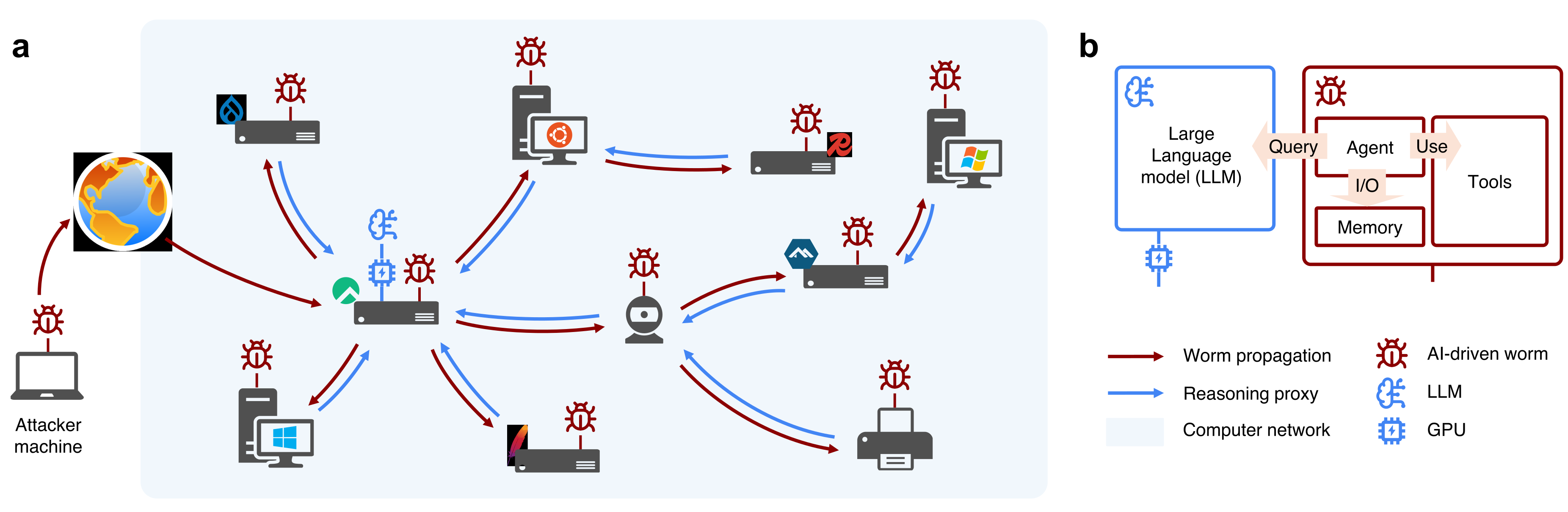
Toronto researchers show in a lab prototype how open language models can make a computer worm adaptive. It is not a live attack, but it is a clear warning for networks.
What this is about
CleverHans Lab at the University of Toronto published the preprint AI Agents Enable Adaptive Computer Worms on June 2, 2026. The work shows, in an isolated lab environment, that freely available open-weight language models can do more than assist a computer worm. They can help plan its next moves.
This is not a report about an attack in the open internet. It is a controlled proof of concept. The important point sits in between: the study makes it plausible that attackers may not need an expensive frontier model to make automated malware more flexible, cheaper and harder to predict.
What the AI worm actually does
A classic worm usually follows a fixed script. It looks for known flaws, tries a prepared sequence and fails if the environment does not match. The researchers' prototype uses a locally running open-weight LLM as a decision layer.
In the simulation, the worm moves through a mixed network of Linux, Windows and IoT systems. It gathers information about the next target, chooses relevant known vulnerabilities, adapts its approach and uses compromised devices as compute for further planning. According to the project page, the experiment was controlled and the release was scrubbed so it would not become a direct misuse guide.
Why it matters
The real shift is cost. If malware gains extra compute after every successful infection, it can prepare the next step more cheaply. That does not make every organization immediately vulnerable, but it changes the logic of defense.
Many security controls are good at spotting known patterns, known tools and fixed attack chains. An adaptive worm targets the gap between signature and situation. It could react to fresh advisories, combine misconfigurations and exploit weak passwords or poorly segmented networks before a human operator scripts every move.
For real people, that means updates, MFA, segmentation and asset inventories are no longer boring IT hygiene. They are the barriers that remove time and freedom from an automated attacker.
In plain language
Imagine a burglar who used to carry one note with five tricks. If the front door looked different, the plan stopped. The new approach is closer to a burglar who reads each room, chooses a new tool and draws power from every outlet found inside to prepare the next attempt.
A practical example
A midsized manufacturer runs 1,200 devices: laptops, cameras, printers, test servers and a few forgotten IoT gateways. In a classic attack, a worm might find 30 systems with the same old flaw. An adaptive approach could use the first ten hits to read configuration files, identify default passwords and reach another 80 systems through different known weaknesses.
The example is fictional, but realistic enough to show the priorities. If each subnet is separated, devices are patched and service accounts have minimal rights, such a worm loses leverage. If everything is flatly connected, every weak device becomes a stepping stone.
Scope and limits
- The study is a preprint and does not mean there is an active internet-scale attack.
- The prototype was built in a controlled environment; real networks are messier, but also full of unexpected weaknesses.
- Open-weight models are not the problem by themselves. Transparent models help defenders too. The risk appears when automation, poor segmentation and known flaws meet.
SEO & GEO keywords
AI Agents Enable Adaptive Computer Worms, CleverHans Lab, University of Toronto, Vector Institute, Nicolas Papernot, AI worm, adaptive malware, open-weight LLM, cybersecurity, IoT security, network segmentation, prompt injection
💡 In plain English
A research team showed that a computer worm can use an open AI model to adapt its next steps. The attack only ran in a lab, but it shows why patching, MFA and network segmentation are becoming more important.
Key Takeaways
- →The preprint appeared on June 2, 2026 and describes a controlled lab prototype.
- →The worm uses an open-weight LLM as a planning layer instead of only a fixed attack script.
- →The main risk lies in poorly segmented networks, known flaws and weak credentials.
- →The work is a warning signal, not evidence of an active attack in the open internet.
FAQ
Is this AI worm already in the wild?
The sources describe a controlled research prototype, not a confirmed attack in the open internet.
Does this make open AI models dangerous?
Not automatically. Open models also help research and defense. The risk grows when they meet exploitable networks and weak controls.
What should companies do first?
Check asset inventories, patch systems, enforce MFA, segment networks and reduce service-account permissions.