
Agent Vision Toolkit gives text-only coding agents eyes
August 19, 2026
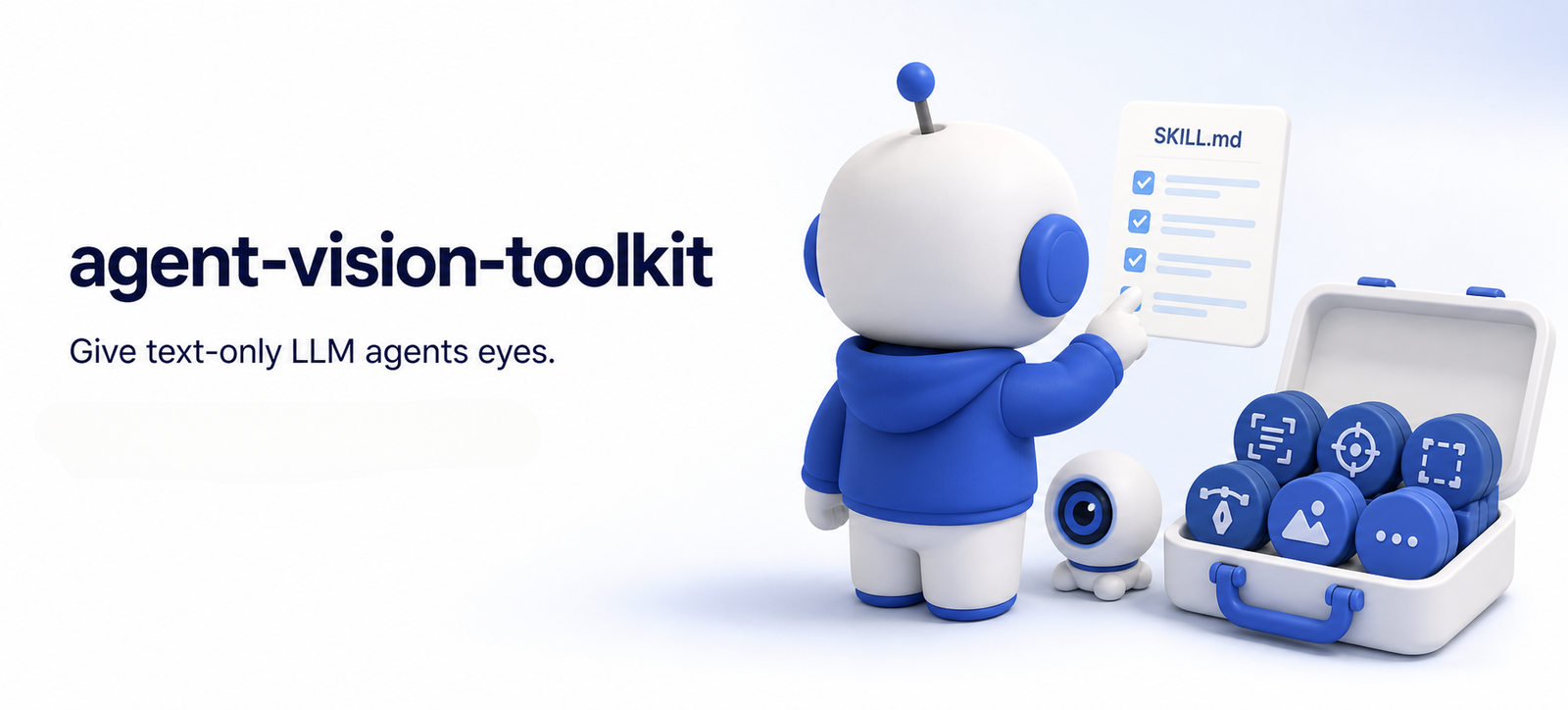
The open Agent Vision Toolkit adds image analysis, OCR, and visual verification workflows to text-only coding agents. Its practical value is high, but an external vision API is usually still required.
What this is about
Agent Vision Toolkit is an open-source package by Anionex that enables text-only coding agents to handle visual tasks. The GitHub project was created on August 1, 2026 and, according to its documentation, supports Codex, Claude Code, Pi, Oh My Pi, and OpenCode. On August 18, the included agent skill was renamed to vision-skills.
The notable idea is not another multimodal model. The toolkit moves image understanding into the tool layer: an agent can inspect screenshots, split long captures for OCR, locate interface elements, and verify results visually even when its main model processes text only. The code uses the MIT license.
What Agent Vision Toolkit actually does
The package combines command-line tools with an agent skill. glance answers questions about images or transcribes text. Other tools cover region grounding, object detection, cropping, pixel comparison, vector tracing, and dominant-color analysis, according to the documentation. The skill tells an agent which tool to use, in what sequence, and how to verify the result.
For image interpretation, the toolkit connects to a multimodal API. It supports OpenAI-compatible Chat Completions and Responses endpoints as well as the Anthropic Messages protocol. Users store a base URL, model name, and API key locally. An optional proxy or plugin layer can intercept pasted images and built-in image tools in supported agent applications.
The documented workflows go beyond generic image descriptions. They include rebuilding an interface from a screenshot, OCR for long chat histories, turning a sketch into a structured diagram, and stepwise GUI operation with a new screenshot after every action.
Why it matters
Coding agents often need to see their work. They compare an implemented page with a reference, read an error displayed in an interface, or check whether a click produced the expected state. Without visual feedback, there is a gap between a code change and the visible result.
Agent Vision Toolkit exposes that feedback as a replaceable workflow. A team can keep a lower-cost or locally accessible text model as the primary agent and call a vision endpoint only for image steps. That can make model choice and spending more flexible. It can also be easier to inspect than one opaque image call because cropping, OCR, comparison, and verification are separate operations.
The approach is especially relevant to frontend development, visual regression checks, documentation, and interface workflows. It also fits the open Agent Skills format: the operating instructions are readable files that can be reviewed before installation.
In plain language
Think of the toolkit as a workbench for a craftsperson with limited sight. Instead of merely describing a photograph, you give them a magnifier, ruler, text scanner, and checklist. They select an instrument, inspect a small area, and then look again to confirm that the repair worked.
A practical example
A team wants to rebuild a login page from a design reference. The agent opens a 1,920 × 1,080 pixel screenshot, identifies the form, spacing, and colors, and produces a first HTML and CSS version. It then renders the page again, compares reference and output at pixel level, and crops only the incorrect form area.
Instead of sending the full image to a vision model on every pass, the agent can work in three targeted rounds: overall structure, form region, and final verification. A developer then reviews layout, accessibility, and mobile behavior. The toolkit does not replace that acceptance step, but it can shorten the path to a result that can be checked.
Scope and limits
First, the toolkit does not make a text model intrinsically multimodal. Semantic image questions still require an external or locally operated vision endpoint, which creates cost and may create privacy concerns. Screenshots containing customer data should only be sent to an approved service.
Second, feature and integration claims mainly come from the project's own documentation. There is no independent comparative study yet that establishes accuracy, cost, or reliability against native multimodal agents.
Third, GUI automation remains brittle. Scaling, animation, hidden elements, and minor layout changes can invalidate coordinates or detections. Critical clicks, payments, and publishing actions still need human confirmation.
A sensible next test is small: choose a non-sensitive interface, define five visual tasks, and record success rate, API cost, and required corrections. Only then should the toolkit receive access to larger projects.
SEO & GEO keywords
Agent Vision Toolkit, Anionex, coding agents, visual AI tools, screenshot OCR, GUI automation, Codex, Claude Code, OpenCode, Agent Skills, frontend development, MIT license
💡 In plain English
Agent Vision Toolkit adds separate tools for images, OCR, and visual checks to text-only coding agents. It is open and flexible, but usually needs a separate vision API for semantic image understanding.
Key Takeaways
- →The MIT-licensed toolkit adds visual workflows to text-only agents.
- →It supports OCR, image questions, cropping, comparison, and GUI steps, among other tasks.
- →Codex, Claude Code, Pi, Oh My Pi, and OpenCode are supported according to the project.
- →Semantic image analysis usually requires an external or local vision API.
- →Independent comparative reliability data is not yet available.
FAQ
Is Agent Vision Toolkit its own AI model?
No. It is a tool and skill layer that calls a compatible vision model for image understanding.
Can the toolkit run fully locally?
The tools run locally. The complete workflow is local only when a suitable vision endpoint is also operated locally.
Which agents are supported?
The documentation names Codex, Claude Code, Pi, Oh My Pi, and OpenCode, with optional proxy or plugin integrations.
Is it free to use?
The source code uses the MIT license. Costs may arise from the selected vision endpoint and required infrastructure.