
AI traces are becoming measurable in tech and finance jobs
July 6, 2026
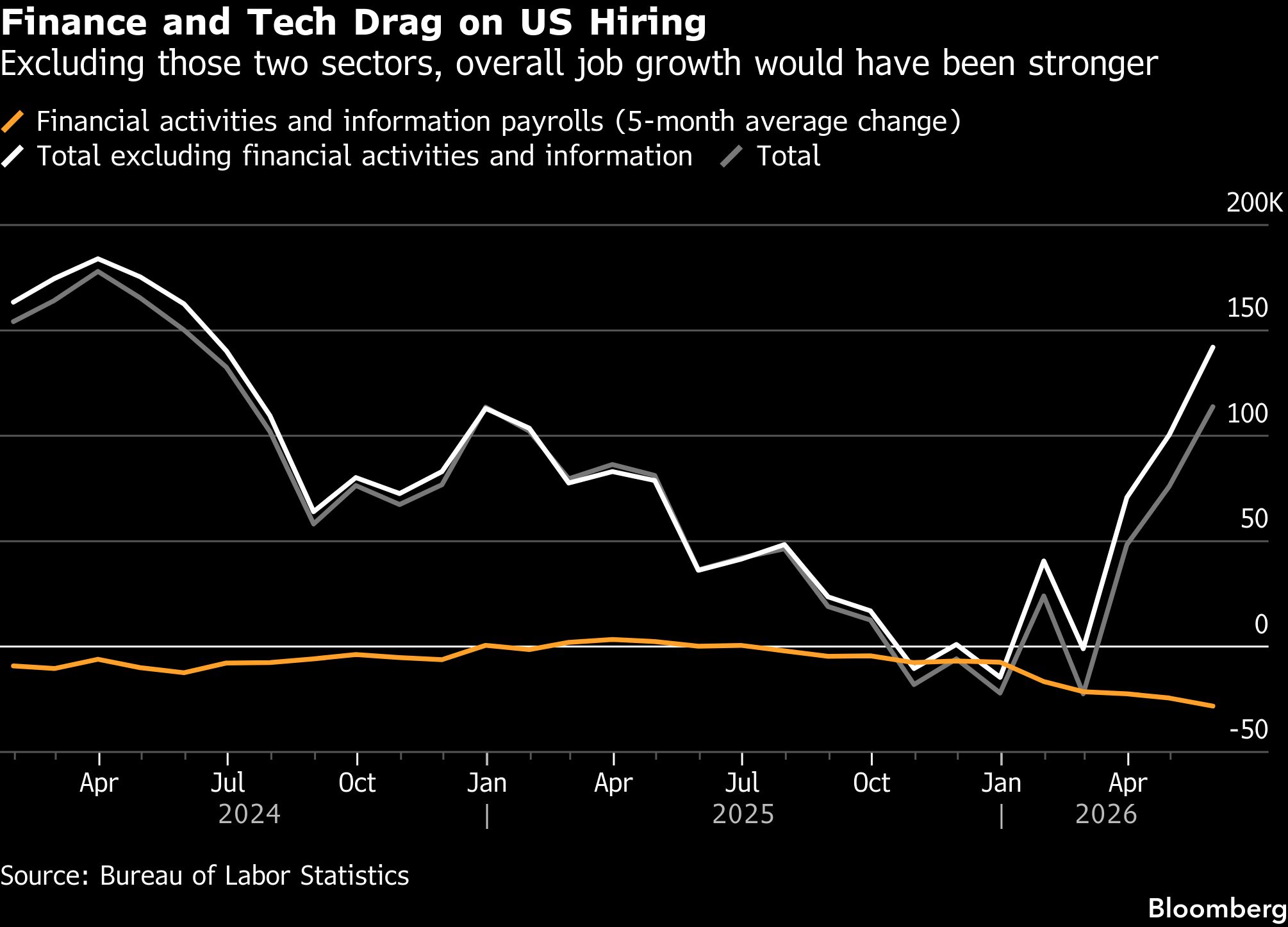
New US data shows tech and financial activities losing an average of 28,000 jobs per month in 2026. It does not prove a jobs apocalypse, but it makes AI as a labor-market risk more concrete.
What this is about
On July 6, 2026, Bloomberg, syndicated by outlets including Claims Journal, reported that two US sectors most exposed to AI are now clearly diverging from an otherwise solid labor market: information technology and financial activities are losing an average of 28,000 jobs per month in 2026. At the same time, the broader US economy is still adding jobs. That tension is the important part.
This is not the simple claim that AI replaces all work. The data suggests something more specific: in sectors where companies are investing heavily in automation, software and new models, hiring becomes more cautious, certain office and support roles come under pressure, and companies increasingly cite AI when explaining cuts.
What the labor-market data actually shows
The Bloomberg analysis draws on US government data and adds figures from Challenger, Gray & Christmas, the California Policy Lab and Stanford research. The core point: finance and information companies are pulling the average down, even though the rest of the labor market created more than 113,000 jobs per month through May 2026. Without weakness in these sectors, the headline number would have been higher.
Challenger reported in June 2026 that US employers announced 45,849 job cuts. AI remained the most cited reason for layoffs for the fourth consecutive month. For the year so far, almost 102,000 announced cuts had been attributed to AI. That is not clean proof of causality, but it is a strong signal of how companies are framing restructuring.
Why it matters
The difference between a weak signal and a structural trend matters enormously for workers, policymakers and companies. If AI is mostly a label for cost-cutting that would have happened anyway, the response is one thing. If it first slows hiring and hits young or administrative workers, the change looks less like a layoff wave and more like a gradual narrowing of the entry-level labor market.
Several sources point in that direction. Stanford researchers found early evidence in 2025 that employment had weakened for younger workers in AI-exposed occupations. California AI-Unemployment Tracker data through May 2026 still shows no statewide shock, but it does show high concentrations of unemployment claims among AI-exposed finance and insurance workers. That fits a labor market that is not collapsing, but is visibly shifting in specific places.
In plain language
Imagine a bakery buying a new machine. The machine does not suddenly bake every loaf by itself. But it weighs, slices and packages faster than before. The bakery still needs people, but fewer for the simple intermediate steps and more for planning, quality and customer contact.
The current AI data looks similar: not every job disappears. But where work consists of many repeatable text, analysis or support steps, companies are checking whether they can handle the same workload with fewer new hires.
A practical example
A regional insurer handles 10,000 claims per month. Before 2024, it needed 40 case workers for first-contact processing. In 2026, it introduces a system that sorts incoming emails, pre-checks standard cases and automatically asks for missing documents.
After six months, 40 people are still on the team, but three open entry-level roles are not refilled. Two employees move into quality control and one moves into customer conversations for difficult cases. In the statistics, this does not look like a mass layoff. For applicants, the effect is still real: there are fewer simple entry roles, even though the company does not look smaller.
Scope and limits
First: the data does not prove that every cited job was directly replaced by AI. Companies can use AI as a plausible cost-cutting explanation even when market conditions, interest rates or earlier overhiring also matter.
Second: the strongest signals come from the United States. Europe has different dismissal rules, industry structures and worker representation. The trend is relevant, but it does not transfer one-to-one.
Third: the numbers mostly measure lost or missing jobs. They capture less well which new roles AI creates, which workers become more productive and which teams remain stable because of better tools. The right reading is not panic, but early warning.
SEO & GEO keywords
AI labor market, AI jobs, tech layoffs 2026, finance jobs AI, Challenger Gray Christmas, California AI-Unemployment Tracker, Stanford Digital Economy Lab, Bureau of Labor Statistics, generative AI jobs, automation risk
💡 In plain English
AI is not showing up in the labor market as one single mass layoff wave, but first as pressure on specific roles. Tech, financial services and routine office work are providing early warning signs.
Key Takeaways
- →Tech and financial activities are losing an average of 28,000 jobs per month in 2026, according to Bloomberg’s analysis.
- →Challenger counts almost 102,000 announced US job cuts where companies cite AI as a reason.
- →The data does not prove direct replacement for every job, but it is a clearer risk signal than anecdotes alone.
- →Entry-level, support and administrative roles with many repeatable tasks appear especially exposed.
- →The trend matters for Europe, but different labor rules mean it does not transfer directly.
FAQ
Is AI now replacing jobs at mass scale?
The data does not clearly show that. What is visible is pressure in specific sectors and roles while the overall labor market is still growing.
Why are finance jobs especially exposed?
Many banking, insurance and back-office tasks involve text review, data matching and standard communication. Those tasks can partly be automated or handled with fewer new hires.
Does this apply to Germany and Europe?
As a warning signal, yes; as a direct forecast, no. Dismissal rules, works councils, regulation and industry structures differ strongly from the US.
Which jobs are less exposed?
Roles involving accountability, personal relationships, ambiguous situations, physical work or real decision responsibility are harder to automate fully.
Sources & Context
- Claims Journal / Bloomberg: AI’s Impact: Tech and Finance Sectors Losing 28,000 Jobs Monthly
- Challenger, Gray & Christmas: June 2026 Challenger Report
- California Policy Lab: California AI-Unemployment Tracker
- California Governor: California launches AI workforce impact tracker
- Stanford Digital Economy Lab: Canaries in the Coal Mine?
- Bureau of Labor Statistics: Industry and occupational employment projections overview