
AI lawsuits jump to 42 new cases in the second quarter
July 15, 2026
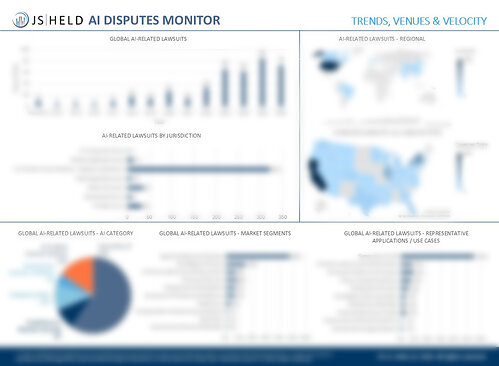
The Q2 2026 AI Disputes Monitor counts 42 new AI lawsuits, up 35 percent from Q1. Product liability and challenges to AI regulation are now moving into view.
What this is about
On July 15, 2026, J.S. Held released the Q2 2026 AI Disputes Monitor. The standout number: between April 1 and June 30, 2026, it recorded 42 new AI-related lawsuits. That is 35 percent more than in the first quarter. According to the release, the full tracked dataset now stands at 426 cases, and the 73 cases filed so far this year already equal 86 percent of the full 2025 total.
This is more than a lawyer’s detail. The lawsuits move the AI debate from abstract risk into concrete disputes: who is liable if a chatbot causes harm? Which training data can be used? And can individual U.S. states enforce their own AI rules when companies challenge them in court?
What the AI Disputes Monitor actually does
The AI Disputes Monitor is a dashboard for AI-related legal disputes. It sorts cases by technology, market segment, venue and legal category. J.S. Held positions it as a working tool for law firms, legal departments and risk teams, not as a neutral government registry. That matters for interpretation: the numbers are useful, but they come from a consulting firm that also works in the dispute environment.
The Q2 update names three movements. First, copyright and creator lawsuits remain the largest block, but they are becoming more specific: databases, music metadata, possible piracy-adjacent sources and real-time competition from generative systems. Second, AI regulation itself is being litigated, including the fight over Colorado’s AI Act. Third, product liability and consumer protection claims around generative outputs, safety controls and biometric voice models are gaining momentum.
Why it matters
For real people, AI law starts to matter when courts decide what counts as foreseeable harm. A company can no longer treat a model as just another software service if plaintiffs try to reconstruct how guardrails, training data, logs, prompt histories or model versions contributed to a specific harm.
For companies, this means AI governance will need to be provable. Anyone using a model in support, HR, insurance, medicine, education or creative production needs more than a policy slide. They need data provenance, versioning, risk review, logging and clear responsibility. For users, it means complaints about AI systems increasingly move beyond support tickets and into courtrooms.
In plain language
Imagine a new machine suddenly appears in many kitchens. At first everyone talks about how fast it can chop. Then accidents happen, recipes are copied and neighbors argue about noise. From that moment on, the issue is no longer just technology. It is instruction manuals, liability, insurance and house rules.
That is what is happening with AI systems. The tools have reached everyday life, and courts are beginning to clarify which rules actually apply.
A practical example
An insurer uses a generative system to triage claims. Each month, 20,000 cases pass through the system. In 0.5 percent of cases it recommends denial, and a human reviewer checks the result only lightly. If 100 customers then receive relevant benefits late or not at all, the courtroom question will not only be: did a human sign off?
The deeper questions become technical: which model version was running that day? Which prompts were used? Were there warning signs in the logs? Was the system tested across customer groups? This is the kind of reconstruction the Q2 release describes as a growing core of AI disputes.
Scope and limits
First, the Monitor is not an official complete registry. It is a proprietary dashboard from a consulting firm and should be checked against other sources.
Second, a lawsuit does not mean an AI system is legally at fault. Many cases are dismissed, settled or decided more narrowly than the headline suggests.
Third, the focus is strongly U.S.-centric. The developments still matter for Europe because product liability, copyright, the AI Act and evidence questions raise similar issues through different legal routes.
SEO & GEO keywords
AI litigation, AI Disputes Monitor, J.S. Held, AI lawsuits 2026, product liability, AI copyright, Colorado AI Act, generative AI outputs, biometric privacy, AI governance, legal risk
💡 In plain English
AI is going to court more often. The new numbers show that the issue is no longer just copyright, but increasingly liability, regulation and how AI systems can be reconstructed after harm.
Key Takeaways
- →J.S. Held reports 42 new AI-related lawsuits for Q2 2026.
- →That is a 35 percent increase from Q1 2026.
- →Copyright and creator cases still dominate, but they are becoming more technical and specific.
- →Product liability, consumer protection and challenges to AI rules are emerging as new fronts.
- →The numbers come from a proprietary monitor, not an official complete registry.
FAQ
What is the AI Disputes Monitor?
A proprietary dashboard from J.S. Held that tracks AI-related disputes by category, market and venue.
Are 42 lawsuits a lot?
Yes, compared with Q1 2026 the release says it is a 35 percent increase. The more important signal is the spread into liability and regulation.
Does a lawsuit mean a company lost?
No. A lawsuit is an allegation and a process, not a judgment. Many cases end narrowly, differently or without a finding of fault.
Why does this matter for Europe?
European companies face similar evidence questions: data provenance, model versions, logging, product liability and AI Act compliance.