
AI Safety Index gives frontier labs weak safety grades
July 8, 2026
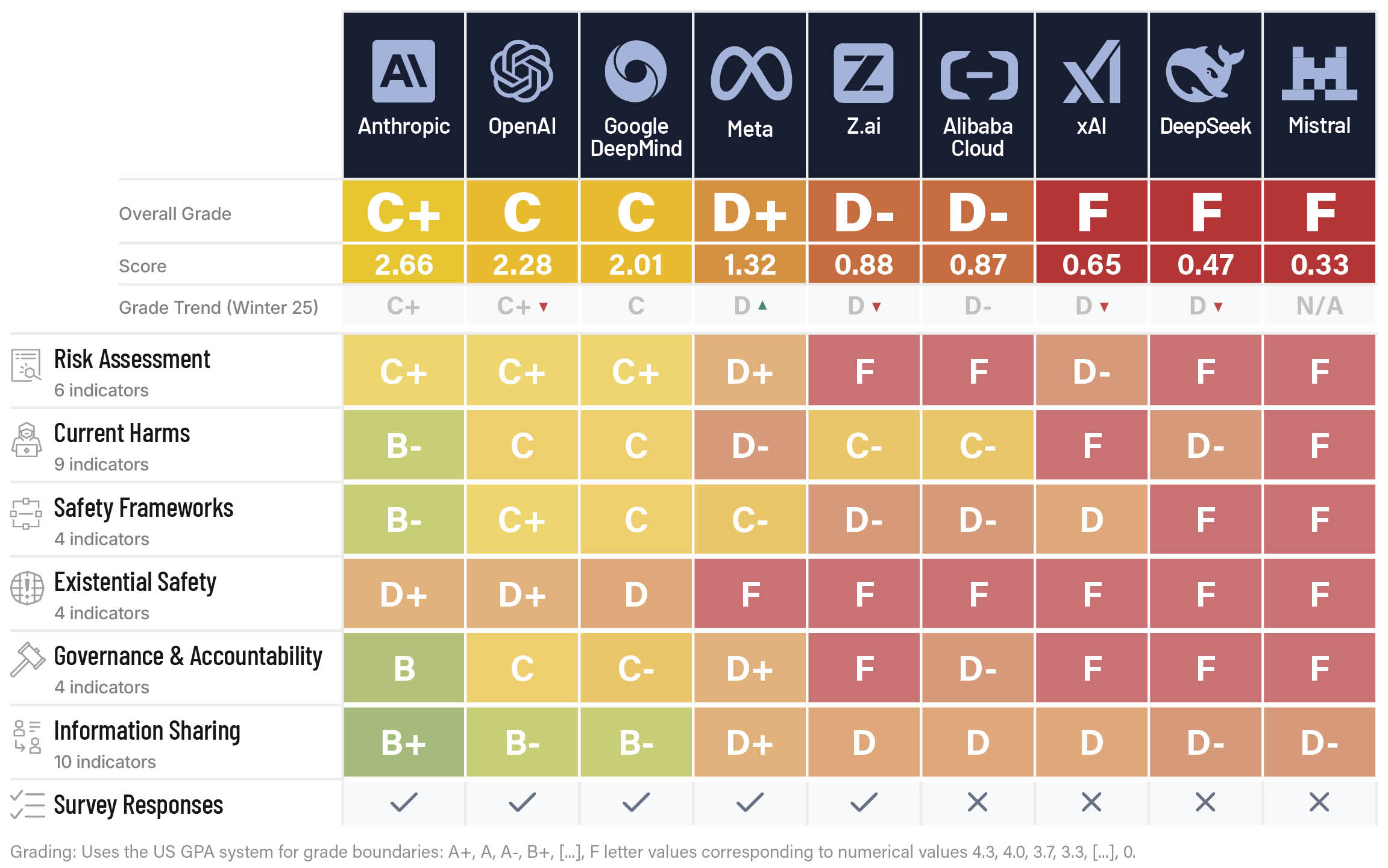
The Future of Life Institute AI Safety Index grades nine leading AI companies. Even the top performer reaches only C+, while several major labs score much lower.
What this is about
The Future of Life Institute published the Summer 2026 edition of its AI Safety Index in early July 2026. The report grades nine companies developing general-purpose AI systems: Anthropic, Alibaba Cloud, DeepSeek, Google DeepMind, Meta, Mistral, OpenAI, xAI, and Z.ai.
The message is uncomfortable: no company receives an A or B. According to the two-page summary, Anthropic ranks first, but only with a C+. OpenAI and Google DeepMind sit in the C range. Several providers score much lower. Axios covered the findings on July 7, 2026 and highlighted that some earlier safety commitments have been weakened or removed.
What the AI Safety Index actually does
The index is not a technical benchmark for model capability. It compares visible safety practices. According to FLI, the evaluation covers several domains, including risk assessment, current harms, safety frameworks, governance, transparency, and risks from very advanced systems.
External experts review public information, company disclosures, and documented policies. The result is a report card: not whether a model can write, code, or plan well, but whether the company can show how it identifies, limits, and exposes risks to outside scrutiny.
That makes the report deliberately uncomfortable. A company can be technically strong and still score poorly if it cannot show robust stop rules, adequate transparency, or clear independent oversight.
Why it matters
Frontier AI is now infrastructure. It sits inside coding assistants, search systems, office workflows, customer service, research, and increasingly safety-sensitive settings. If the most important providers receive only middling or weak safety grades, this is not an abstract future problem. It affects companies buying these systems, developers building on them, and regulators deciding what counts as enough.
The report also touches a weak spot in the industry: many safety promises are voluntary. If a company changes a policy, redefines a threshold, or stops publishing certain information, there is often no direct sanction. That is why comparable external evaluations matter. They make gaps between marketing and demonstrable safety work visible.
At the same time, the index should not be read as a final verdict on individual models. It evaluates practices and transparency, not every internal safety measure. A provider may be doing more internally than outsiders can see. For customers and society, that is exactly the problem: invisible safety is hard to trust.
In plain language
Imagine a bakery that makes bread for an entire city. The bread tastes good and is cheap. The Safety Index does not ask about taste. It asks for hygiene plans, temperature checks, recall procedures, and independent inspections. If the bakery says "trust us" but the checklists are missing, it does not get a top grade.
A practical example
A midsize software vendor uses a frontier model for 10,000 code suggestions per day. Only 0.05 percent of suggestions contain security-relevant mistakes. That sounds small. In absolute terms, it is five risky spots every day, perhaps in authentication, logging, or data access.
If the model provider has clear safety reports, documented red-team results, and stable escalation paths, the software vendor can design better controls. If that information is missing or only described in vague language, the customer has to guess which risks are realistic. That is the gap the index tries to make visible.
Scope and limits
- The AI Safety Index evaluates visible safety practices. It does not prove that a specific model is unsafe in every use.
- FLI is a civil-society organization with its own view of extreme AI risks. The methodology should be read, not treated blindly as an official rating.
- Good grades do not replace local due diligence. Companies still need to review data flows, liability, monitoring, human approvals, and exit plans for their own applications.
SEO & GEO keywords
AI Safety Index 2026, Future of Life Institute, frontier AI safety, Anthropic C plus, OpenAI safety grade, Google DeepMind safety, Meta AI safety, AI governance, model risk management, AI regulation
💡 In plain English
The index does not say which model is smartest. It asks whether the companies behind the models can show strong safety rules, transparency, and oversight. In 2026, the answer is sobering.
Key Takeaways
- →The Summer 2026 AI Safety Index grades nine leading AI companies.
- →No provider receives an A or B; Anthropic leads with a C+.
- →The index evaluates visible safety practices, not raw model capability.
- →The findings matter for customers because many safety commitments remain voluntary.
- →The rating does not replace a local risk review for concrete AI deployments.
FAQ
Is the AI Safety Index an official legal rating?
No. It is produced by the Future of Life Institute as an external assessment, not as a government classification.
Does a poor grade mean a model is useless?
No. The grade concerns company safety practices and transparency. A model can be capable while its governance practices are rated weak.
Why is Anthropic only at C+ despite ranking first?
Because the index applies demanding criteria for risk management, transparency, and oversight. First place does not mean the sector as a whole is doing well.
What should companies take from this?
They should choose vendors not only by performance and price, but also by safety reporting, auditability, data controls, and exit options.