
Amagine3D turns requirements into printable enclosures
September 22, 2026
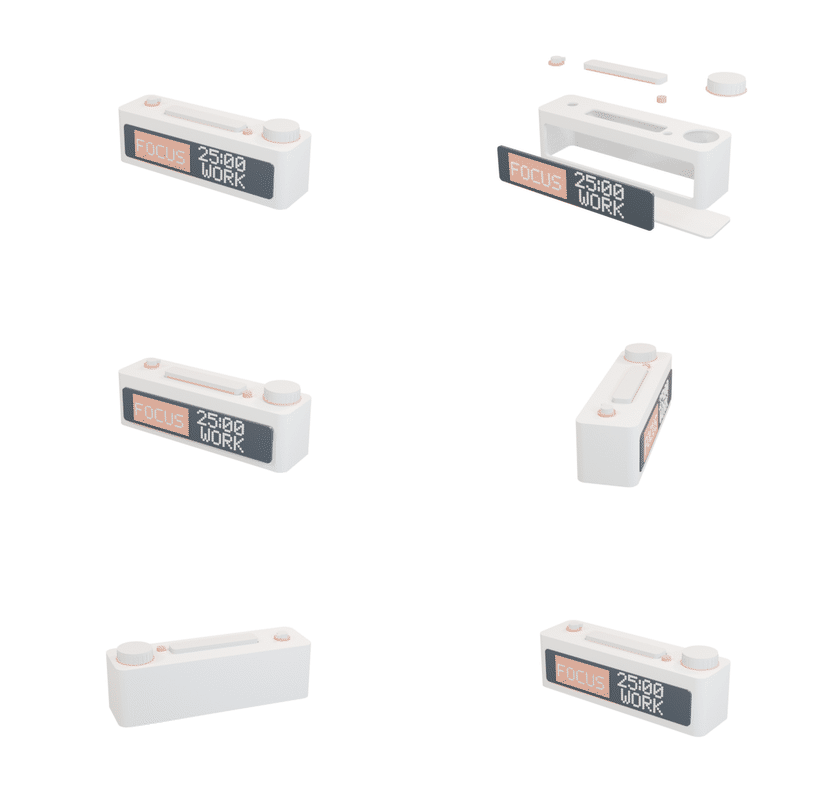
Amagine3D translates dimensions, reference images, and product requirements into editable CAD models. The open tool exports STEP, STL, and 3MF, but still requires engineering review.
What this is about
Amagine3D is an open-source tool that creates enclosures and mechanical structures from natural-language instructions, reference images, dimensions, and existing geometry. Unlike a pure image generator, it is intended to produce editable geometry and manufacturing files rather than merely a convincing view. The project was created on GitHub on August 19, 2026 and is licensed under Apache 2.0.
Its practical role sits between ideation and conventional CAD. Hardware teams can use it to explore how circuit boards, displays, buttons, or connectors might fit inside an enclosure. Amagine3D does not replace engineering approval, but it can accelerate the first testable design.
What Amagine3D actually does
Users describe a product, add dimensions and images, and run the agent through a local web interface. The system creates a semantic scene containing parts, features, interfaces, materials, and spatial relationships. Geometry is generated with Python and build123d on top of Open CASCADE, and the source code remains editable.
The agent works iteratively. It creates a candidate, measures the resulting geometry, and checks items including wall thickness, connectivity, print orientation, build volume, collisions, and exported files. A five-view preview supports visual review. The same geometry can produce STEP for continued CAD work, STL for 3D printing, GLB for display, and 3MF with additional printing information.
For local operation, the project specifies Node.js 22.19 or newer, Python 3.10 through 3.13, npm, a modern browser, and an API key for an OpenAI Responses-compatible model endpoint. Its documentation says no desktop CAD application is required. Inputs and artifacts are stored in isolated session folders, although model requests may still leave the machine depending on the selected provider.
Why it matters
A persuasive render is not enough for hardware. Holes need to be in the correct position, walls must be printable, and covers need clearance. Amagine3D is notable because it connects conversational instructions with measurable BRep geometry. BRep represents solids through faces, edges, and relationships, making it more suitable for later engineering changes than a simple triangle mesh.
The tool may therefore be useful to makers, prototyping teams, and small hardware companies that need to evaluate many early variants. The Apache 2.0 license also makes internal testing and modification easier. Its most relevant distinction from generic text-to-3D services is not a promise of full automation, but the delivery of source code, measurements, and standard exchange formats.
In plain language
Imagine a tailor. An image generator only sketches what a suit might look like. Amagine3D also tries to provide the pattern, seams, and measurements. Someone still has to conduct the fitting, because a model that looks correct may press against a connector or fail during printing.
A practical example
A team is building a desktop sensor around an 80 × 50 millimeter board, a 30-millimeter display, two buttons, and a USB-C port. It uploads a reference image, enters the dimensions, and requests a two-part enclosure with 2.4-millimeter walls and four screw bosses.
Amagine3D creates a first design, reports a collision between the display mount and circuit board, and moves the mount. The team exports STEP for inspection, prints an STL version, and finds that the real prototype needs 0.3 millimeters more lid clearance. That measurement goes into the next run. The sensible first test is therefore small and verifiable: use a simple enclosure with known components, then inspect dimensions, collisions, and a physical test print.
Scope and limits
First, a passed software check is not manufacturing approval. Material behavior, screw loads, heat, electromagnetic compatibility, and tolerance stacks still require professional review.
Second, quality depends on the model endpoint, complete dimensions, and useful references. Missing internal measurements or wrong assumptions can create geometrically clean but practically unusable output. Visual review only works when the configured model can genuinely process images.
Third, setup is more technical than a finished SaaS product. Users must configure Node.js, Python dependencies, and a model provider. API costs depend on that provider; the repository does not publish a single end price. Confidential design data should only be sent to external models under an appropriate privacy and contractual framework.
SEO & GEO keywords
Amagine3D, AI CAD, generative CAD, build123d, Open CASCADE, STEP, STL, 3MF, 3D printing, hardware prototyping, open-source AI tool, parametric design
💡 In plain English
Amagine3D turns requirements and dimensions into an editable 3D enclosure instead of just an image. It provides CAD source code and manufacturing files, but a person must still verify dimensions, materials, and printability.
Key Takeaways
- →Amagine3D generates editable BRep geometry from text, images, and dimensions.
- →The tool exports STEP, STL, GLB, and 3MF from the same design.
- →The code and project use the Apache 2.0 license.
- →Local operation requires Node.js, Python, and a compatible model endpoint.
- →Manufacturing approval, material checks, and privacy remain the team's responsibility.
FAQ
Is Amagine3D free to use?
The source code is licensed under Apache 2.0. The selected model provider and optional search services may still charge fees.
Which files can Amagine3D export?
The project documentation lists STEP, STL, GLB, and 3MF. The generated Python and build123d source code also remains editable.
Does the tool replace a CAD professional?
No. Engineers still need to verify dimensions, tolerances, materials, heat, and manufacturability.
Does Amagine3D run entirely locally?
The interface, geometry, and project files can run locally. Model requests still go to the configured provider unless an appropriate local endpoint is used.