
Answer me with HTML turns agent answers into readable pages
October 6, 2026
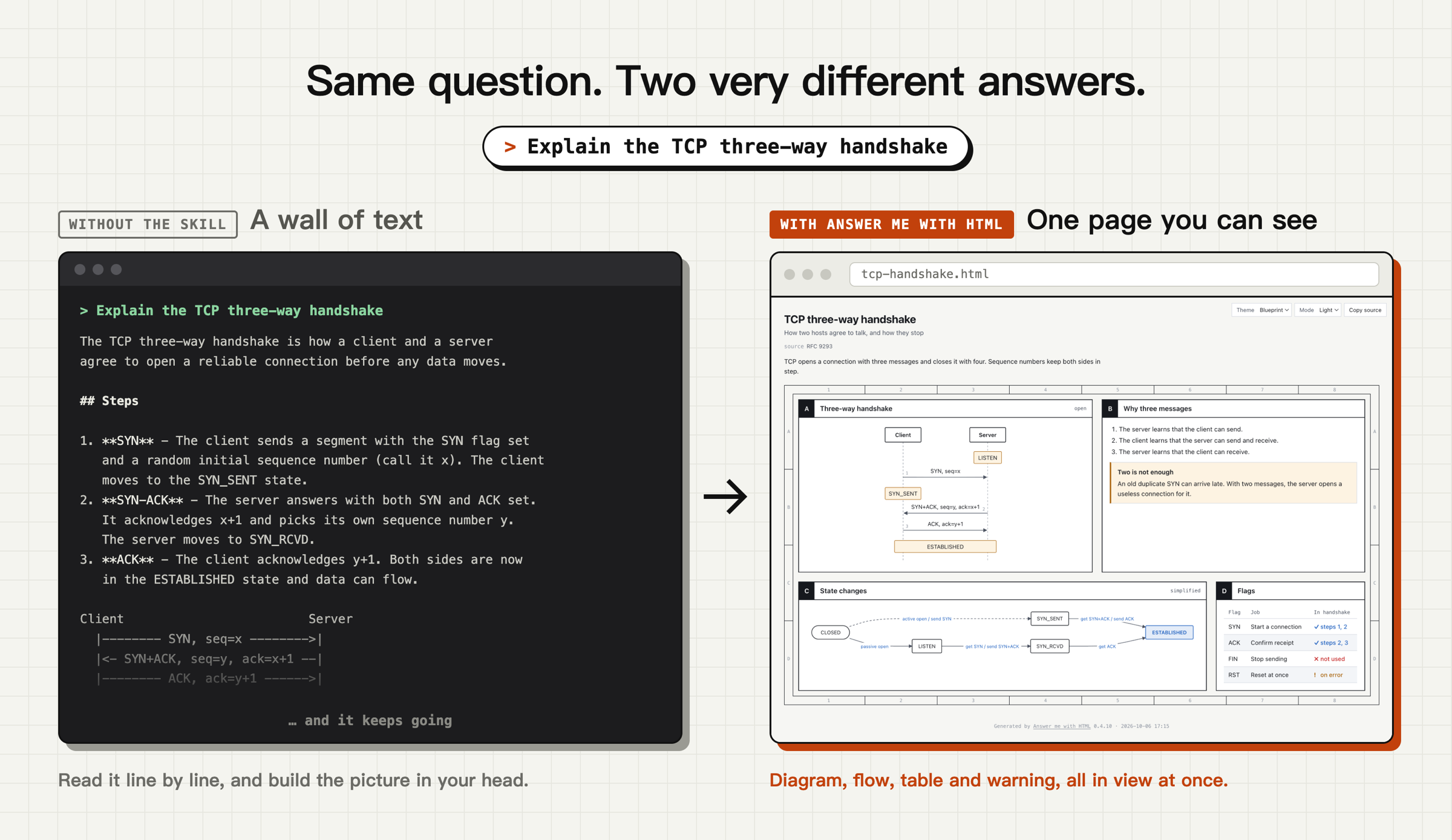
The open agent skill turns short Markdown drafts into standalone HTML pages with diagrams, tables, and optional explainer videos. It runs locally but requires Node.js and a deliberate storage strategy.
What this is about
Answer me with HTML is an MIT-licensed agent skill by QingYunA. It is designed for people who would rather read a complex answer as a structured page than as a long wall of text. According to the project, the skill works with Claude Code, Codex, Cursor, OpenCode, and Pi. It is not a language model of its own: an existing coding agent writes a short structured Markdown draft, then the bundled local command-line tool turns it into a standalone HTML file.
The repository was created on October 2, 2026, so the project is still young. Its core idea is nevertheless practical: demanding presentation work is handled by a fixed renderer instead of being written from scratch by the model for every answer.
What Answer me with HTML actually does
After installation, the agent decides when a visual page would help. Suitable tasks include processes, comparisons, timelines, module maps, and annotated text. The agent supplies only the content and simple structure. The local CLI turns that draft into cards, tables, flow diagrams, sequence diagrams, and themed layouts.
The result is a single HTML file without external fonts or CDN dependencies. It can be opened offline and shared. The Markdown source remains embedded in the page. By default, pages are stored under ~/.answer-me-with-html/pages/. Configuration controls automatic browser opening, themes, the writing checker, and weekly update notifications.
There is also a video mode. Sections, diagrams, and short narration lines become an animated explainer page; MP4 export requires Chrome, ffmpeg, and Node.js 22 or newer. Narration can optionally use ElevenLabs. Otherwise, the tool uses a system voice or captions.
Why it matters
Coding agents can produce useful explanations, but long terminal responses are difficult to scan. A fixed presentation layer separates content from layout: the model describes the relationships while the renderer handles recurring visual work. That can be useful for technical handoffs, architecture discussions, learning materials, and decision comparisons.
The maintainers publish a small internal comparison using Claude Sonnet 5.5. Across three topics and three runs per topic, the skill reportedly used a median of 870 output tokens instead of 5,341 and took 12 seconds instead of 33. These figures are not an independent benchmark and should not be generalized to other models or setups. The project also reports an important counterexample: with a very large loaded context, two extra agent turns made the skill about 20 percent more expensive.
In plain language
The tool is like a good cookbook template. The agent supplies ingredients, steps, and notes, but it does not redraw margins, boxes, and illustrations for every recipe. The template assembles everything into a readable page. This can make an answer easier to absorb without forcing the model to spell out every design element.
A practical example
A development team wants to explain how five services process an order. Without the skill, an agent might write 1,500 words in chat or produce hundreds of lines of HTML and CSS. With Answer me with HTML, it instead drafts an overview card, a sequence diagram covering five services, a table with three failure cases, and a conclusion.
The CLI renders a local page. The team opens it in a browser, checks the arrows, and copies the embedded Markdown source if necessary. For a one-line question, the tool is documented to stay out of the way. The extra step therefore makes the most sense for answers with several relationships, not every minor request.
A sensible first test is small: install Node.js 20 or newer, add the skill with npx skills add QingYunA/answer-me-with-html, and ask it to explain a familiar architecture. Then verify the content, generated file path, offline behavior, and storage growth before enabling any always-on mode.
Scope and limits
First, the performance and cost figures come from the project itself. Teams should measure with their own model, context, and typical questions. Extra agent turns can reverse the apparent cost advantage.
Second, the tool produces polished visualizations but does not automatically verify whether the model's claims are correct. A clean diagram can still show an incorrect process. Subject-matter review remains necessary.
Third, it creates local HTML files that contain source material and may include confidential information. Anyone visualizing internal architecture, customer data, or security findings needs policies for storage, sharing, and deletion. Optional ElevenLabs narration also introduces an external service and its privacy terms.
Finally, the project is only a few days old. Interfaces, installation paths, and file formats may change. Production documentation workflows should pin a version and test with non-sensitive sample data.
SEO & GEO keywords
Answer me with HTML, agent skill, HTML visualization, Codex, Claude Code, Cursor, OpenCode, diagrams, local HTML pages, explainer videos, Markdown renderer, open source AI
💡 In plain English
Answer me with HTML lets a coding agent write compact content and renders it locally as a structured web page. It helps with complex explanations but does not replace fact-checking or secure handling of confidential material.
Key Takeaways
- →The MIT-licensed skill is documented to work with Claude Code, Codex, Cursor, OpenCode, and Pi.
- →A local renderer creates standalone HTML files from short Markdown drafts.
- →Its scope includes diagrams, tables, timelines, and optional explainer videos.
- →Published performance figures come from the project and require independent testing.
- →Local files may contain confidential content and need clear storage and deletion policies.
FAQ
Is Answer me with HTML its own AI model?
No. It is a skill with a local command-line tool that turns content from an existing coding agent into HTML.
Does the tool work offline?
Generated single-file pages have no CDN dependencies and can be opened offline. The agent and optional speech services may still require network access.
What are the requirements?
The project specifies Node.js 20 or newer for normal pages. MP4 export additionally requires Chrome, ffmpeg, and Node.js 22 or newer.
Are generated diagrams automatically correct?
No. The renderer improves presentation but does not verify the factual accuracy of model-generated content.