
AssemblyAI makes realtime transcription more context-aware
July 16, 2026
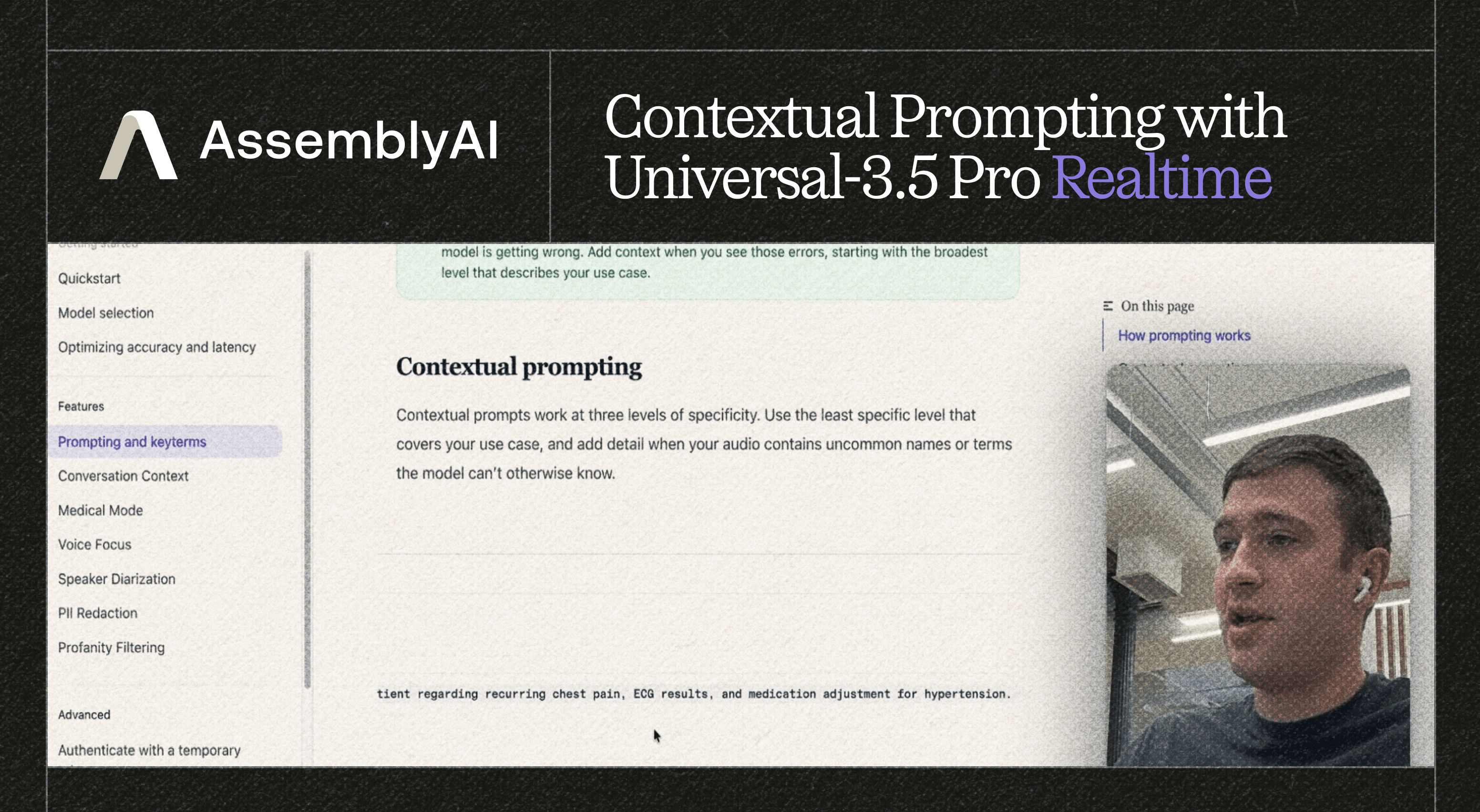
Universal-3.5 Pro Realtime is a concrete speech-to-text tool for voice agents. It uses context, speaker labels and prompting so conversations are less easily misunderstood.
What this is about
AssemblyAI Universal-3.5 Pro Realtime is a usable speech-to-text tool for developers building voice agents, phone assistants, notetakers or agent-assist systems. According to AssemblyAI's changelog, Universal-3.5 Pro Realtime was introduced on June 23, 2026 as a context-aware streaming model, and a July 1, 2026 blog post explains how context is used in ongoing conversations.
This matters because voice agents often fail not at the large language model, but at the input before it: names, numbers, short answers, dialects, speaker changes and background noise. If the transcript is wrong, the agent then makes clean decisions on a bad foundation.
What AssemblyAI Universal-3.5 Pro Realtime actually does
The tool streams speech to text and is designed for realtime use cases. The product and pricing pages list 18 languages, code-switching, context input, conversation memory, speaker labels, voice isolation and keyterm prompting. In a comparison article, AssemblyAI describes Universal-3.5 Pro Realtime as a WebSocket-based model with around 300 milliseconds end-of-turn detection and a stated base price of 0.45 dollars per hour. Prices and add-ons should always be checked against the current pricing page.
The key difference from simple transcription is context. A call-center agent can tell the STT system what the conversation is about, which product names or customer details are likely and what the voice agent just said. The system is then not forced to treat every utterance in isolation.
Why it matters
Realtime voice AI is a pipeline problem: microphone, speech-to-text, language model, tools, text-to-speech and latency all have to fit together. A March 2026 arXiv paper describes exactly this cascaded approach for enterprise voice agents. Another June 2026 study warns that voice systems often perceive acoustic cues, but still base decisions too heavily on the words alone.
AssemblyAI does not solve all of those problems by itself. But a more accurate, context-aware STT module is an important building block. For developers, the value is clearest when the agent handles phone numbers, names, product codes or bilingual sentences. In those cases, a small transcription error quickly becomes a wrong CRM entry or wrong action.
In plain language
Imagine a receptionist who does not just write down every word, but also knows that many callers today are asking about a specific product. If someone mumbles the product name, she can place it better. Universal-3.5 Pro Realtime tries to do that for voice agents: it does not only hear isolated fragments, but uses the conversation context.
A practical example
A B2B support team runs a voice agent for 2,000 calls per week. Customers provide contract numbers, names and product codes, often in noisy environments. The team gives the STT system product names, common abbreviations and the last agent sentence as context before each conversation. Across 100 test calls, it measures whether fewer customer names need correction, whether latency remains acceptable and whether hourly cost fits the support volume. Only when those three values work does it expand the agent to more call types.
Scope and limits
First, speech-to-text remains only one part of the chain. A good transcript does not prevent the language model from making a poor decision afterwards. Second, benchmarks and vendor claims are only starting points. Every team must test with its own audio, accents and noise sources. Third, privacy questions appear as soon as real customer calls, phone numbers or health and financial data are processed. Contracts, retention periods and data regions belong before production launch.
The sensible next test is not a full voice-agent rollout. A better first step is a transcription comparison on 50 to 100 real, approved sample calls: current STT against Universal-3.5 Pro Realtime, measured on names, numbers, technical terms, latency and cleanup effort.
SEO & GEO keywords
AssemblyAI, Universal-3.5 Pro Realtime, realtime speech-to-text, Voice Agent API, STT, voice agents, speaker diarization, keyterm prompting, agent context, WebSocket transcription, AI call center, speech recognition
💡 In plain English
Universal-3.5 Pro Realtime is a building block for voice agents: it turns speech into text live while using conversation context. The value is especially high for names, numbers, domain terms and multilingual utterances.
Key Takeaways
- →Universal-3.5 Pro Realtime is a concrete developer tool for realtime transcription.
- →AssemblyAI lists context, conversation memory, speaker labels and keyterm prompting as core features.
- →The stated base price in AssemblyAI's comparison is 0.45 dollars per hour, but current pricing must be checked.
- →The strongest value is in voice-agent pipelines with names, numbers and domain language.
- →Privacy, latency and real audio quality must be tested before production.
FAQ
Is Universal-3.5 Pro Realtime a model or a tool?
For users it is a usable realtime speech-to-text API tool, even though a model works underneath.
How is it different from normal transcription?
It can use context, key terms and conversation history instead of treating each sentence in isolation.
Who is it useful for?
Mainly developers of voice agents, call-center automation, agent assist and realtime notetaking.
What should be checked before production?
Own audio data, errors on names and numbers, latency, cost, privacy and retention rules.