
Beaver brings an evidence-focused AI agent directly into Zotero
August 20, 2026
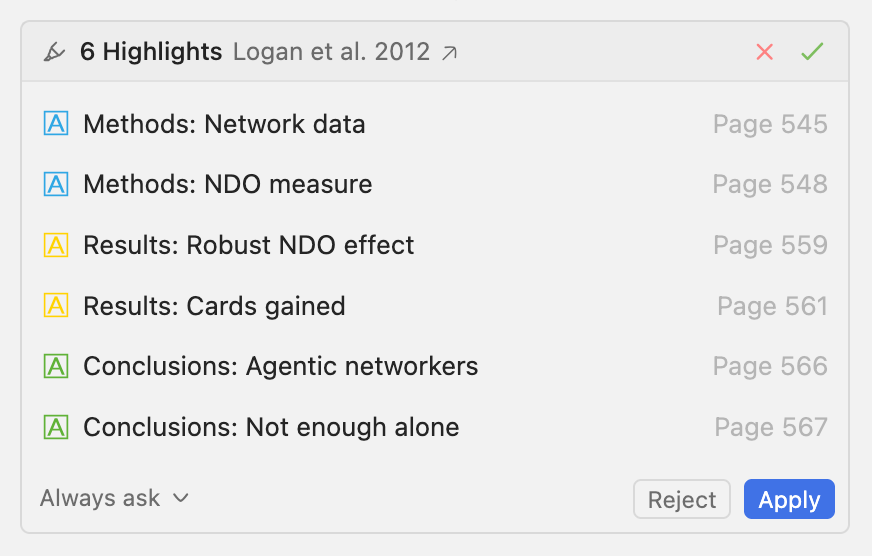
Beaver searches a user's Zotero library, cites answers sentence by sentence, and can create real annotations. Its code is open, but the cloud component still requires a privacy review.
What this is about
Beaver is an AI research assistant that works as an extension inside Zotero. Instead of uploading literature to a separate chat, the agent uses the existing library, the open PDF, and the current reading context. It answers questions with sentence-level evidence and, after approval, can change annotations, notes, tags, and collections.
The project is developed under AGPL 3.0 and supports Zotero version 7 and later. Its public repository was actively maintained on August 20, 2026. Beaver can be used for free with a user's own API key; the project also offers a service that does not require a personal key. Specific prices may change and should be checked on the official pricing page.
What Beaver actually does
Beaver combines metadata queries, semantic search, full-text analysis, and web search when needed. The agent decides step by step which source it requires and is designed to connect claims to the exact sentences supporting them. A click opens the PDF at the relevant passage. This is more useful than a source list at the end of a long answer because users can inspect each individual claim.
Inside Zotero's reader, Beaver can explain selected text, tables, or figures. It can highlight methods, results, or conclusions in different colors. These marks are real Zotero annotations, remain editable, and synchronize with the library. Changes require approval by default and can be undone.
The agent can also search annotations across the library, create or edit notes, correct metadata, and discover additional literature. The project says its external search covers more than 240 million scholarly works. An included MCP server makes a user's library available to compatible clients; it currently offers read tools and an additive tool for creating new notes.
Why it matters
Research rarely fails only because a PDF cannot be found. Much of the time is spent finding a claim again, comparing multiple texts, and transferring evidence into notes. Beaver targets precisely this part of the workflow: the agent works where researchers already read and organize.
For students, researchers, analysts, and investigative teams, sentence-level traceability is the central benefit. It does not automatically reduce the error rate, but it makes errors easier to identify. Zotero integration also prevents AI output from disappearing in a separate chat history. An annotation remains part of the working library and can later be corrected by a person.
In plain language
Beaver is like a librarian who does not merely recommend a book but places a sticky note beside the exact paragraph supporting every answer. She may also reorganize the shelf, but asks before every change. The sticky note is not proof of truth; it simply shows where a claim can be checked.
A practical example
A doctoral student manages 380 papers on urban heat research in Zotero. For a chapter, she wants to know which studies published from 2022 through 2026 measured a relationship between tree cover and nighttime temperature. Beaver searches titles, metadata, and full text, then produces an answer citing eight relevant papers.
The student opens every sentence-level citation, rejects two studies with unsuitable measurement methods, and asks Beaver to mark the methods in the remaining six papers in blue and the result values in yellow. She then approves a Zotero note containing the evidence. She does not accept any wording without review, but avoids manually finding 24 passages again.
Scope and limits
First, sentence-level citations can link to the correct passage while still interpreting it incorrectly. Context, study design, and conflicting evidence require human review. Second, depending on the feature, Beaver processes library content through external model and service providers. Confidential manuscripts, personal data, or documents with licensing restrictions require a prior privacy and contractual review. Third, performance depends on PDF quality, OCR, metadata, and specialist language; tables, formulas, and poor scans can weaken retrieval.
Beaver does not replace systematic review protocols, literature databases, domain expertise, or correct citation practice. A sensible first test uses ten familiar papers: ask five concrete questions, verify every cited sentence, observe change approvals, and check which data flows to which model provider.
SEO & GEO keywords
Beaver, Zotero, AI research assistant, literature review, PDF annotations, sentence-level citations, scholarly search, MCP server, AGPL 3.0, research tool, source verification
💡 In plain English
Beaver is an AI assistant inside Zotero. It searches a user's literature, links claims to exact passages, and can create annotations or notes after approval.
Key Takeaways
- →Beaver works directly inside Zotero version 7 and later.
- →Answers link claims to sentence-level evidence.
- →Annotations and notes are real, editable Zotero objects.
- →Changes require human approval by default.
- →External model processing requires a privacy review for sensitive documents.
FAQ
Is Beaver a standalone reference manager?
No. Beaver is an extension for Zotero and uses its library and PDF reader.
Are its citations automatically reliable?
No. Sentence-level evidence makes checking easier, but people must still review interpretation, context, and study design.
Can Beaver change my PDFs?
Beaver can create real Zotero annotations and notes. The project says changes require approval by default and can be undone.
Is Beaver open source?
The public repository uses the AGPL 3.0 license. Connected cloud and model services have additional terms.