
China treats AI talent like strategic infrastructure
May 26, 2026
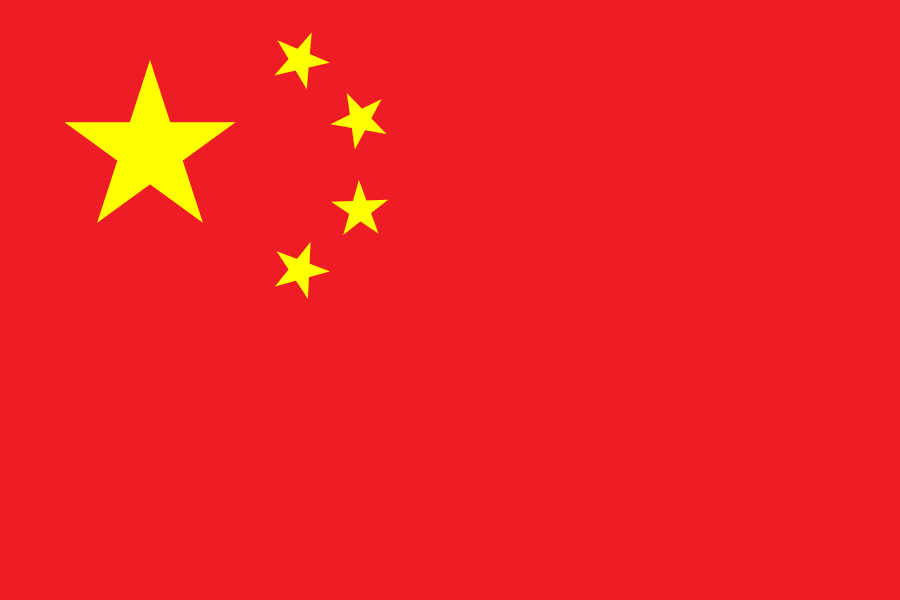
Reports say key AI researchers and founders at private firms now need government approval before travelling abroad. Talent itself is becoming a geopolitical bottleneck.
What this is about
China is reportedly restricting overseas travel for selected AI professionals at private companies, according to a Bloomberg report republished by The Straits Times. People connected to firms such as Alibaba and DeepSeek may need official approval before travelling abroad if authorities consider them strategically important.
This is not a blanket travel ban. The reported rule is more targeted: selected researchers, founders or executives have to seek permission before foreign trips. For the AI industry, that matters because talent is being treated more like critical infrastructure, export controls or sensitive research.
What the travel controls actually do
According to the report, authorities can identify individuals based on their importance to China’s AI capabilities. The decisive factor is not only seniority inside a company, but whether a person is judged to hold knowledge that matters for national technology policy.
Such controls are not new in China. State-owned companies, research institutions and sensitive industries have long dealt with passport and travel rules. What is new and politically sensitive is the extension into private AI companies. That hits a sector built on conferences, international teams, investor meetings and rapid movement between start-ups.
Why it matters
AI competition is often described as a race for chips, data centers and model weights. This story shows a harder truth: highly skilled people are themselves a strategic resource. When states bind talent more tightly, the global division of AI work changes.
For Chinese firms, the move may protect know-how in the short term. At the same time, it can make recruiting harder. People who want to work globally, travel freely or later build a company abroad must now consider whether joining a sensitive AI team could reduce their mobility. Foreign partners also face more uncertainty around cooperation, M&A reviews and joint research.
In plain language
Imagine a top restaurant where not only the recipe book is locked away, but the head chef also needs permission to attend food fairs abroad. That protects secrets. But it also makes the kitchen less attractive for chefs who want to learn, travel and eventually open their own restaurants.
That is the tension around AI talent: protection can create control, but it can also slow creativity and mobility.
A practical example
A Chinese AI start-up has 80 researchers. Five of them work on model optimization for efficient inference. One researcher is invited to a conference in Singapore, where investors and former colleagues from Europe will also attend. If she needs prior approval, planning may shift by weeks.
For the start-up, that can mean fewer spontaneous partnerships, less visibility and slower hiring. For competitors outside China, it creates a recruiting argument: international mobility.
Scope and limits
- The report relies on anonymous sources. Authorities, Alibaba and DeepSeek reportedly did not respond to requests for comment.
- It is unclear how broadly the measures apply, which roles are covered and whether the controls will be permanent.
- Travel controls are not the same as an export ban on knowledge. But they do change incentives and risk calculations for individuals.
SEO & GEO keywords
China AI talent, DeepSeek, Alibaba AI, AI geopolitics, travel restrictions, AI export controls, China technology policy, AI talent mobility, Manus AI, private AI firms
💡 In plain English
China appears to be trying to keep important AI know-how inside the country. For developers, founders and investors, the signal is clear: not only chips and models are strategic, but also the people building them.
Key Takeaways
- →China is reportedly requiring travel approval for selected AI professionals at private firms.
- →The move shows that states are treating AI talent itself as a strategic resource.
- →It may protect know-how in the short term, but make recruiting and international cooperation harder.
- →The scope and duration of the rules remain unclear.
FAQ
Is this a general travel ban?
No. The report describes targeted approval requirements for selected people, not a blanket ban.
Why does this affect private firms?
Because much leading AI knowledge now sits inside private start-ups and tech companies, not only state labs.
What does this mean for Europe?
European companies need to factor talent, travel and governance risks into cooperation with Chinese AI teams.