
Cisco makes open AI model provenance easier to verify
August 2, 2026
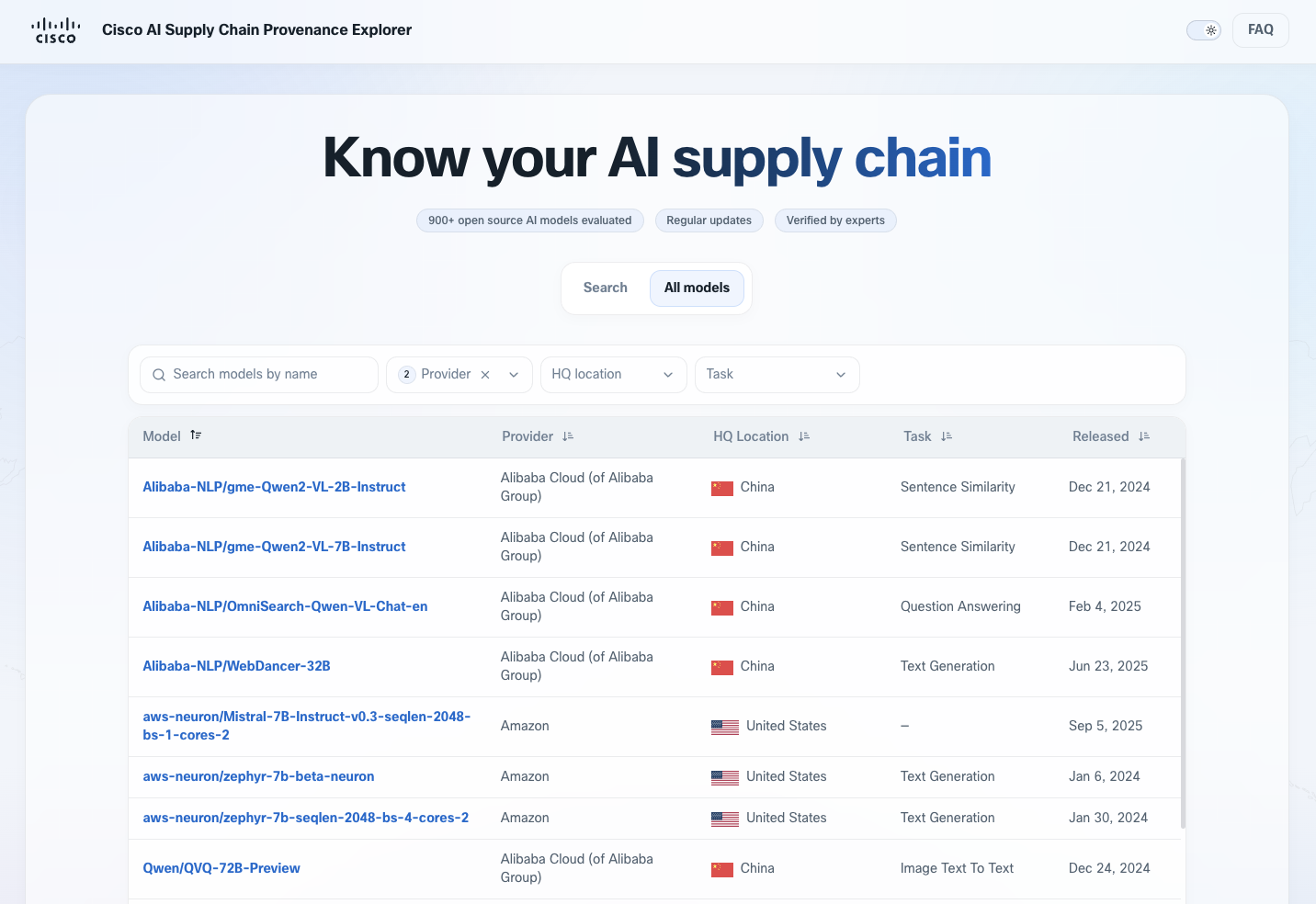
Cisco launched a public Provenance Explorer for almost 900 open AI models. For developers, security teams, and legal teams, it surfaces what is often unclear before download.
What this is about
Cisco introduced the AI Supply Chain Provenance Explorer on July 30, 2026. According to Cisco, the public tool catalogs almost 900 open AI models and brings together information on provenance, provider context, licensing, usage restrictions, and security findings.
That may sound like enterprise hygiene, but it is practically important. Many teams now download models from platforms such as Hugging Face, build them into prototypes, and later move them into production workflows. At that point, it is not enough to know whether a model answers well. Teams also need to know where it came from, how it changed, and what obligations come with it.
What the Provenance Explorer actually does
The Explorer is a search and review surface for open models. Cisco collects model metadata such as release and update dates, parameter size, training-related signals, and download signals. It also adds provider information such as organization, headquarters location, and linked Hugging Face organizations.
The more interesting part is provenance checking. Cisco points to its Model Provenance Kit and Project VAIL so model relationships are not derived only from self-reported repository claims. Instead, static fingerprints and runtime behavior are meant to help classify similarities, derivations, and variants. The tool also surfaces license signals, usage restrictions, and security scans of repository files.
Why it matters
Open models are easy to access, but their supply chain is often hard to read. A model may have been fine-tuned, distilled, quantized, merged, and republished. Along the way, license files can disappear, security findings can be missed, or provenance claims can become too vague.
For developers, this means a model is not automatically clean just because its repository page looks polished. For security and legal teams, it means review has to start earlier, not only after an incident. Cisco itself does not guarantee that every listed model is safe or current. That limitation matters because it frames the tool as decision support, not a permission slip.
In plain language
Imagine buying used car parts for a repair shop. The box has a recognizable name on it, but you still want to know which car the part came from, whether it was modified, and whether it is safe. The Provenance Explorer is that kind of parts list for AI models: it does not replace your own inspection, but it shows where to look more closely.
A practical example
A midsized software team wants to run a 7-billion-parameter model locally for support tickets. Without provenance review, the team checks only benchmark results, the license label, and memory needs. With a provenance check, it also sees that one variant comes from several derivations, a non-commercial restriction appears in the model family, and some repository files still raise security questions. A quick download becomes a deliberate decision: choose another model, ask legal to review it, or test it only internally.
Scope and limits
First, Cisco does not replace a complete supply-chain review. Its disclaimer says data may be outdated or inaccurate, and users remain responsible for their own assessment.
Second, provenance does not prove quality. A transparently documented model can still answer poorly, contain bias, or be unsuitable for a particular use case.
Third, coverage remains limited. Almost 900 models is substantial, but the open AI market grows faster than any single catalog can fully capture.
SEO & GEO keywords
Cisco AI Supply Chain Provenance Explorer, Model Provenance Kit, Project VAIL, open AI models, Hugging Face, AI supply chain, model provenance, license review, AI Security, AI governance, Open Source AI, model fingerprinting
💡 In plain English
Cisco is building a kind of provenance check for open AI models. Teams can review whether licensing, origin, and security signals fit their risk before deployment.
Key Takeaways
- →Cisco introduced the Provenance Explorer on July 30, 2026.
- →The tool catalogs almost 900 open AI models, according to Cisco.
- →It surfaces provenance, provider information, license signals, restrictions, and security findings.
- →The review is not based only on self-reported repository metadata.
- →Cisco explicitly frames the data as decision support, not a safety guarantee.
FAQ
Is the Provenance Explorer a security seal?
No. Cisco itself notes that the data is not a guarantee of safety, freshness, or fitness for use.
Why does model provenance matter?
Licenses, restrictions, provider location, and derivations can decide whether a model fits a product legally and technically.
Who should review it?
Developers, security owners, and legal teams should review open models together before they enter production systems.