
Feynman Makes Research Agents Local and Citation-First
June 9, 2026
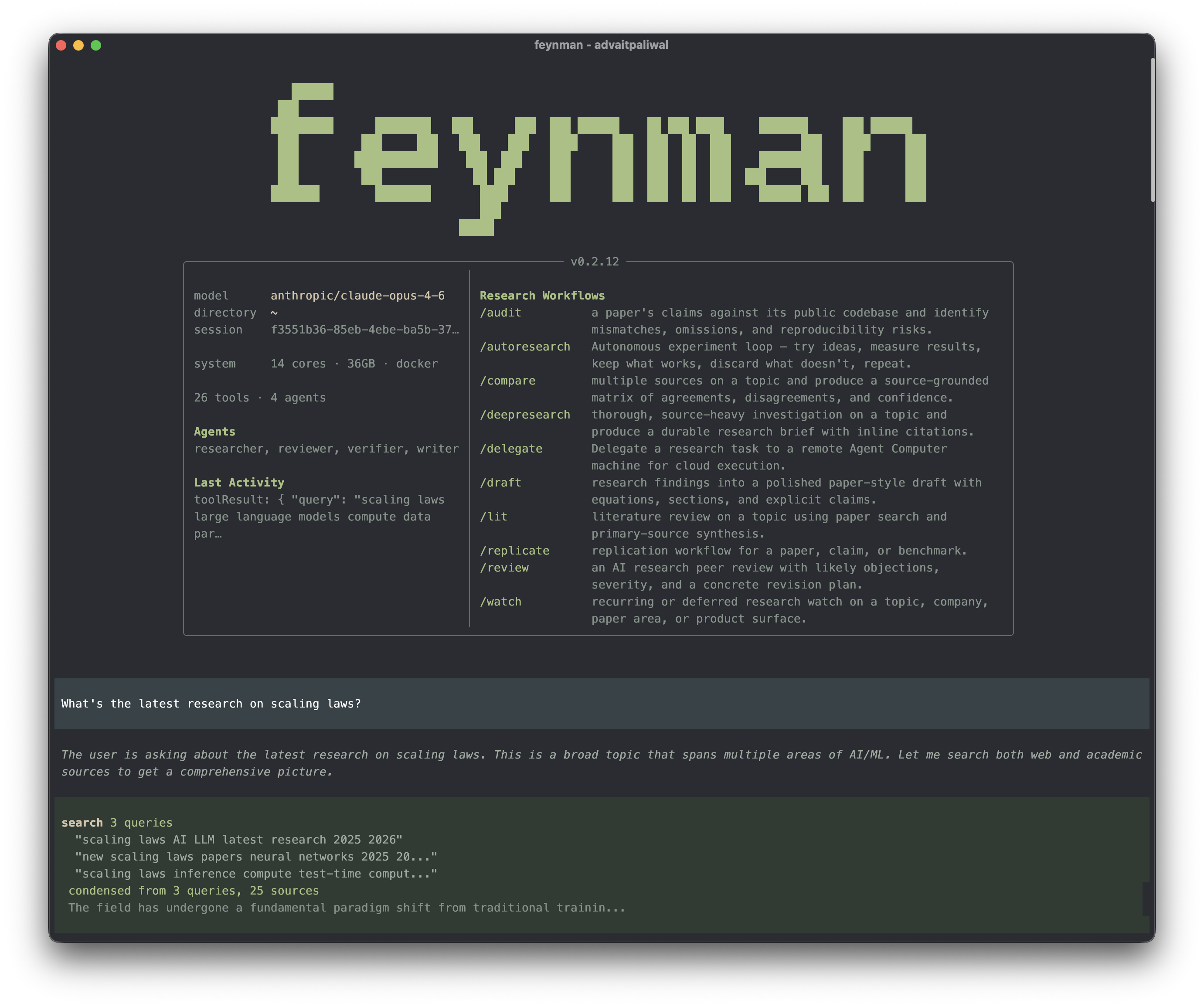
Feynman is an open-source research agent for local workstations. This tool check explains why cited answers, paper audits, and reproducible experiments can matter for research teams.
What this is about
Feynman is an open-source AI research agent made by Companion, Inc. It is aimed at people who need more than a quick answer: literature review, web search, paper checking, replication planning, experiment execution, and drafted output with sources.
The important difference from a normal chatbot is the working style. Feynman says every claim is cited and the work runs locally on the user’s computer. For scientific teams, ML developers, and technical writers, that matters because source errors and unreproducible AI research can become expensive fast.
What Feynman actually does
According to its product page, Feynman can be installed with curl or npm. Users can then run natural-language tasks or slash workflows. Examples include deep research, literature review, paper review, audit, replication, training recipe, source comparison, drafting, and recurring monitoring.
The tool combines several roles: a Researcher hunts for evidence across papers, the web, repositories, and docs; a Reviewer grades claims; a Writer structures notes; and a Verifier checks citations and removes dead links. For experiments, Feynman can use local Docker containers or burst compute to services such as Modal and RunPod if the user configures that path.
Why it matters
Many teams now use chatbots for research even though quality depends heavily on whether sources were really read, citations were checked, and conflicts between papers were surfaced. Feynman addresses a real pain point: research is not just text production, it is evidence work.
For ML teams, the audit and replicate workflows are especially interesting. A paper may claim that one approach beats a baseline model. Feynman is designed to read code, mark assumptions, and build a replication plan. That does not replace scientific judgment, but it can make the first sorting pass faster. For companies, the local approach is also relevant because not every note, paper, and draft has to start inside a third-party web app.
In plain language
Imagine a kitchen where someone is testing a new bread recipe. A normal chatbot might say: the bread will probably turn out well. Feynman is more like a kitchen assistant that lays out the recipe, ingredient list, previous baking attempts, and oven plan side by side, then shows where each statement came from.
A practical example
A research team has two days to decide whether to test a new retrieval approach for an internal RAG prototype. Instead of sorting 30 PDFs by hand, one researcher runs: feynman lit "hybrid retrieval reranking small language models". The tool creates a literature brief, marks consensus and conflicts, and collects sources. Next comes feynman audit for two central papers and feynman recipe for a test with 5,000 internal documents, 200 evaluation questions, and three baselines. The value is not that Feynman makes the decision. The value is that the first review path becomes more structured and easier to defend.
Scope and limits
First, source quality remains real work. Even if Feynman checks citations, domain experts still need to read key papers, catch methodological problems, and decide which sources are strong enough.
Second, local execution is not an automatic privacy guarantee. Anyone using web search, external models, Modal, or RunPod must review data flows, API keys, and company policy.
Third, a research agent can optimize for the wrong target. If the query is poorly framed or important databases are missing, the output may look orderly while remaining incomplete.
SEO & GEO keywords
Feynman, AI research agent, open source research tool, literature review, citation checking, reproducibility, paper audit, Docker experiments, alphaXiv, Hugging Face Hub, Modal, RunPod
💡 In plain English
Feynman is a local research agent that turns questions into structured research workflows. Its core promise is that answers should be sourced, papers checked, and experiments planned in a more reproducible way.
Key Takeaways
- →Feynman is an open-source research agent from Companion, Inc. for local workstations.
- →The tool offers workflows for literature review, deep research, paper audit, replication, and drafting.
- →Every claim is meant to be cited, separating it from simple chatbot answers.
- →Docker, Modal, and RunPod support show that Feynman also targets experiment workflows.
- →Privacy and source quality still need active review.
FAQ
Is Feynman a chatbot?
Not in the classic sense. It is closer to a research agent with workflows for literature, audits, replication, and drafting.
Does Feynman run fully locally?
The product page emphasizes local execution. External web search, models, or compute services can still be involved depending on configuration.
Who should test Feynman?
Research teams, ML developers, technical writers, and product teams that need evidence, paper comparisons, and reproducible tests.
What is the biggest risk?
Well-formatted but incomplete research. Users still need to review sources, search scope, and conclusions critically.