
Framer Agents edit websites directly on the design canvas
August 24, 2026
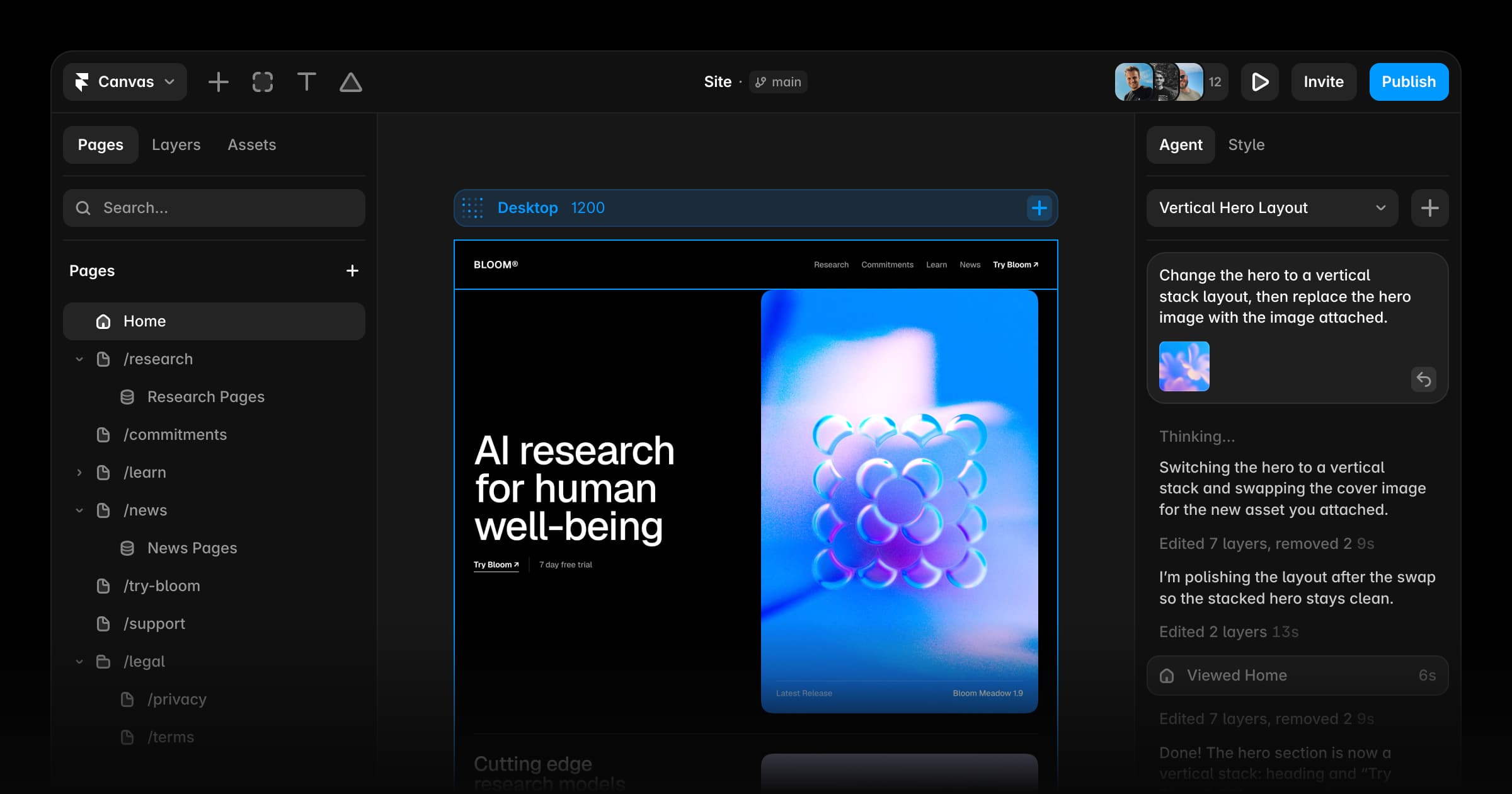
Framer connects an AI agent to its design canvas, CMS, code components, and publishing workflow. This practical check covers the value, limits, and a sensible first test.
What this is about
Framer Agents puts an AI agent directly inside Framer's visual website editor. The official product page was published on August 21, 2026 and describes a workflow in which users can create pages, change existing layouts, maintain CMS content, build code components, and review a website before publishing. The result remains editable on the canvas.
This matters to designers, marketing teams, and smaller web teams because the agent does not merely return text or an image. It works inside the same project where people control layout, breakpoints, components, content, and publishing. The practical value therefore lies less in the first draft than in the connection between drafting, revision, and operation.
What Framer Agents actually does
A user describes a new page or requested change in chat. The agent can turn that request into editable pages, sections, copy, and visual elements in the Framer project. Existing layers can be selected as context, while pages, CMS collections, styles, files, and URLs can also be referenced. People can continue through the conversation or take over directly on the canvas at any point.
According to Framer, the agent can also create and populate CMS collections, prepare responsive variants, generate code components, and review websites for contrast problems, typos, missing alt text, SEO gaps, and inconsistent styles. For larger changes, Framer provides branches and staging so teams can review agent edits separately before publishing. External coding agents such as Claude Code and Codex can also be connected.
The boundary matters: Framer Agents is not a general desktop agent. It operates within the Framer ecosystem and focuses on websites, content, and connected development work.
Why it matters
Many website generators produce a quick first draft, but the real work starts afterward: correcting mobile views, structuring content, adjusting components, checking accessibility, and publishing changes safely. Framer is attempting to keep those steps inside one shared project.
For real teams, an editable result and a reviewable publishing path matter more than an impressive preview. Designers retain access to typography, spacing, effects, and breakpoints. Editorial teams can work with CMS content. Developers can inspect code components. Product Hunt's monthly leaderboard for August 2026 lists Framer AI Agents as a design, website-builder, and artificial-intelligence product. That is an additional sign of current attention, not proof of quality.
In plain language
Framer Agents is like a new colleague in a well-equipped workshop. The colleague does not merely hear “build a table”; they work at the existing bench with the existing tools. The craftsperson can see every cut, correct it, and inspect the result before delivery. The agent speeds up individual tasks, but it does not automatically take responsibility for the finished piece.
A practical example
A small software company runs a Framer website with 18 pages and 60 CMS entries. It needs a landing page for a new product line. The team gives the agent the existing homepage, brand styles, and a product brief as context. The agent creates a page draft, adds a mobile view, and creates four CMS entries.
A designer then checks spacing, contrast, and image selection. A developer reviews the generated pricing-calculator component. The editorial team corrects claims and alt text. Only then is the branch merged into the main version and published. A sensible first test would be much smaller: one unpublished subpage with two sections and one CMS entry. The team should measure how many agent changes are usable without rework and how long review takes.
Scope and limits
First, generated copy, layouts, and code components can contain errors. Claims, accessibility, mobile rendering, and technical security need human review.
Second, the team remains tied to Framer as its design, CMS, hosting, and publishing environment. Anyone needing a fully self-hosted or framework-independent solution should examine export options and the operating model first.
Third, agents need context. Vague briefs, conflicting styles, or poorly maintained CMS structures can easily produce inconsistent results. An automated review also replaces neither a genuine accessibility test nor a security assessment.
Privacy adds another question. Files, internal content, and credentials should enter an agent workflow only after the selected integrations and contracts have been reviewed. Framer names several selectable models and external agents on its product page; a company must determine where data travels for its specific configuration.
SEO & GEO keywords
Framer Agents, Framer AI, AI website builder, visual website creation, design agent, CMS automation, code components, responsive web design, website audit, Claude Code, Codex, website publishing
💡 In plain English
Framer Agents helps create and modify websites directly inside a Framer project. Results stay editable and can be reviewed before publishing. Copy, code, privacy, and accessibility still require human oversight.
Key Takeaways
- →The agent works directly with editable layers on the Framer canvas.
- →It can modify pages, CMS content, responsive variants, and code components.
- →Branches and staging support review before publishing.
- →Framer remains the central design, CMS, hosting, and publishing environment.
- →A small unpublished page is the most sensible first test.
FAQ
Is Framer Agents a general computer agent?
No. The agent is designed for website work within the Framer ecosystem.
Do generated pages remain editable?
Yes. Framer describes editable canvas layers rather than a fixed image or locked template.
Can the agent manage CMS content?
Yes. Framer says it can create, populate, and organize collections.
Does the result need human review?
Yes. Copy, code, mobile rendering, accessibility, and privacy especially require review.