
Gemini Notebook turns purchased ebooks into AI sources
August 28, 2026
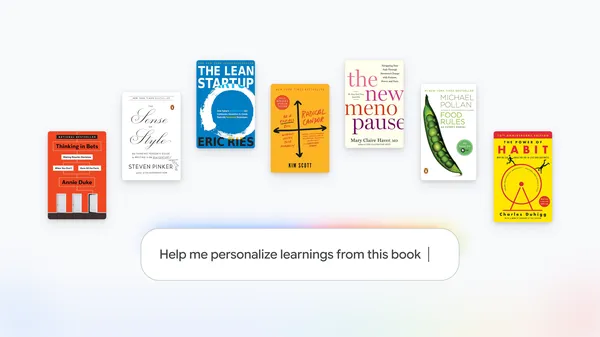
Google now lets selected Play Books titles be analyzed directly in Gemini Notebook. That can simplify source work, while raising questions about availability, citation, and privacy.
What this is about
Google introduced “Expert Intelligence” on August 27, 2026. It lets users add selected ebooks purchased through Google Play Books directly as sources in Gemini Notebook. The AI can answer questions about a book and produce summaries, study plans, infographics, or audio formats from it.
This is more significant than another chat feature. Readers previously often had to obtain a file or copy individual passages before working with a book in an AI tool. Google is now connecting purchase access with an analysis workspace. Google says the launch covers more than 100,000 titles, but not every book or region is automatically included.
What Gemini Notebook actually does
Owners of a supported title can add it as a source to a notebook. The model then works with the book’s content instead of relying only on general knowledge encoded in the model. A user might ask about an argument in one chapter, compare ideas across several books, or create a structured learning path from the material.
The original remains an ebook in Google Play Books. Gemini Notebook creates new working views, not a freely distributable copy. Google’s announcement lists output formats including notes, infographics, and audio overviews. Actual quality will depend on the title, the question, and the system’s ability to preserve long-range context accurately.
Why it matters
The integration removes a practical barrier between reading and doing further work. Students, professionals, and curious readers can search a lawfully purchased book more efficiently without downloading it from questionable sources. That is especially useful for nonfiction, manuals, and long technical texts.
It also concentrates control over access. Whether a purchased book can become an AI source depends on Google’s catalog, rights agreements, region, and product rules. Publishers face a new distribution question: a book is no longer only read but may become the foundation for automatically generated study and work materials. Publishers Weekly and several technology publications therefore framed the release as more than a convenience feature.
In plain language
Imagine a 500-page cookbook. Previously, you had to search the index and mark every relevant page yourself. Now you can ask an assistant to find all vegetarian recipes for four people and turn them into a shopping list. The assistant saves search time, but you should still check the selected recipes in the book.
A practical example
An apprentice owns three supported textbooks totaling 1,200 pages. Before an exam, she asks for the differences between three processes and requests a seven-day study plan. Instead of rereading every chapter in full, she checks the cited sections in the originals and corrects two inaccurate summaries. The AI becomes a navigation tool, not a replacement source.
At a company, an employee might use a purchased industry book while preparing a workshop. He asks for five central claims but keeps only those whose page context he has personally verified. Before adding confidential notes or personal information, he should check which data enters the notebook and which organizational rules apply.
Scope and limits
- The catalog is limited: Google says more than 100,000 titles are supported. That does not mean every purchased book, language, or region is available.
- Answers can compress information incorrectly: A plausible summary may omit context, caveats, or counterarguments. Checking the original remains essential for education, law, medicine, and professional decisions.
- Access is not permanent portability: The feature depends on a Google account, platform, and licensing relationships. It does not create an open, independently archived knowledge base.
- Privacy remains a product question: Anyone adding notes, questions, or work context should review Google’s current data rules and their organization’s policies.
SEO & GEO keywords
Gemini Notebook, Google Play Books, Expert Intelligence, ebooks, AI learning, source work, digital books, summaries, education technology, copyright, Google Gemini
💡 In plain English
Supported Play Books titles you purchased can now be used directly as sources in Gemini Notebook. It saves search time but does not replace checking the original or reviewing privacy and availability.
Key Takeaways
- →Google is launching the feature with more than 100,000 supported ebooks.
- →Gemini Notebook can use purchased titles as sources for questions and new working formats.
- →The integration can speed up research and learning when results are checked against the original.
- →Catalog, region, licensing terms, and platform access limit availability.
- →Personal notes and work context still require a privacy review.
FAQ
Does the integration work with every Play Books title?
No. Google says more than 100,000 titles are supported at launch; availability may depend on the book, region, and rights.
Does Gemini Notebook replace reading the book?
No. It helps find and structure information but can compress or misrepresent context.
Can generated material be shared without restrictions?
Not automatically. Copyright, quotation rules, licensing terms, and the intended use still matter.
Sources & Context
- Google: Expert Intelligence — a new way to engage with trusted content
- 9to5Google: Google announces Expert Intelligence for Play Books
- Android Authority: Gemini Notebook imports Google Play Books titles
- The Verge: Google’s AI note-taking app now lets users interact with books
- Publishers Weekly: Google launches AI tool for interactive ebooks