
GeoPT simulates physics with up to 60 percent less data
August 11, 2026
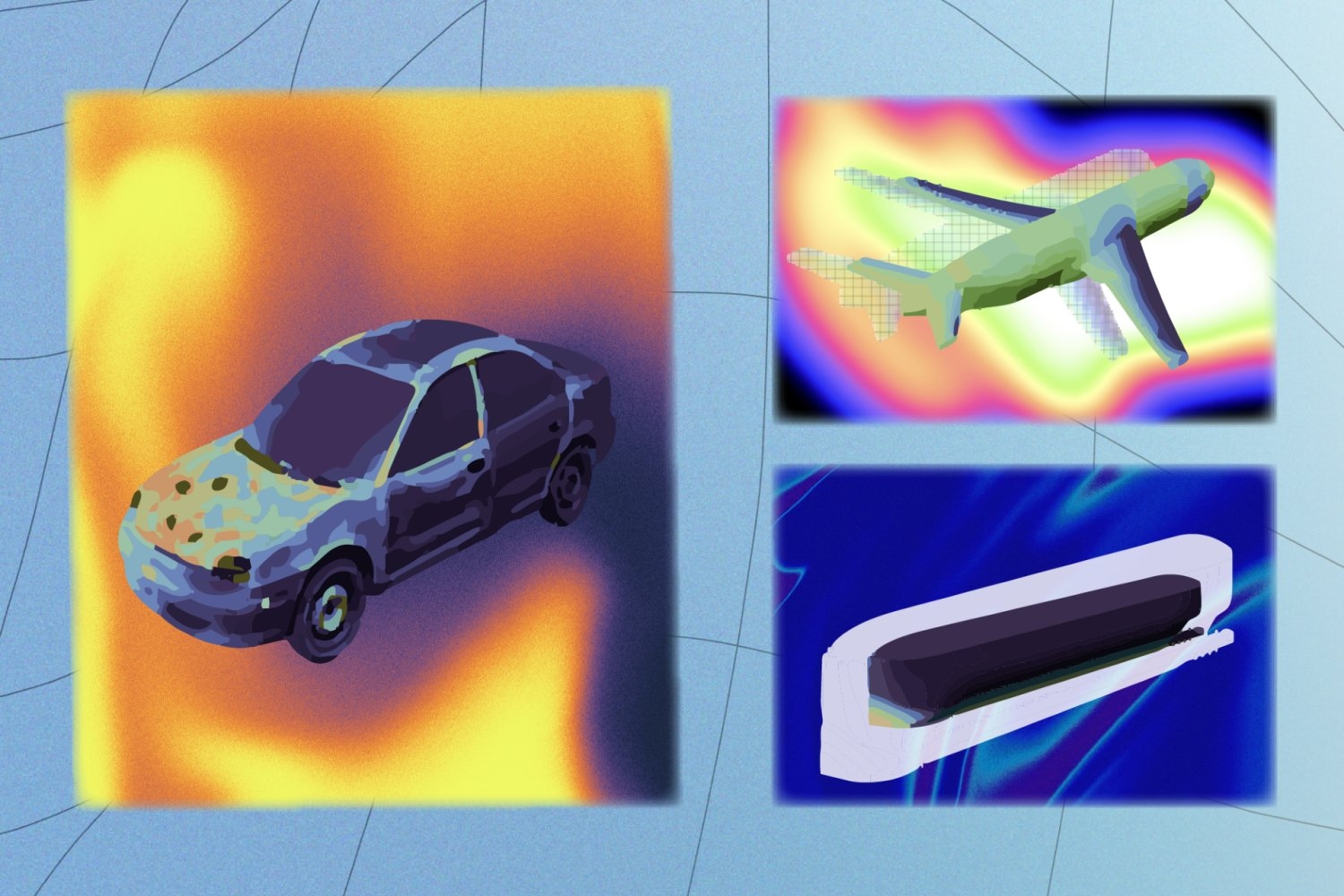
MIT and Tsinghua train an AI model with synthetic particle motion. In tests, GeoPT needs 20 to 60 percent less labeled data for engineering simulations.
What this is about
Engineering simulation is expensive. Testing how wind affects an aircraft, how water loads a ship hull, or how a car deforms in a crash requires accurate computational models and large amounts of high-quality training data. Researchers at the MIT Computer Science and Artificial Intelligence Laboratory (CSAIL) and Tsinghua University propose a different approach with GeoPT.
The MIT report published on August 10, 2026 describes pre-training that learns physical relationships from synthetic particle motion. According to the research paper, GeoPT reduced labeled-data requirements by 20 to 60 percent across several industrial benchmarks and accelerated convergence by a factor of two. The paper itself was submitted in February, revised in May, and presented at ICML in July; what is new is MIT's detailed August 10 explanation.
What GeoPT actually does
GeoPT does not start with complete, expensively computed flow or collision datasets. Instead, the model was pre-trained on more than one million synthetic examples. Small virtual particles move toward complex 3D shapes at different speeds and angles, then stop on contact. From these simplified interactions, the model jointly learns about geometry and motion.
It can then be fine-tuned for specific tasks. Users provide a 3D model of a vehicle, for example, together with the direction and speed of a force. The system produces a spatial prediction such as a pressure-distribution map or expected deformation. The source code is publicly available on GitHub.
Why it matters
Neural simulators can complement conventional numerical methods, but high-quality simulation data are expensive to generate. That data bottleneck has limited scaling. The paper's benchmarks cover fluid mechanics for cars, aircraft, and ships, as well as solid mechanics in crash simulation.
The difference was especially pronounced for combined air and water forces on a ship hull: MIT says GeoPT needed 60 percent less labeled data and reached peak accuracy four times faster than the compared baselines. The researchers also report simulations involving more than 100 million mesh points in seconds. Results like these could shorten design loops before expensive wind-tunnel, towing-tank, or crash testing begins.
In plain language
Imagine teaching someone to pack a suitcase. Instead of showing a thousand completely packed suitcases with detailed scores, you first let the person practice with many objects and differently shaped cases: what fits where, what bumps into a wall, and how is space distributed? GeoPT similarly learns basic spatial interactions first. Only then does it receive expensive specialist examples for aircraft, ships, or cars.
A practical example
An engineering team is developing a delivery drone and owns 100 computationally expensive airflow cases. A conventional model might need all 100 cases for stable predictions. If the 20-to-60-percent reduction measured in the paper transferred to this task, GeoPT might need 40 to 80 cases.
The team would still perform physical tests. It could, however, screen more wing variants and reserve the most expensive simulations for the most promising designs. The figures in this example are illustrative; the researchers did not report this specific saving for drones.
Scope and limits
First, the performance figures come from the authors and selected benchmarks. The reviewed sources do not provide an independent replication in continuous industrial use. Second, the synthetic particles represent highly simplified contacts: they stop at surfaces and do not automatically capture every turbulence pattern, material property, or chemical reaction. Third, GeoPT is not a substitute for certification, physical crash tests, or safety-critical high-precision simulation.
There is another timing caveat. The paper predates the current MIT report by several months. This is not a model newly released on August 10, but a new public explanation of previously presented research. Whether the measured advantages transfer to weather modeling, new materials, or realistic video remains unknown.
SEO & GEO keywords
GeoPT, MIT CSAIL, Tsinghua University, physics simulation, neural simulation, synthetic dynamics, 3D geometry, fluid mechanics, crash simulation, ICML 2026, physics foundation model
💡 In plain English
GeoPT first learns from simple virtual particle motion before receiving expensive engineering simulation data. In tests, this reduced labeled-data needs by 20 to 60 percent, but it does not replace physical safety testing.
Key Takeaways
- →GeoPT was pre-trained on more than one million synthetic-dynamics examples.
- →The authors report a 20-to-60-percent reduction in labeled-data requirements.
- →Benchmarks cover flows around vehicles and ships as well as crash simulation.
- →Public source code enables technical inspection and replication.
- →The reviewed sources do not establish independent long-term industrial validation.
FAQ
What is GeoPT?
GeoPT is a pre-trained model for neural physics simulation. It learns from synthetic particle motion around 3D objects.
How much data does GeoPT save?
The authors measure 20 to 60 percent less labeled training data depending on the benchmark. That is not a guarantee for every new application.
Is GeoPT publicly available?
Yes. The researchers publicly link source code and project materials on GitHub.
Does GeoPT replace physical testing?
No. Safety-critical designs still require validated simulation, certification procedures, and physical testing.