
Human Review makes feedback to AI agents visible
September 1, 2026
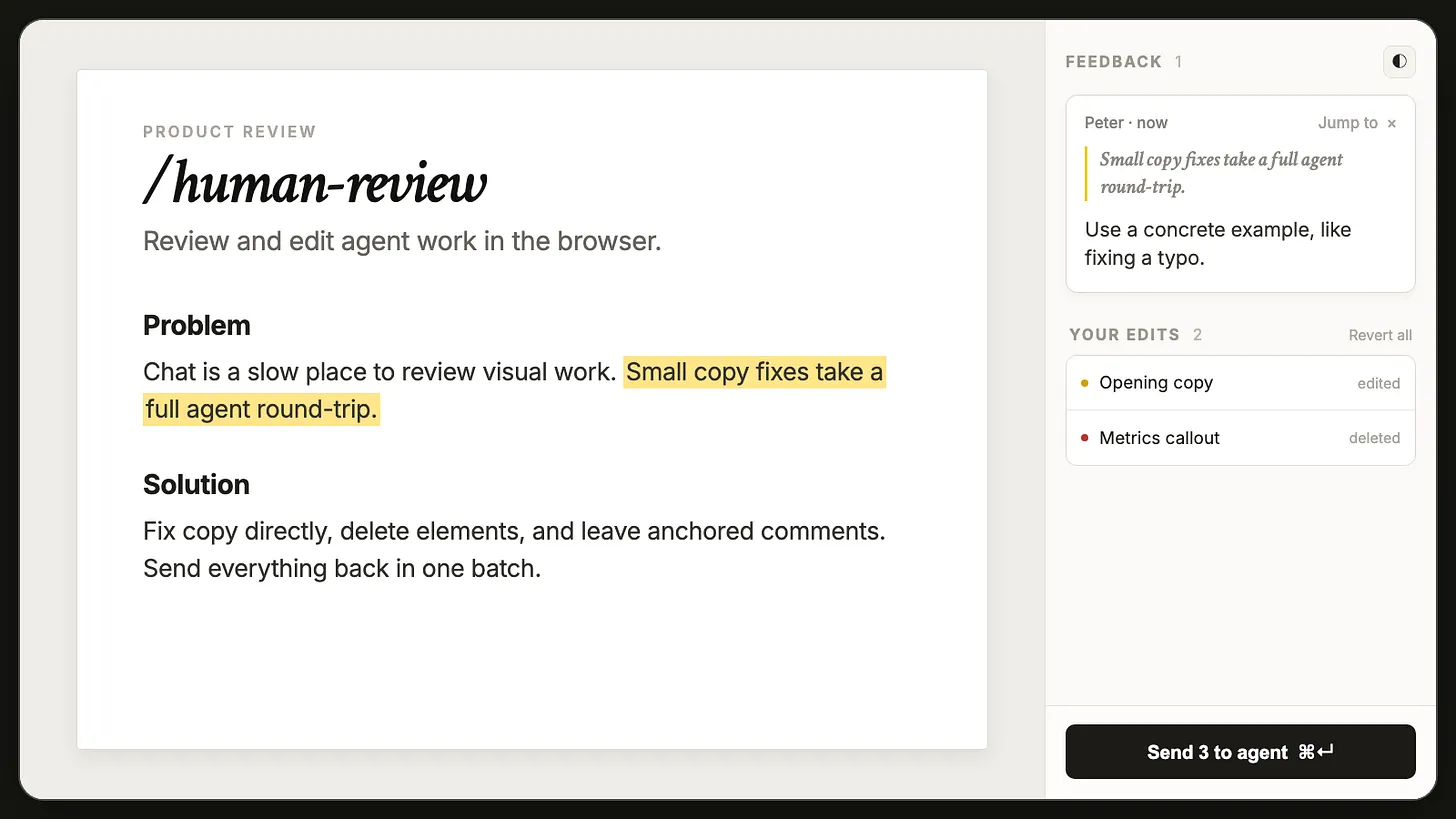
Human Review opens HTML, Markdown, and local websites in a visual review view. Edits and comments are sent back to the AI agent as one batch.
What this is about
Human Review is an open-source tool for the awkward phase after AI generation: an agent has built a page, plan, or document, but corrections are cumbersome to describe in chat. The tool opens HTML files, Markdown documents, or a local website in the browser. A person can edit text directly, move elements, and attach comments to precise locations.
The project appeared in late July 2026 and was at version 0.6.1 on September 1, 2026. According to its documentation, it runs locally and needs no account, cloud service, database, or separate API key. The code uses the MIT License.
What Human Review actually does
Installation works as a skill for supported coding agents or through npx -y human-review setup --global. The /human-review command then starts a browser review session for a file or local URL. For HTML, the interface saves direct edits and resizing automatically. For Markdown and local websites, the Send button passes bundled feedback to the agent, which then updates the source files.
The interface supports text formatting, lists, links, movable blocks, and images pasted from the clipboard. Comments can be anchored to text, images, charts, or full sections. Multiple local pages can be reviewed within one session. Technically, the project combines a local command line, server, browser client, and a skill that teaches the agent the return format.
Why it matters
AI agents have become faster at producing work, but acceptance remains human labor. Free-form chat instructions such as “shorten the third paragraph and remove the duplicate card” are error-prone: references can be ambiguous, several corrections are easily mixed up, and each new round costs time. Human Review makes that handoff spatially explicit.
Its value is not another model but a clearer workflow between person and agent. It is particularly relevant to developers, designers, editors, and product teams already using Codex, Claude Code, or similar tools. Because the review view runs locally, content does not have to be sent to an additional review service. The connected AI agent may still transmit data to its model provider; Human Review does not change that provider's privacy rules.
In plain language
Instead of telling a craftsperson by phone which three places in a room need changes, you walk through the room with sticky notes. You move one chair yourself, mark the wrong paint directly on the wall, and hand over all notes together. Human Review is that shared walkthrough for files and local websites.
A practical example
A small team asks a coding agent to create a landing page with twelve sections. During review, the product owner finds 18 items: five text corrections, four paragraphs that are too long, three incorrect image sizes, and six structural comments. In chat, each item would need section names or quotations.
With Human Review, she opens the local page, corrects five texts directly, resizes three images, removes one duplicate section, and leaves the remaining comments on the affected elements. After Send, the agent receives one bundled package. The team then inspects the actual Git diff and runs its tests. The tool replaces neither code review nor testing, but it shortens the translation from visible problems into concrete change requests.
Scope and limits
First, Human Review is young. Version 0.6.1 and its short development history argue for testing it on non-critical projects, not trusting it blindly with large production changes.
Second, HTML, Markdown, and local websites are handled differently. Direct changes to a rendered local page must be translated back into source code by the agent, and the implementation can diverge from the visible request. The Git diff therefore remains the authoritative check.
Third, a local review view does not automatically protect against risks introduced by the connected agent. Credentials, internal documents, and unpublished code belong only in an environment with appropriate permissions. The tool is also not a complete design editor: complex layouts, accessibility, browser compatibility, and functional defects still require specialized checks.
The sensible first test is small: open a copy of a Markdown document or a local sample page, send three direct edits and two comments, and then inspect exactly which source files the agent changed.
SEO & GEO keywords
Human Review, visual AI review, coding agents, Codex, Claude Code, HTML review, Markdown editor, local workflow, human in the loop, agent feedback
💡 In plain English
Human Review gives you a visual interface for reviewing AI-created files and local websites. You edit content directly or comment on exact locations, and the agent receives everything as one batch.
Key Takeaways
- →Human Review reviews HTML, Markdown, and local websites in the browser.
- →Direct edits and anchored comments are bundled for the AI agent.
- →The MIT-licensed tool runs locally and needs no separate cloud service.
- →Git diff inspection, tests, and security checks remain necessary.
- →The best starting point is a non-critical document with a few targeted changes.
FAQ
What content can Human Review open?
The tool supports HTML files, Markdown documents, and local websites. How feedback is applied differs by content type.
Does all data stay on the computer?
The review view runs locally and needs no separate cloud service, according to the project. The connected AI agent may still send content to its model provider.
Does Human Review replace code review?
No. It improves the handoff of visible corrections but replaces neither Git diff inspection, tests, accessibility review, nor security controls.
How much does Human Review cost?
The source code is available under the MIT License. Costs may still come from the AI agent or model provider being used.