
Khoj connects your own documents to a personal AI assistant
October 25, 2026
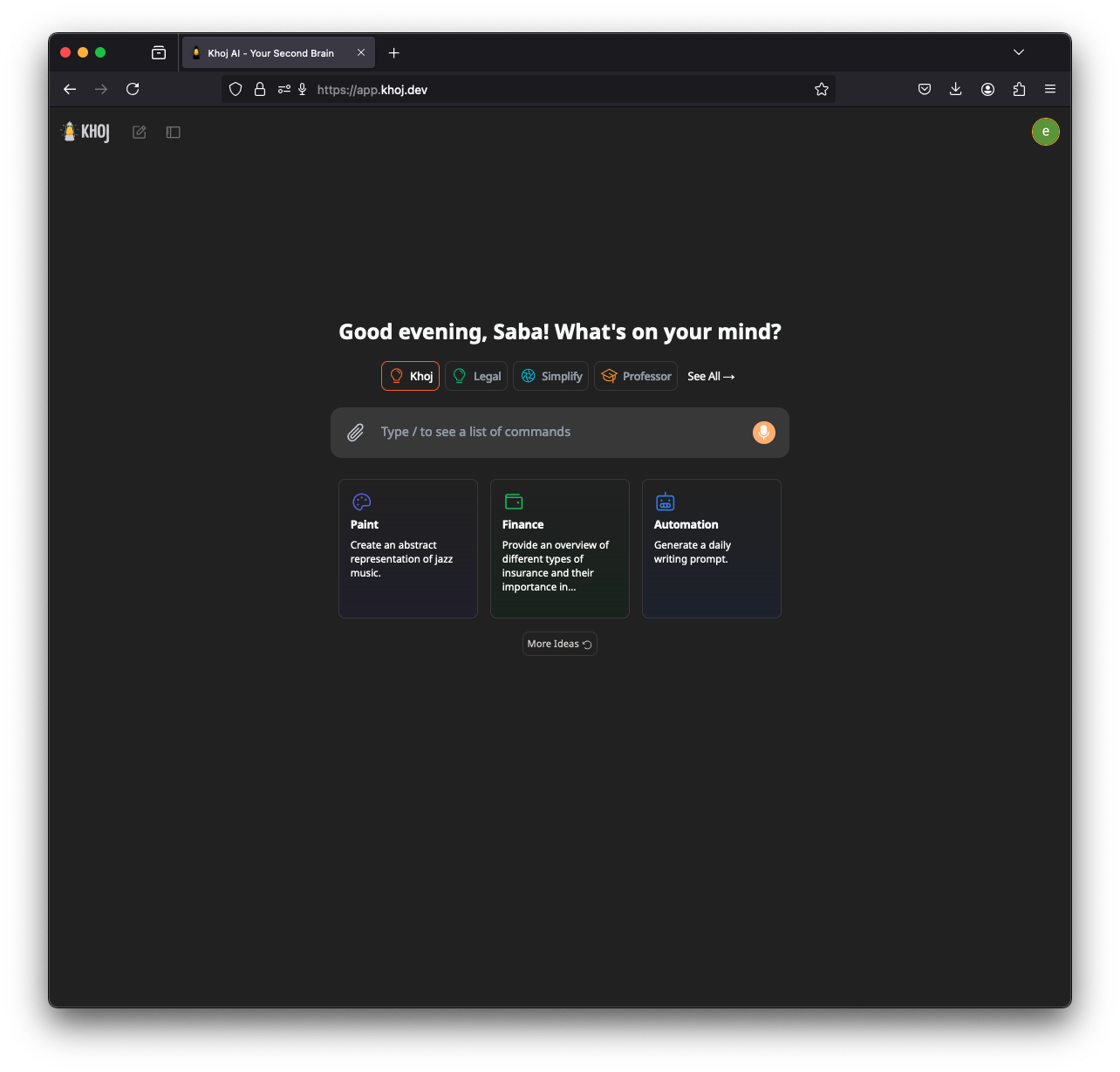
Khoj searches notes and documents, answers questions and schedules research. The open-source assistant can be self-hosted, but a local installation does not automatically keep all data traffic local.
What this is about
Khoj, from Khoj Inc., is a usable AI assistant for people whose knowledge is scattered across notes, PDFs and other documents. Instead of copying files into a new chat for every question, users can connect their own knowledge base. Web research, configurable agents and scheduled tasks extend that foundation. Users can start with a web application or run their own installation.
This tool check is based on product pages, documentation and the public repository retrieved on October 25, 2026. It describes an existing tool, not a new model launch. We did not perform an installation test or measure answer quality. Khoj is particularly interesting for people who want to combine document search with a model connection they can choose themselves.
What Khoj actually does
The search documentation describes two steps. One model converts document passages and search queries into numerical representations of their meaning. Khoj uses these to find relevant passages. Another model then reranks the results. This searches for related meaning rather than just identical words. Retrieved content can provide context for a language model's answer.
The project lists PDF, Markdown, plain text, Org-mode and Notion among its data sources. Files can be uploaded through the web interface; clients for Obsidian, Emacs and desktop can synchronize documents. The selected connection therefore also determines which content arrives. A folder on a hard drive does not become part of the knowledge base simply because Khoj has been installed.
Local or external models can be configured for answers. The installation guide describes connections to Ollama and commercial model APIs, among other options. Configurable agents add their own knowledge collections, roles and tools. Automations run queries at scheduled times and can deliver results by email. According to the documentation, self-hosted installations need additional authentication and a Resend configuration for this email route.
Why it matters
The practical value is in connecting existing material to a reusable search and conversation interface. People who regularly move between project notes, manuals and public information can build a connected research workflow. That is more concrete than adding another chatbot that lacks the background at the beginning of every session.
The research paper Retrieval-Augmented Generation for Knowledge-Intensive NLP Tasks explains the general approach of combining language generation with retrieved information. It is an academic background source, not an independent test of Khoj. Its results therefore cannot establish an accuracy rate for this product.
Our editorial usefulness rating is 8 out of 10: document connections, several access methods and self-hosting provide a clear use case. Setup effort and the need to verify answers prevent an unqualified recommendation. Someone who only occasionally wants to summarize a single file does not necessarily need a dedicated service for that task.
In plain language
Think of Khoj as an assistant in a study. It knows the labeled folders, retrieves relevant pages and writes an answer from them. The language model is the person writing; document retrieval is the act of reaching onto the shelf. If the necessary page is not on that shelf, or the wrong folder is selected, even a fluent answer can miss the actual problem. Checking the original remains important.
A practical example
A fictional freelance project consultant starts with 20 non-confidential documents: 12 project notes and 8 publicly available manuals. Before importing them, he writes down 10 questions with known answers. These include five straightforward factual questions, three comparisons between documents and two questions whose answers are deliberately absent. These numbers describe a proposed test, not measured product performance.
After importing the documents, he asks which note records a particular approval and how two described procedures differ. He checks the answers directly against the original passages. For the unanswerable questions, he watches whether the assistant acknowledges the gap in its knowledge. Only then does he expand the collection or configure recurring research.
The test record also includes the selected chat model, search configuration and enabled external services. That makes it possible to distinguish whether an improvement came from better documents, different retrieval or a model change. The next useful step is therefore a limited document test, not immediately uploading an entire personal archive.
Scope and limits
- Retrieved results do not guarantee truth. Missing, poorly extracted or outdated content can lead to incorrect answers. The documentation also notes that multilingual search may require a different model configuration. People working primarily with German documents should test precisely that material.
- Self-hosted does not automatically mean offline. The privacy documentation says relevant document passages may be sent to an external model provider. The project also describes usage telemetry and a self-hosting opt-out. Local operation requires checking the search model, chat model and other enabled services as well.
- Open source does not remove operating work or costs. The repository specifies AGPL-3.0. Hardware, maintenance and possibly external APIs require effort or expenditure; cloud plans are separate. This check deliberately avoids quoting an unverified current monthly price. License obligations should be checked before deploying a modified version.
The hero image is an official documentation screenshot of the web interface, not evidence of the current appearance of every installation.
SEO & GEO keywords
Khoj, Khoj Inc., AI assistant, document search, semantic search, self-hosting, Obsidian, Ollama, Retrieval-Augmented Generation, AGPL-3.0
💡 In plain English
Khoj helps you find answers in your own notes and documents. You can run the service yourself and choose the model it uses. You should still verify its answers and where data travels.
Key Takeaways
- →Khoj combines document search, chat, agents and scheduled research.
- →The web interface and clients offer different ways to access the knowledge base.
- →Both local and external models can be connected.
- →Self-hosting alone does not prevent data transfers to external services.
- →A small test with known answers is more useful than an immediate full import.
FAQ
Is Khoj a language model of its own?
No. Khoj is an application that connects search models, documents and selectable language models.
Does self-hosting keep all data local?
Not automatically. External model APIs and other services may receive data; the documentation also describes usage telemetry that can be disabled.
How should I start a useful test?
Import a few non-confidential documents and ask questions with known answers. Check results against the originals and also test questions the collection cannot answer.
Sources & Context
- Khoj – offizielle Produkt- und Unternehmensseite
- Khoj Inc. – Terms of Service und Anbieterangaben
- Khoj – offizielles Repository und AGPL-3.0-Lizenz
- Khoj – Self-Host
- Khoj – Search
- Khoj – Privacy
- Khoj – Automations
- Lewis et al. – Retrieval-Augmented Generation for Knowledge-Intensive NLP Tasks
- Khoj – offizieller Screenshot der Weboberfläche