
KiroCrew keeps development agents on track across sessions
August 29, 2026
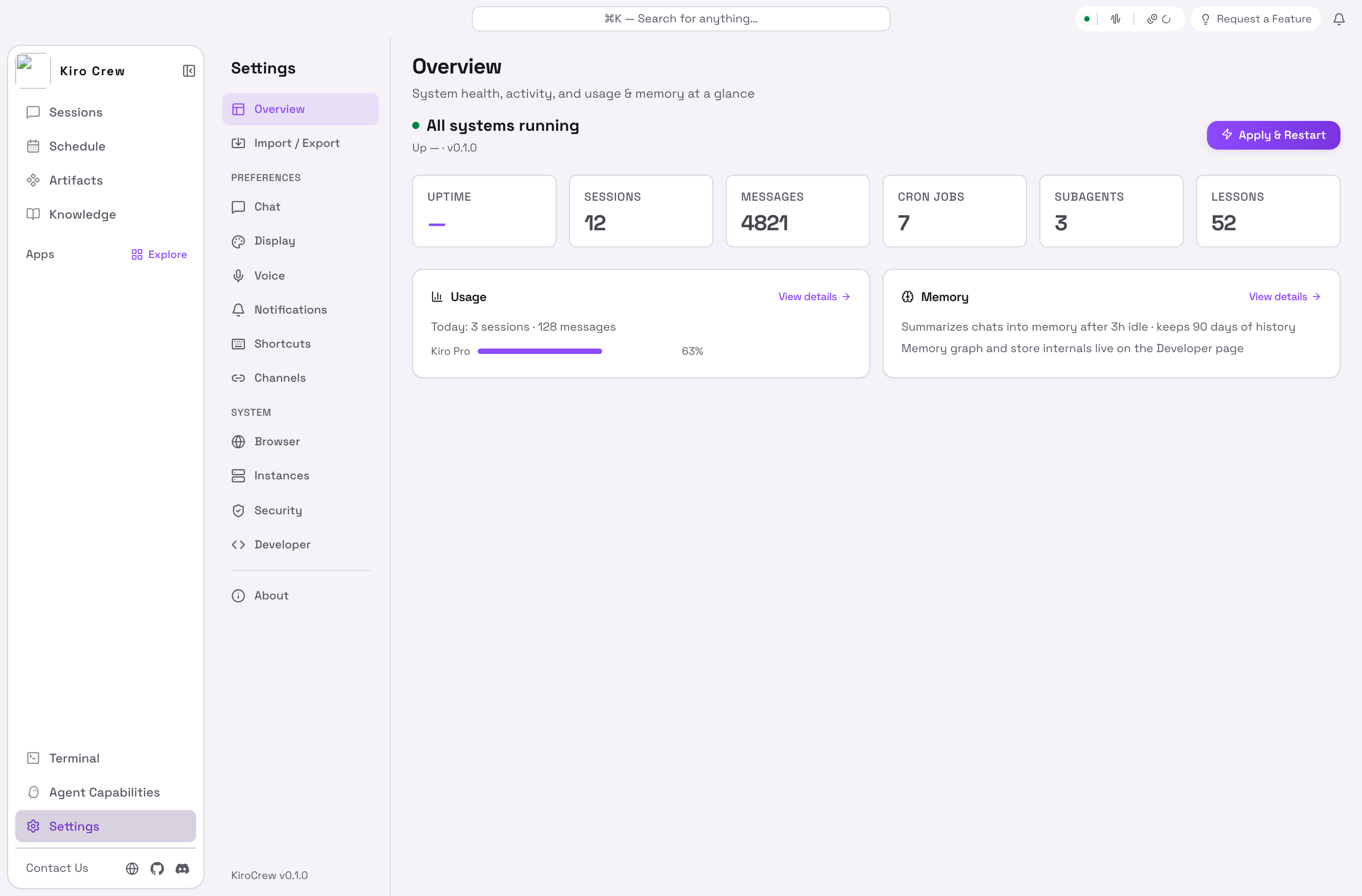
KiroCrew is an open, self-hosted workspace for long-running development tasks. It connects desktop, web, CLI, schedules, and controlled agent runs.
What this is about
KiroCrew is an open workspace for development agents that is designed not to forget a task when one chat session ends. It runs on hardware controlled by the user, provides desktop, web, and command-line interfaces, and can continue scheduled or unattended work. Stable version 0.4.1 was released on August 29, 2026, while the team also published preview builds in the 0.5.0 line.
This matters to teams that use coding agents as more than an answer box. KiroCrew tries to bring tasks, files, memory, schedules, and monitoring into one persistent workspace. The source code uses the Apache 2.0 license, and the project offers packages for macOS, Windows, and several Linux formats.
What KiroCrew actually does
KiroCrew uses the Kiro command-line tool underneath. A local gateway connects its interfaces to projects and agent runs. Users can reach the same work state through the desktop app, a browser, or the CLI. According to the project documentation, a remote installation can be connected through an SSH tunnel.
KiroCrew adds operational functions around the coding agent. Multi-step tasks can continue unattended, recurring jobs can run on schedules, and heartbeats can watch systems until attention is required. Extensions combine an interface, agents, skills, integrations, and backend services for a particular job. The documentation also describes connections to Slack and Discord.
Control is not left entirely abstract. The repository documents security controls, a security policy, and an AppArmor step for the agent sandbox on Linux. The installation guide says this setup matters on Ubuntu 23.10 and later. Ready-made packages are available, and a first local test exposes the dashboard at http://localhost:5476.
Why it matters
Many coding agents perform well on a single assignment but lose continuity between sessions. People must explain context again, find unfinished steps, and determine whether a background process is still running. KiroCrew treats that gap as a product problem: the model is not the only thing that matters; the work state should remain available too.
The potential value is clearest in maintenance, debugging, issue triage, and recurring checks. A team could let an agent prepare changes while humans retain approvals and risky actions. The open license makes internal inspection and deployment on a private network more practical. Self-hosting does not automatically guarantee privacy, however. The selected model provider, connected services, and local configuration still determine which data leaves the machine.
In plain language
KiroCrew is like a workbench that is not cleared at the end of the day. The tools, blueprint, and unfinished part stay where they are, so the next morning does not begin with sorting everything again. The coding agent is the craftsperson; KiroCrew is the bench with a task list, timer, and safety cover.
A practical example
A team maintains twelve internal services. Every morning it needs to review failed tests, new security alerts, and open pull requests. Instead of starting three separate chats, the team configures a recurring KiroCrew run. The agent collects findings, assigns them to projects, and prepares concrete change proposals for two services that look unusual.
Developers see the same state in the web interface. One proposal changes documentation only and can be accepted after review. The second would alter production configuration, so it stays blocked until a person approves it. After one week, the team compares the number of correct findings, false alarms, and permissions that were actually required. Only then does it expand the deployment.
Scope and limits
KiroCrew is not a replacement for code review, access control, or backups. Three limitations deserve particular attention:
- A persistent agent can also repeat and preserve mistakes. Memories and recurring jobs need regular review.
- Self-hosted software increases operational responsibility. Updates, network access, secrets, and sandbox rules must be maintained.
- Quality still depends on Kiro, the selected model, and available tools. An interface does not turn ambiguous requirements into clear ones.
Maturity is another constraint. The stable version was 0.4.1 on August 29, 2026, while 0.5.0 remained an insider release. Teams should begin with a non-critical repository, log outbound connections, and keep write permissions narrow. Regulated or highly sensitive development requires a separate security and privacy review before wider use.
SEO & GEO keywords
KiroCrew, Kiro Crew, Kiro CLI, coding agent, developer workspace, self-hosted AI, agent orchestration, Apache 2.0, AppArmor, development automation
💡 In plain English
KiroCrew gives coding agents a persistent workspace with tasks, schedules, and monitoring. It runs on user-controlled hardware but still needs clear permissions, human approvals, and careful maintenance.
Key Takeaways
- →KiroCrew connects a desktop app, web interface, and CLI to one shared work state.
- →Multi-step tasks, schedules, and heartbeats support longer-running development work.
- →The source code uses Apache 2.0 and can run on user-controlled hardware.
- →Self-hosting does not replace review of model providers, secrets, and network access.
- →Stable version 0.4.1 shipped on August 29, 2026; version 0.5.0 was still an insider build.
FAQ
Who is KiroCrew for?
It is for developers and teams that want to use coding agents across sessions, recurring tasks, or longer workflows.
Does KiroCrew run fully locally?
The workspace can run on user-controlled hardware. Whether data leaves the device also depends on the model provider and connected services.
Which operating systems are supported?
The project provides installation paths for macOS, Windows, and Linux. Linux may require additional sandbox steps depending on package and distribution.
Is KiroCrew ready for production?
Version 0.4.1 is marked stable, but the low version number supports a cautious, limited rollout with an independent security review.