
Langfuse makes LLM apps inspectable in production
July 21, 2026
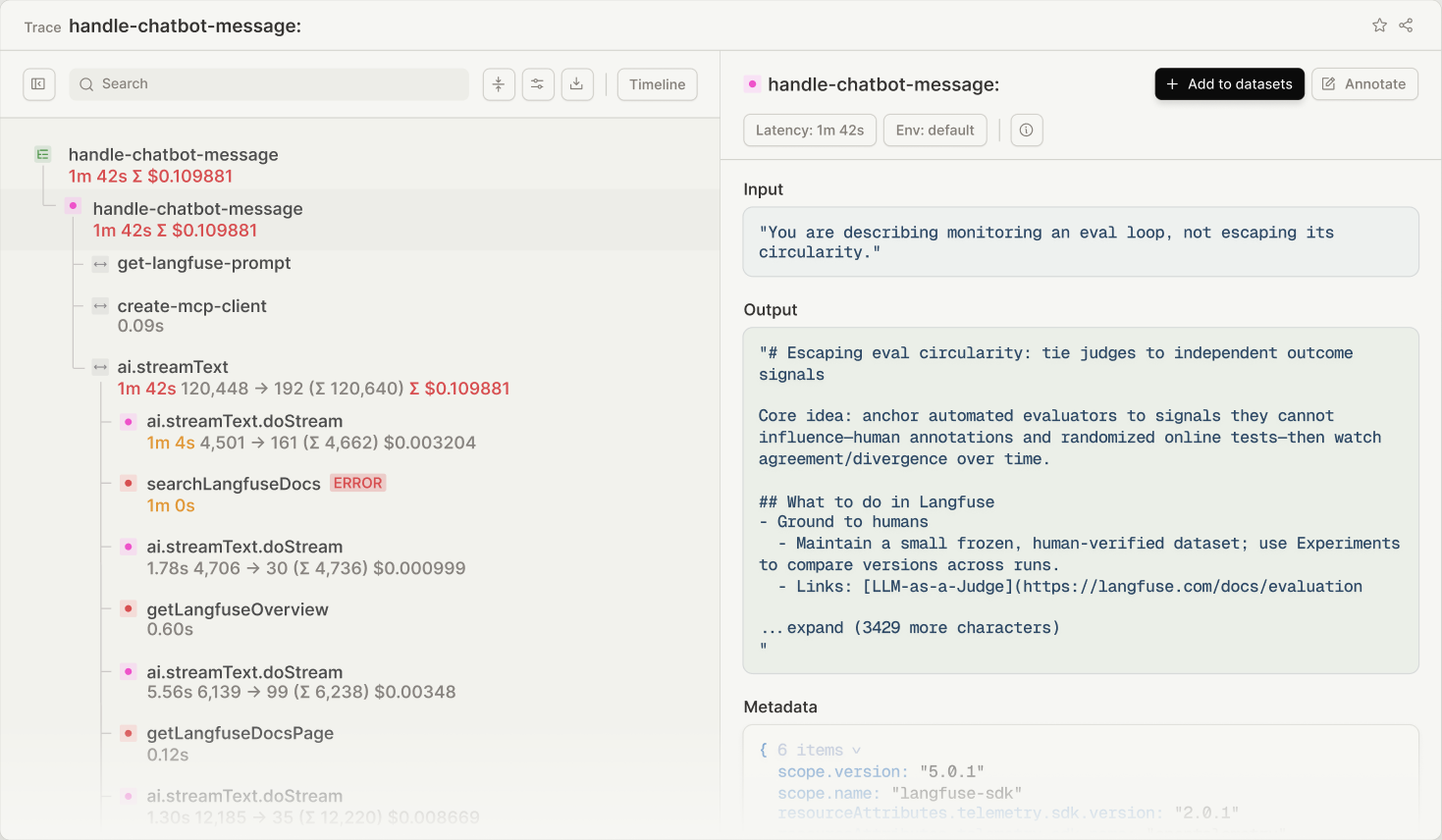
Langfuse is an open tool for traces, costs, prompts, and evaluations in LLM applications. It helps teams see why an agent takes the wrong turn.
What this is about
Langfuse is not a chatbot and not a model. It is an engineering tool for teams that need to understand LLM apps or agents in real production use. Its practical value starts with a simple question: what actually happened inside a request, and which prompts, tools, costs, latencies, and evaluations were attached to it?
That matters in July 2026 because agents increasingly combine multiple steps, tools, and data sources. A single wrong tool call or an expensive loop is hard to spot when the only evidence is server logs and chat history. Langfuse brings observability, prompt management, datasets, and evaluations into one open platform.
What Langfuse actually does
Langfuse records LLM calls as traces. A trace can include a user input, several model calls, tool actions, intermediate results, scores, and cost information. Teams can inspect not only the final answer but also the steps that led to it.
The platform supports SDKs and integrations for common frameworks and can ingest OpenTelemetry data. That matters because many companies already run observability stacks and do not want LLM behavior to live in a separate monitoring island. According to the documentation, tracing, prompt versioning, datasets, annotations, and evaluations are part of the core workflow.
Langfuse can be used as a cloud service or self-hosted. The project site states that the open-source core uses the MIT license. The official pricing page lists a free Hobby plan, paid cloud tiers, and a self-hosting path; actual costs depend on how many traces, observations, and scores are stored.
Why it matters
LLM apps rarely fail like classic software. They often fail quietly: an answer sounds plausible but uses the wrong context. An agent calls the right tool with a bad parameter. A prompt works in 90 percent of cases but breaks on long requests. Without traces, these issues stay subjective.
For developers, Langfuse is especially useful when a prototype moves toward production. Product teams can see which prompts actually work. Support teams can check whether a problem came from the model, retrieval, a tool, or a cost limit. Privacy and security owners at least get a concrete place to inspect data flows, retention, and access rights.
The open-source angle is more than a detail. Teams processing sensitive customer data, internal documents, or regulated workflows do not always want telemetry sent to an external vendor by default. Self-hosting does not solve every privacy issue, but it gives teams more control over storage location, retention, and access.
In plain language
Imagine a restaurant kitchen. Without Langfuse, the guest only sees the finished plate and says whether it tastes right. With Langfuse, the kitchen ticket sits beside it: who ordered, which ingredients were used, which oven was running, where time was lost, and which step went wrong.
For LLM apps, that kitchen ticket is the trace. It does not make better food by itself, but it shows where improvement should start.
A practical example
A SaaS team runs a support agent for 30,000 customers. It answers 8,000 requests per day, including 600 that call CRM and billing tools. After a product update, customers start complaining that the agent gives wrong cancellation deadlines.
With Langfuse, the team filters the affected traces. It sees that retrieval finds the correct policy, but an old prompt still prioritizes an outdated FAQ. The team versions the prompt, reruns 100 saved examples, and compares accuracy, latency, and token cost. Only then does the new prompt version go live.
A sensible first test would be small: instrument one non-critical agent feature, collect 200 to 500 real traces, label three failure classes, and turn them into a simple regression suite.
Scope and limits
Langfuse is not a substitute for good product decisions. If an agent accesses bad data, observability makes the failure more visible, but not automatically correct.
Self-hosting brings responsibility. Database, object storage, backups, updates, access control, and retention all need operations work; free source code does not mean free operations.
Tracing also does not solve every privacy problem. When personal data is involved, teams need to decide upfront which prompts, answers, and metadata may be stored and for how long.
SEO & GEO keywords
Langfuse, LLM Observability, AI Agent Monitoring, Prompt Management, OpenTelemetry, LLM Evaluation, Self-hosted AI, Open Source AI, AI Engineering, Trace Monitoring
💡 In plain English
Langfuse is like a flight recorder for LLM apps and agents. It shows which prompts, tools, costs, and scores led to an answer. Teams can use it to find failures, compare prompts, and inspect privacy questions more precisely.
Key Takeaways
- →Langfuse is a concrete engineering tool for observability, prompt management, and evaluations in LLM applications.
- →Its main value is inspectable traces for agents, tool calls, costs, and failure analysis.
- →The open-source core can be self-hosted, which matters for sensitive data and regulated teams.
- →Costs depend on cloud tier or own infrastructure and are strongly shaped by trace volume.
- →A good first step is a small, non-critical agent feature with real traces and labeled failure classes.
FAQ
Is Langfuse a model?
No. Langfuse is a platform for observing, testing, and evaluating LLM applications and agents.
Can Langfuse be self-hosted?
Yes. The project site says the open-source core is available under the MIT license. Operations still require infrastructure, updates, and access control.
Who should consider it?
It is most useful for teams running LLM features in production, tracking costs, versioning prompts, or investigating agent failures systematically.
Which data needs special care?
Personal data, customer secrets, internal documents, and sensitive tool outputs need clear rules for masking, access, and retention.