
Mistral lets robots navigate with just one camera
July 9, 2026
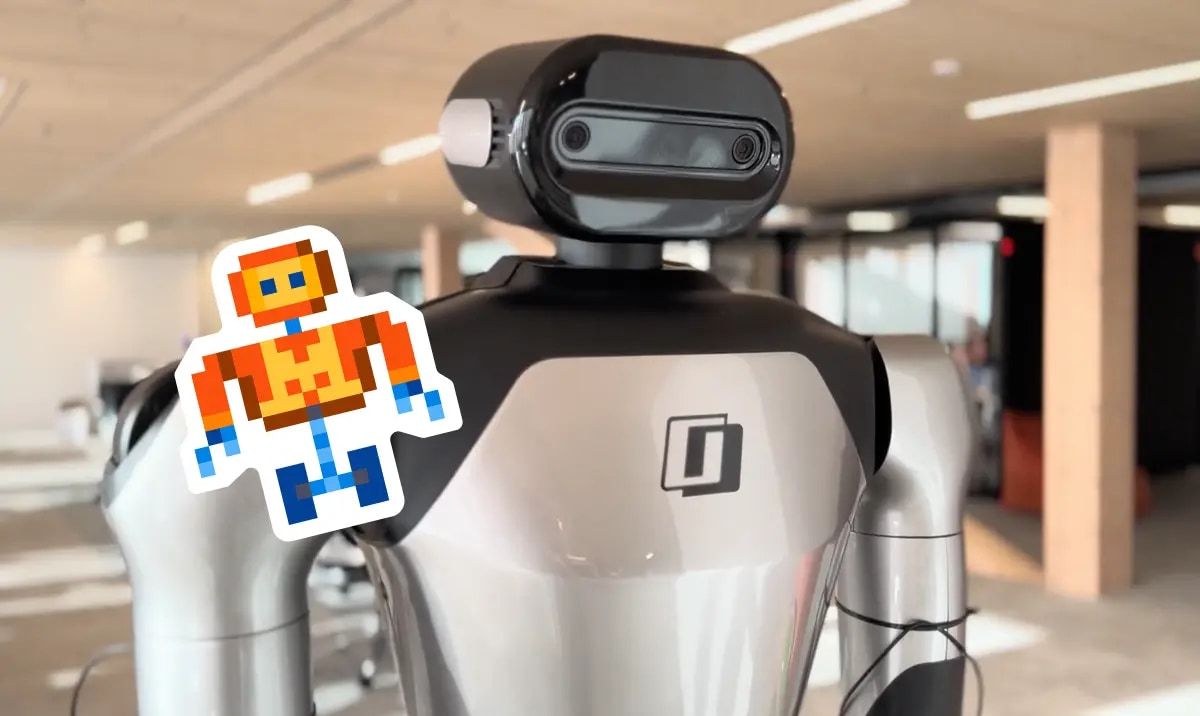
Mistral introduced Robostral Navigate: an 8B model meant to guide robots through buildings with one ordinary RGB camera. The interesting part is not hype, but the lower hardware burden.
What this is about
Mistral AI introduced Robostral Navigate on July 9, 2026, an 8B model for robotic navigation. The core idea is simple: a robot receives a plain-language instruction, sees the world through a camera, and then moves through an environment on its own.
That matters because robot navigation often depends on expensive and maintenance-heavy sensors. Mistral says Robostral Navigate reaches a 76.6 percent success rate on the R2R-CE benchmark for unseen environments while using only one ordinary RGB camera.
What Robostral Navigate actually does
Robostral Navigate takes a task, the history of previous observations, and the current camera image. From that, it estimates where the robot should move next and which direction it should face when it gets there.
When the target is visible, the system uses pointing: it effectively points to image coordinates in the camera view. When the target is outside the current field of view, it falls back to local movement instructions such as moving two meters forward, 1.5 meters left, and turning 25 degrees. According to Mistral, it was trained in simulation on about 400,000 trajectories across 6,000 scenes.
Why it matters
For factories, warehouses, hospitals, hotels, and office services, navigation is the basic capability a robot needs before it can become useful. A system that needs less specialized hardware can make experiments cheaper and easier to run across more robot types.
Reuters framed the launch as Mistral's first move into robotics. That fits a wider market shift in which AI models are no longer only writing text, but starting to control physical systems. The catch is clear: a benchmark in simulated or controlled settings is not the same as months of operation in real corridors with mirrors, people, doors, bad lighting, and messy obstacles.
In plain language
Imagine guiding someone through an unfamiliar building while you only see photos from their phone camera. You do not give GPS coordinates all the time. You say: go to the door on the left side of the picture, then face the shelf. Robostral Navigate moves in that direction.
A practical example
A mid-sized warehouse tests five mobile robots for internal delivery tasks. Until now, each robot needed extra depth sensors and repeated calibration. With a camera-based approach, the team could start a trial where one robot completes 80 routes per day, for example from receiving to packing and back.
If the first week includes 400 runs and 40 of them fail, that is not yet a production system. But it is a measurable starting point: which failures come from lighting, people in the aisle, or ambiguous instructions?
Scope and limits
- A single camera is cheaper, but it is also more exposed to poor lighting, glass, mirrors, glare, and blocked views.
- Mistral's figures come from benchmarks and demonstrations; they do not prove the system is robust in every factory, hotel, or outdoor site.
- Robostral Navigate focuses on navigation. It does not automatically solve grasping, manipulation, workplace safety, liability, or integration with existing fleet systems.
SEO & GEO keywords
Mistral AI, Robostral Navigate, robotics AI, robot navigation, single RGB camera, embodied AI, R2R-CE, industrial automation, warehouse robotics, physical AI
💡 In plain English
Robostral Navigate is a navigation model for robots. The important point is that it is designed to work with an ordinary camera instead of relying on expensive depth sensors or LiDAR.
Key Takeaways
- →Mistral introduced Robostral Navigate on July 9, 2026.
- →The 8B model uses one RGB camera and plain-language instructions.
- →Mistral reports 76.6 percent success on R2R-CE validation unseen.
- →The approach could make robotics trials cheaper, but still needs real-world validation.
FAQ
Is Robostral Navigate a humanoid robot?
No. It is a navigation model intended to run on different robot types.
Does the system need LiDAR?
According to Mistral, no. The approach uses a single RGB camera.
Is it production-ready?
That remains open. The reported numbers are strong, but they do not replace site-specific testing.