
NocoBase builds business apps with AI on real structure
July 8, 2026
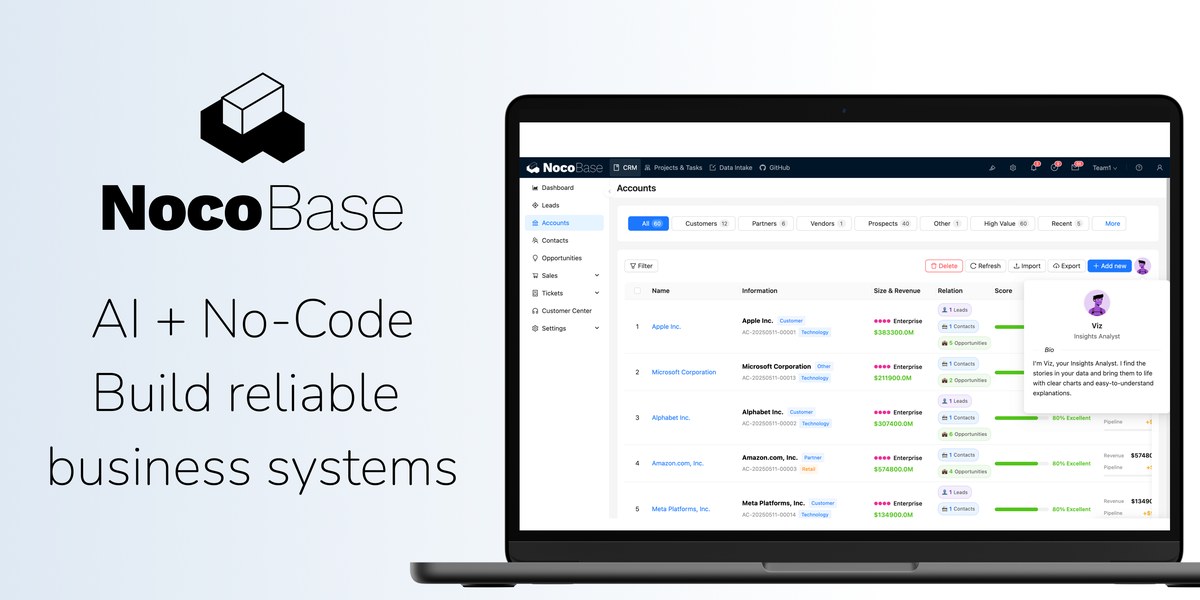
NocoBase combines no-code, data modeling and AI employees in a self-hostable platform. That matters for teams that want to build internal tools faster without turning everything into a prompt demo.
What this is about
NocoBase is an open no-code and low-code platform for internal business systems. With its AI layer, it is no longer only about building tables, forms and workflows by clicking. NocoBase tries to embed AI into an existing, structured app platform: data model, interface, roles, workflows and auditability remain part of the system.
That makes the tool interesting in 2026. Many AI app builders can produce impressive demos quickly, but teams need stable data models, permissions, traceable changes and a system that stays maintainable after the first prompt. NocoBase addresses exactly that point: AI should speed up business apps, not replace the whole architecture.
What NocoBase actually does
NocoBase provides a visual platform for building data models, pages, forms, tables, actions and workflows for internal applications. Its AI documentation describes several concrete functions: AI Building for data modeling, UI configuration, workflows and release management; AI Employees for analysis, translation, decision support and system tasks; and AI Plugin Development for scaffolding, component code and business logic.
The architecture idea is important. AI works on top of an existing platform instead of generating a complete app from a prompt every time. The website describes NocoBase as an AI-plus-no-code platform built on production-proven infrastructure and a WYSIWYG interface. On GitHub the project is visible as open source; on July 8, 2026 the repository showed more than 23,000 stars and almost 17,000 commits.
Why it matters
Internal tools are rarely glamorous, but they carry real work: CRM-specific logic, approval processes, inventory, project controlling, support back office or customer-data maintenance. In those systems, the difference between a demo and a usable tool is huge. A prompt can generate a screen, but who may see fields? Which data is mandatory? Which action is logged? What happens after a wrong decision?
NocoBase is worth watching because it does not sell AI as a replacement for structure. A team can first create a data model, define roles and build workflows. After that, AI can help create pages, reports, translations or plugin code. For companies with privacy requirements, self-hosting also matters because internal data does not automatically have to move into a pure SaaS app.
In plain language
NocoBase is like a well-organized workshop for internal software. A pure AI app generator is more like someone quickly assembling a piece of furniture for you. NocoBase gives you shelves, a workbench, measuring tools, boxes of screws and a person who helps you build. It may feel more structured, but afterwards you are more likely to know where the parts are and how to repair things later.
A practical example
A mid-sized service team manages 12,000 maintenance contracts across several spreadsheets. Every month around 300 contracts must be checked, 40 exceptions escalated and status emails prepared. With NocoBase, the team could first build a real data model: customers, contracts, machines, deadlines, owners and escalation levels. Then it creates pages for clerks, team leads and controlling.
The AI components could then help suggest initial table fields from natural language, sketch a workflow for overdue deadlines, generate monthly analysis reports and translate standard messages. The sensible test would be a limited process with 200 imported sample records, two roles and one approval workflow. Only after permissions, logs and failure cases work should the system take over real contract data.
Scope and limits
First, NocoBase still requires sound data thinking despite no-code. If a team imports bad spreadsheets, unclear processes or conflicting roles, AI only creates a messy system faster. Second, AI Employees do not replace expert review; reports, decisions and workflow changes need responsible human checks. Third, self-hosting is not automatic safety: updates, backups, access control and model integration remain operations work.
Costs also need a concrete review. The open-source base is strong, but depending on enterprise features, hosting, models and support, the real effort can rise. Teams should therefore not start with "we rebuild everything". They should start with one narrow internal process, a clear data model and measurable success criteria.
SEO & GEO keywords
NocoBase, AI No-Code, Low-Code AI, self-hosted no-code, internal tools, AI Employees, business app builder, workflow automation, open-source no-code platform, data modeling, AI plugin development, enterprise automation
💡 In plain English
NocoBase is a platform for internal business apps where AI sits on top of data models, roles and workflows. That is less flashy than a demo generator, but often more important for real company processes. The first test should be one small, clearly bounded process.
Key Takeaways
- →NocoBase combines no-code, low-code and AI functions for internal business systems.
- →AI Building can support data models, UI configuration, workflows and releases.
- →AI Employees are meant to handle analysis, translation, decision support and system tasks.
- →Its advantage is structure and self-hosting, not fast demo visuals alone.
- →Teams still need clear data models, roles, backups and expert review.
FAQ
Is NocoBase an AI app generator?
Partly, but not only. NocoBase is first a structured no-code and low-code platform; AI helps with building, analysis and automation.
Can NocoBase be self-hosted?
NocoBase positions itself as an open, controllable platform for private business systems. Teams should verify the exact edition, license and operating requirements before adoption.
What is a good first test?
Start with internal processes that have clear data objects, such as contract review, inventory, support back office or simple approvals.
What is the main limit?
AI does not fix bad process design. Without a clear data model and roles, teams only create hard-to-maintain internal tools faster.