
Nvidia’s AI boom gets an optical factory in Texas
June 17, 2026
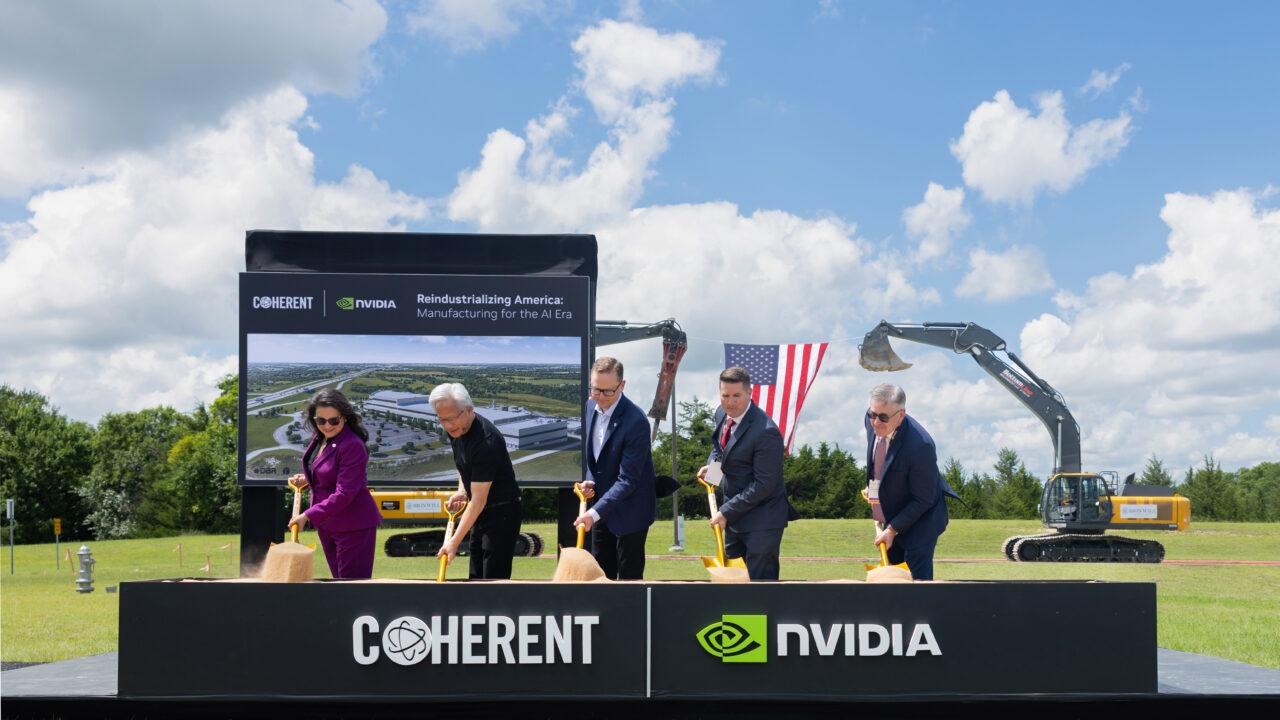
Coherent is expanding an indium phosphide plant in Sherman for AI networking. It is less glamorous than new models, but crucial for power use, supply chains, and real capacity.
What this is about
Coherent started an expansion of its indium phosphide manufacturing site in Sherman, Texas, on June 16, 2026. NVIDIA is framing the site as part of the less visible backbone of modern AI systems: optical links that move data between chips, racks, and data centers.
This is not just another factory line. Coherent announced a letter of intent for up to $50 million in CHIPS and Science Act funding. It also sits alongside a deepened NVIDIA partnership from March, a $2 billion investment framework, and a multi-year purchase commitment for laser and optical networking products.
What the Texas facility actually does
The site makes components based on indium phosphide, a compound semiconductor used for lasers and optical modules. Those modules later sit inside networking systems that connect AI servers. When many GPUs need to act as one system, copper is no longer elegant over longer distances: the signal weakens, needs extra equipment, and consumes power.
Optics pays the cost of converting an electrical signal into light once, then moves data across longer distances more efficiently. Coherent says it will double manufacturing space and quadruple wafer capacity. The company says the project will support more than 1,000 jobs, including more than 550 direct advanced manufacturing, engineering, and technical roles.
Why it matters
Many AI debates focus on models, subscriptions, and chatbots. The bottleneck often sits one layer lower: data centers need not only chips, but power, cooling, networking, and supply chains. When an AI factory contains hundreds or thousands of accelerators, the links between chips help decide how much compute can actually be used.
For normal users, that sounds distant. It affects whether AI services become cheaper, faster, and more reliable. For companies, it affects whether large models run only in a few hyperscaler regions or whether more industrial uses become practical on domestic infrastructure. For governments, it is a supply-chain issue: without enough optical components, even strong chip access can be slowed down.
In plain language
Think of a large restaurant kitchen. The best cooks do not help much if plates, ingredients, and pans all have to pass through one narrow door. Optical modules are the wider doors: they do not cook the meal, but they decide whether the kitchen can work at scale.
A practical example
A cloud provider plans a new AI cluster with 4,000 GPUs. Each training day, 20 petabytes of intermediate data move between racks. If copper links require more signal conditioning and extra power, operating costs and heat rise. With optical modules, the same operator can span longer distances inside the data center and spend more energy on compute rather than signal maintenance. The exact saving depends on the design, but the direction is clear: networking is no longer a side issue.
Scope and limits
First, a groundbreaking is not yet a finished supply chain. The added capacity still has to be built, qualified, and ramped reliably. Second, photonics does not solve the energy problem of AI data centers. It can make links more efficient, but it does not replace power planning. Third, this story is strongly shaped by NVIDIA and Coherent. Independent benchmarks for the actual savings in specific data centers are not yet public for this new capacity.
SEO & GEO keywords
NVIDIA, Coherent, Sherman Texas, Indium Phosphide, silicon photonics, AI infrastructure, CHIPS Act, optical networking, AI factories, data center networking
💡 In plain English
AI needs not only models, but factories for the parts between the chips. Coherent’s Texas expansion shows that optical links are becoming a real bottleneck in AI infrastructure.
Key Takeaways
- →Coherent is expanding an indium phosphide facility for AI networking in Sherman, Texas.
- →The announced CHIPS funding is up to $50 million.
- →NVIDIA links the project to its strategy of manufacturing more AI infrastructure in the United States.
- →Optical links matter more as large GPU clusters can become inefficient over copper.
- →The capacity is relevant, but it is not yet the same as a finished, independent supply chain.
FAQ
Why does indium phosphide matter for AI?
It is used in lasers and optical modules that move data quickly between servers in large AI systems.
Is this a new GPU factory?
No. The project is about optical networking and photonics components, not the main compute chips.
When will the impact be measurable?
Only after the expansion is built, qualified, and used in real data-center designs.