
opencodex opens Codex and Claude Code to other models
August 17, 2026
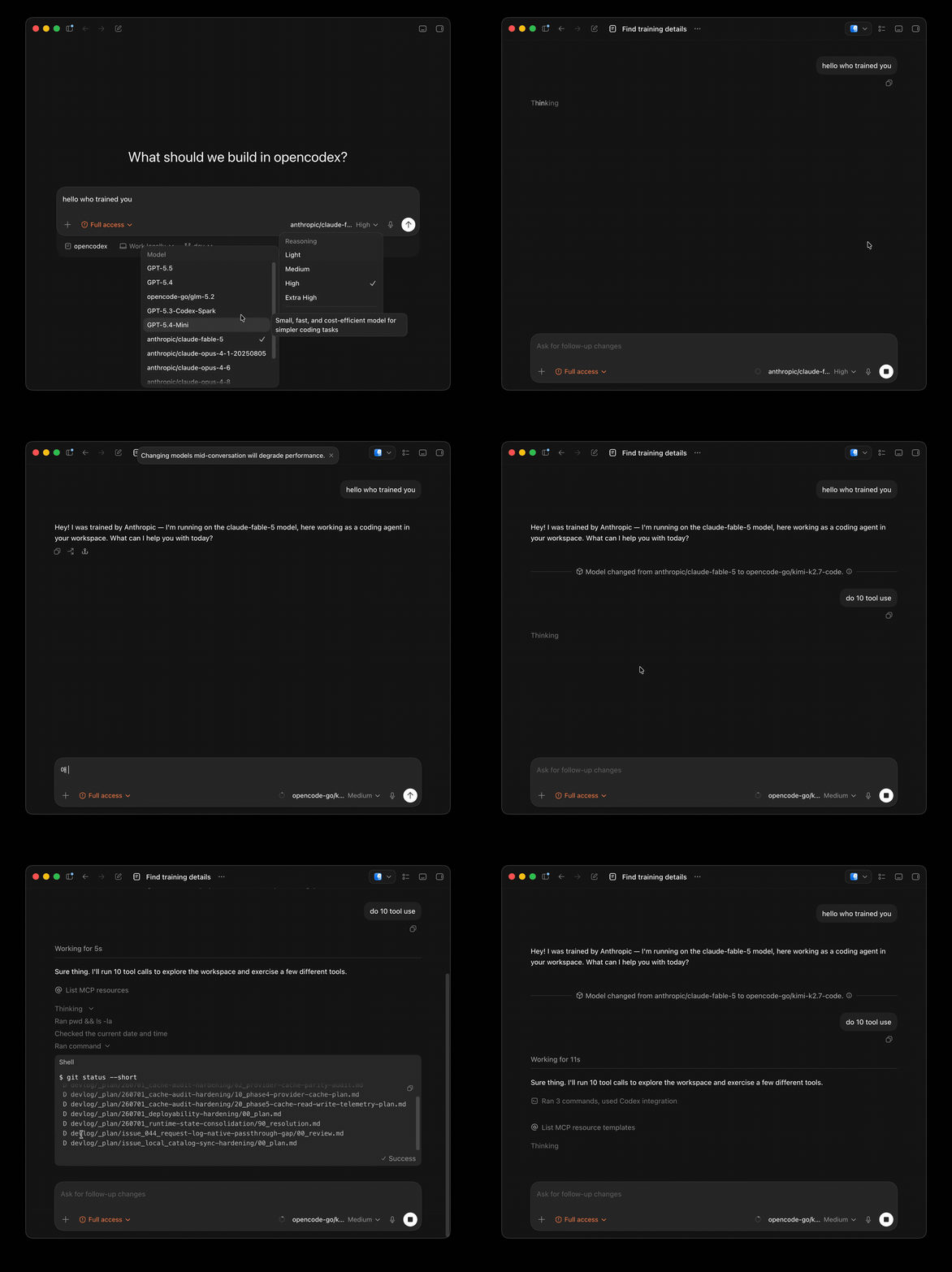
opencodex places a local translator between coding clients and model providers. Teams can connect Codex or Claude Code to more than 40 services and local Ollama models.
What this is about
opencodex is a local proxy for developers who want to keep the Codex or Claude Code interface while choosing models and providers more freely. The open-source project translates different API formats in the background. Its documentation says it supports streaming, tool calls, reasoning output, and images in both directions.
The project has been available on GitHub since June 2026 under the MIT license. Version 2.24.1 was released on August 17, 2026. The important point is not that small bug-fix release alone, but the practical use: an existing coding workflow can reach models from Anthropic, Google, xAI, DeepSeek, Kimi, OpenRouter, or a local Ollama installation without modifying the client itself.
What opencodex actually does
After installation, ocx start launches a service on the user's computer. Its dashboard is available at localhost:10100 by default. Providers, credentials, models, and routing rules are configured there. ocx init then connects the existing Codex configuration to the proxy. ocx stop is designed to restore the original configuration.
Technically, opencodex receives requests in the coding client's format and converts them into the selected provider's format. The documentation lists more than 40 preconfigured providers. OpenAI-compatible endpoints and local Ollama models can also be connected. Features called combos provide failover rules or weighted distribution across providers. A dashboard shows active requests, cache tokens, and connection status.
The tool supports macOS, Linux, and Windows and requires Node.js 18 or newer. The published npm package bundles its Bun runtime. opencodex is an independent community project and is not endorsed by OpenAI or Anthropic.
Why it matters
Coding agents often bind their interface, accounts, and models closely together. That creates switching costs for developers: a different model can require a different client, different commands, and a new workflow. opencodex separates those layers. The familiar client remains while the model becomes replaceable.
This is particularly useful for teams balancing cost, privacy, or model quality by task. Sensitive code could go to a local model, while a difficult analysis can use a selected external service. Failover rules may also help when a provider is unavailable or a quota is exhausted. GitHub's API showed about 10,600 stars and 776 forks on August 17, 2026. Those figures demonstrate interest, but they do not replace a security review.
In plain language
Think of opencodex as a travel adapter. The laptop stays the same, but the adapter connects it to different wall sockets. In the same way, the coding client remains unchanged while the proxy reshapes requests for different model services. A travel adapter does not make electricity safer, however; opencodex likewise does not automatically verify that a provider is confidential or contractually suitable.
A practical example
A five-person development team handles 30 tasks in one day. It uses a lower-cost model for 18 small changes, a more capable model for eight code analyses, and a local Ollama model for four confidential tasks. Instead of maintaining three coding clients, the team registers the providers once in opencodex and selects them through model names or routing rules.
Before production use, the team should run a limited test with a non-sensitive repository: verify installation, connect one provider, observe tool calls, inspect the request log, and then test ocx stop. Only after the configuration, costs, and data paths are understood should it move to a pilot with real tasks.
Scope and limits
First, the proxy handles credentials and code between the client and provider. This adds a community project to the trust chain. Teams should review the source code, dependencies, local file permissions, and update process.
Second, the official documentation warns that some providers may restrict traffic routed through third-party proxies in their terms of service. A technically working login is therefore not contractual approval.
Third, a shared proxy does not guarantee identical results. Models differ in tool calls, context limits, and response formats. Failover rules can also change cost or behavior unnoticed if they are not monitored. Regulated or highly sensitive projects require a privacy and security review before adoption.
SEO & GEO keywords
opencodex, Codex CLI, Claude Code, LLM proxy, model routing, Ollama, OpenRouter, coding agents, developer tools, local AI, MIT license, API translation
💡 In plain English
opencodex connects Codex and Claude Code to different AI models through a local proxy. It adds choice, but it also adds another software component to security and contract reviews.
Key Takeaways
- →opencodex translates requests from Codex and Claude Code for more than 40 providers and local Ollama models.
- →The MIT-licensed project runs locally on macOS, Linux, and Windows.
- →Routing rules can select models by task or switch when a provider fails.
- →Credentials, source code, and provider terms require review before production use.
- →A test with a non-sensitive repository is the sensible next step.
FAQ
Is opencodex an OpenAI product?
No. It is an independent community project and, according to its documentation, is neither supported nor endorsed by OpenAI or Anthropic.
Can opencodex use local models?
Yes. The documentation lists local Ollama models and OpenAI-compatible endpoints alongside many cloud providers.
Which operating systems are supported?
The official documentation lists macOS, Linux, and Windows. It requires Node.js 18 or newer, while the npm package bundles the Bun runtime.
Is its use automatically privacy-compliant?
No. The data path, provider, logging, credentials, and terms of service must be reviewed for each use case.