
Paperclip flaws expose the trust problem in AI agents
August 5, 2026
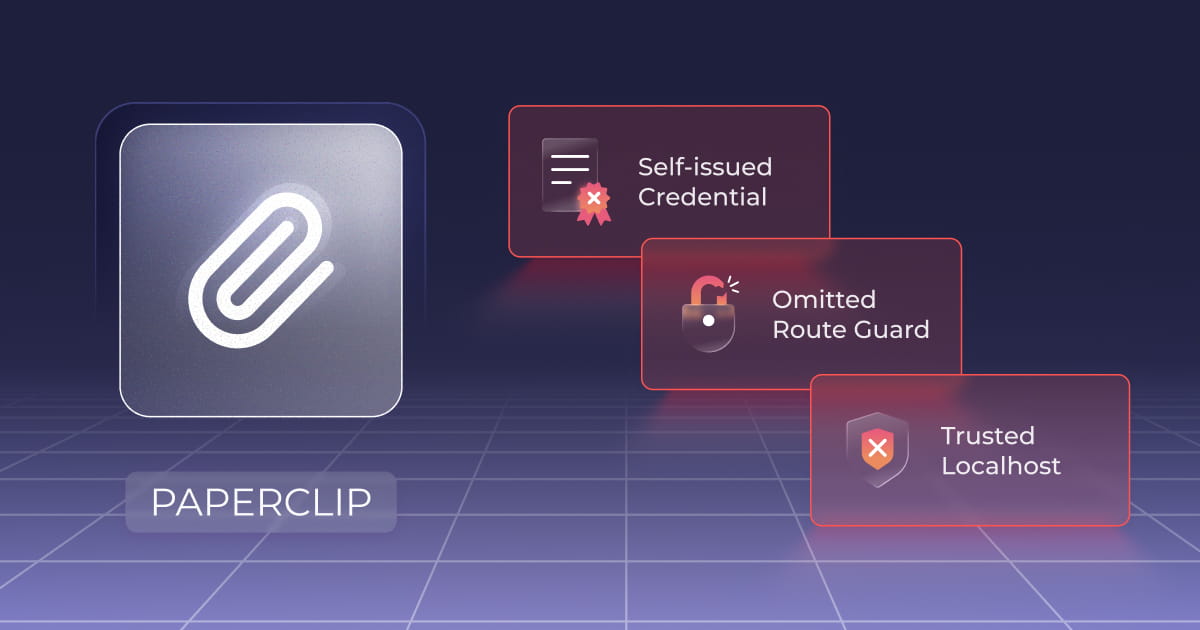
Oasis Security reports three critical Paperclip vulnerabilities. The case shows why agent configurations must be treated like executable code.
What this is about
Oasis Security described three vulnerabilities in Paperclip on August 5, 2026, including CVE-2026-41679 with a CVSS score of 10.0. This is more than a single project notice. It shows a pattern that can become dangerous across many agent platforms: what looks like configuration can ultimately decide which code runs.
Paperclip manages autonomous AI agents. Systems like this can call tools, start commands, and act on behalf of users. If an access check is too loose in one place, the damage is not always limited to data exposure. In the worst case, an attacker gets a direct path to code execution.
What Paperclip actually does
Paperclip organizes agents, companies, deployments, and executable agent configurations. A legitimate import can define which agents exist and which commands they may run through adapters. That is what makes the platform useful: teams can describe agents portably and bring them into an environment.
Oasis describes three routes to the problem. First, a self-registered user could approve their own API access and reach administrative impact through an import path. Second, sensitive API routes lacked authorization or tenant checks. Third, in local mode, DNS rebinding could break the assumption that localhost is automatically trusted.
Why it matters
Agents are not just chat windows with tools. They are becoming non-human identities that execute commands and hold access. Traditional security models often ask: who logged in? For agents, that is not enough. Teams also need to know which human delegated which intent, which agent selected which tool, and which permission reached the target system.
The Paperclip case is interesting because it does not need science fiction. Open registration, missing checks, and local services in a browser context are familiar web problems. What is new is the impact when the target system executes agent configurations.
In plain language
Imagine a hotel that lets guests print their own room keys. A second door checks whether someone has a key, but not whether they may enter that room. A back entrance trusts anyone arriving from the courtyard. If every room also contains powered tools, weak access control can quickly become real damage.
A practical example
A DevOps team tests Paperclip internally for build automation. Ten agents are supposed to review pull requests, read logs, and start small scripts. Registration stays open for a pilot. An attacker creates an account, approves API access, and imports a manipulated agent configuration with a process adapter.
When that agent is woken, the configured command runs with the privileges of the Paperclip process. On a server with access to build secrets, internal repositories, and deployment tokens, the difference between a test and an incident is only a network boundary.
Scope and limits
First, the analysis comes from Oasis Security, a vendor in the identity and agent security market. That does not invalidate the technical findings, but the framing should acknowledge that perspective.
Second, not every Paperclip installation was necessarily internet-facing or running with open registration.
Third, the case does not mean agent platforms are inherently unsafe. It shows that agent configurations must be treated like code: review, approval, isolation, and logging belong in the process.
SEO & GEO keywords
Paperclip, CVE-2026-41679, Agent Security, AI Agents, DNS Rebinding, Remote Code Execution, Authorization, Non-Human Identity, Agent Configuration, Open Source Security
💡 In plain English
Paperclip manages AI agents that can execute commands. If those agent configurations are imported without proper checks, they are not just text; they can become a launch button for real code.
Key Takeaways
- →Oasis published the analysis on August 5, 2026.
- →CVE-2026-41679 reaches CVSS 10.0 according to Oasis and can enable remote code execution.
- →Additional flaws involve missing authorization and DNS rebinding in local mode.
- →Paperclip released fixes in version 2026.416.0 according to Oasis.
- →The case highlights a core problem for agent platforms: configuration becomes executable power.
FAQ
What is Paperclip?
Paperclip is an open-source system for managing autonomous AI agents and their execution environments.
What is the main flaw?
Oasis names CVE-2026-41679 with CVSS 10.0. It combines open registration, self-approved API access, and an import path into code execution.
Why does DNS rebinding matter?
DNS rebinding can redirect browser requests so a local service on 127.0.0.1 treats remote instructions as trusted.
What should operators do?
They should upgrade to Paperclip 2026.416.0 or later, review registration settings, and treat agent configurations like code.