
ReelMimic turns reference videos into reviewable production plans
October 4, 2026
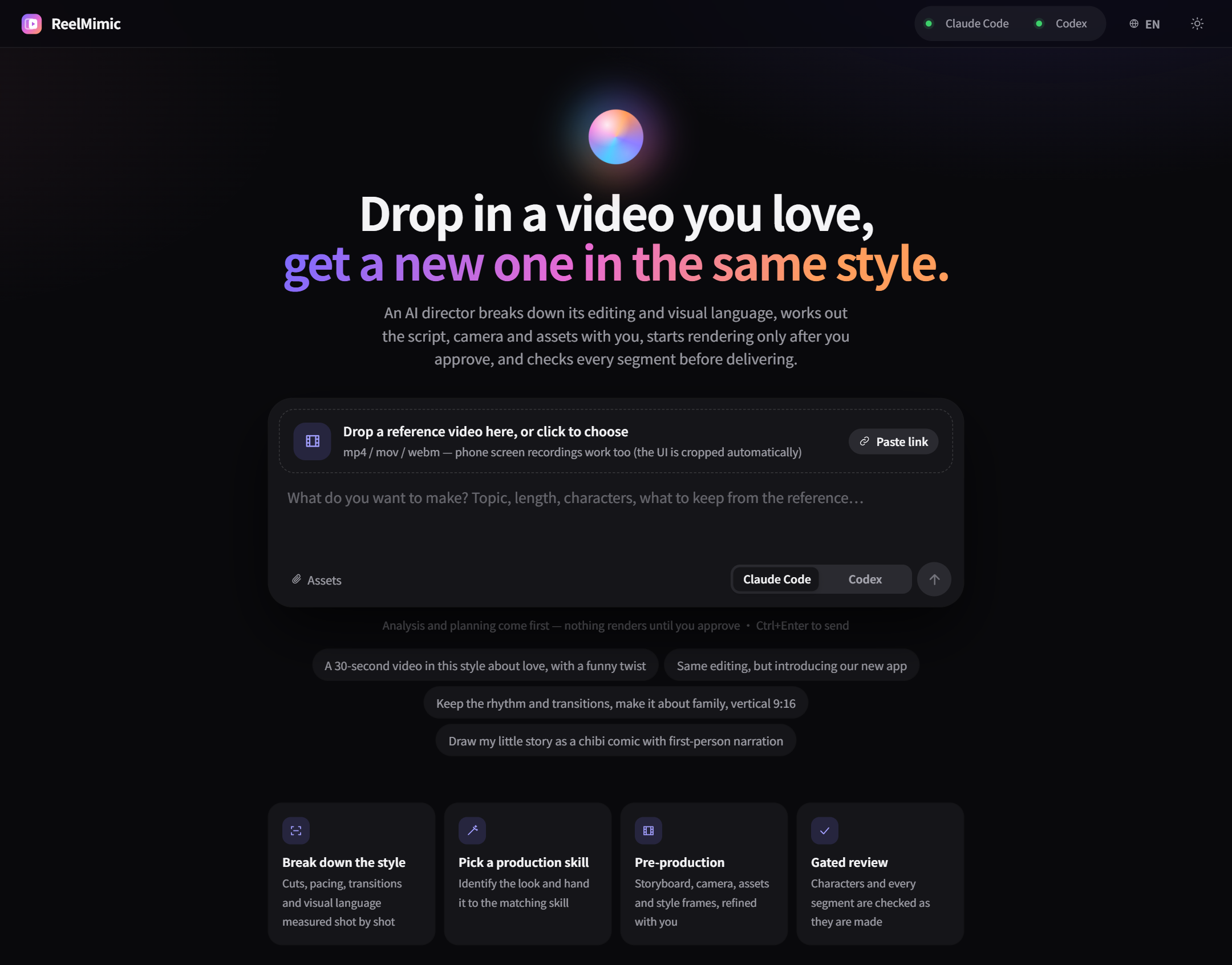
ReelMimic analyzes the rhythm and visual language of a reference video, then coordinates a local, multi-stage animation workflow with Codex or Claude Code.
What this is about
ReelMimic is a local open-source tool for animated short videos. Users provide a video file, phone recording, or YouTube link as a reference and describe the new result they want. The tool studies editing rhythm, shots, transitions, colors, and camera movement. It then creates a production plan that a person can review and change before work begins.
Created on September 28, 2026, the project uses Claude Code or Codex as its execution agent. The code is available under the MIT license. Unlike a simple text-to-video generator, ReelMimic uses a production line: planning, parallel implementation, independent review of individual shots, and correction loops.
What ReelMimic actually does
After import, ReelMimic breaks the reference into measurable design elements. These include shot count and length, tempo, transitions, composition, and color. It produces a storyboard containing characters, required assets, and style frames. Production begins only after the user approves this plan.
According to the project documentation, up to six agents can work on different sections at the same time. A completed shot is reviewed by an agent other than the one that built it. Fixes are expected to include before-and-after images so the change remains traceable. The interface exposes work steps, executed commands, and inspected frames. After rendering, users can place comments directly at a position on the video timeline.
The tool produces 2D animation only. Its styles include vector and motion graphics, watercolor, crayon, pixel art, paper cut-out, whiteboard drawing, and anime cel. Installation and operation require Node.js, Python, FFmpeg, Chrome, and a signed-in Claude Code or Codex setup.
Why it matters
With creative AI tools, the difficult part is often not the first draft but controlled revision. ReelMimic makes planning, ownership, and review visible. For a small creative team, that may be more useful than a single generation whose errors can only be corrected by starting over.
Local operation also gives users more control over project files. However, agent requests still run through the selected Claude Code or Codex account and count against its usage limits. External media remains a separate rights issue. ReelMimic says it logs the source, author, and license of content it finds and flags unclear licenses. That process is not a substitute for legal clearance.
In plain language
The workflow resembles a film crew studying another music video as a style reference. The director and editor do not take its actors or footage; they record its tempo, framing, and transitions. The crew then shoots a new story and has every scene checked by a second person.
A practical example
A small agency wants a 40-second product clip in a paper cut-out style. Its reference has twelve shots, quick transitions, and a distinct color palette. ReelMimic turns this into a plan with twelve new scenes, three characters, and required product images. The agency replaces two proposed scenes and approves the storyboard.
Four agents work on separate sections in parallel. Review rejects an abrupt transition in scene seven and requests a correction with before-and-after evidence. After the full render, the designer leaves a comment at second 24 about the visibility of an object. Production adjusts that section without rebuilding every scene. The README says a 30-to-60-second video typically takes 1 to 3.5 hours; this is a project claim, not an independent benchmark.
Scope and limits
First, ReelMimic says it does not copy characters or original footage, but imitating a highly distinctive style may still create legal or ethical questions. Users must assess their references, trademarks, and licenses. Second, the tool is limited to 2D animation; real people and photorealistic live action are explicitly outside its scope. Third, several style engines are described as young, while macOS and Linux have received less testing than Windows.
The setup requirements and agent-account usage can also be substantial. A first trial should be only 10 to 15 seconds long, use owned material, and begin with two parallel agents. A longer production run makes sense only after the plan, logs, and correction loop work reliably.
SEO & GEO keywords
ReelMimic, local video production, AI animation tool, Codex, Claude Code, multi-agent workflow, storyboard, 2D animation, FFmpeg, reference video analysis
💡 In plain English
ReelMimic analyzes how a reference video is made and turns that into a controllable animation workflow. People review the plan and can request targeted corrections to individual scenes.
Key Takeaways
- →ReelMimic analyzes the rhythm, shots, transitions, and visual language of a reference video.
- →A person must approve the storyboard and production plan before execution.
- →Multiple agents can build scenes in parallel and review one another's work.
- →The open-source tool runs locally but requires Codex or Claude Code and additional software.
- →Users remain responsible for rights to references and external materials.
FAQ
Does ReelMimic create live-action video?
No. The project targets 2D animation and excludes photorealistic depictions of real people.
Which agents can the tool use?
The current documentation lists Claude Code and Codex. Either one must already be installed and signed in.
Does ReelMimic run entirely offline?
The application and project files run locally. Agent requests still use the selected Claude Code or Codex account, and optional media sources may require network access.
Can any reference video be used?
The software can import several source types, but users must determine whether the reference, trademarks, style, and assets are legally and ethically appropriate.