
Remiqora unifies local AI music production in one interface
September 24, 2026
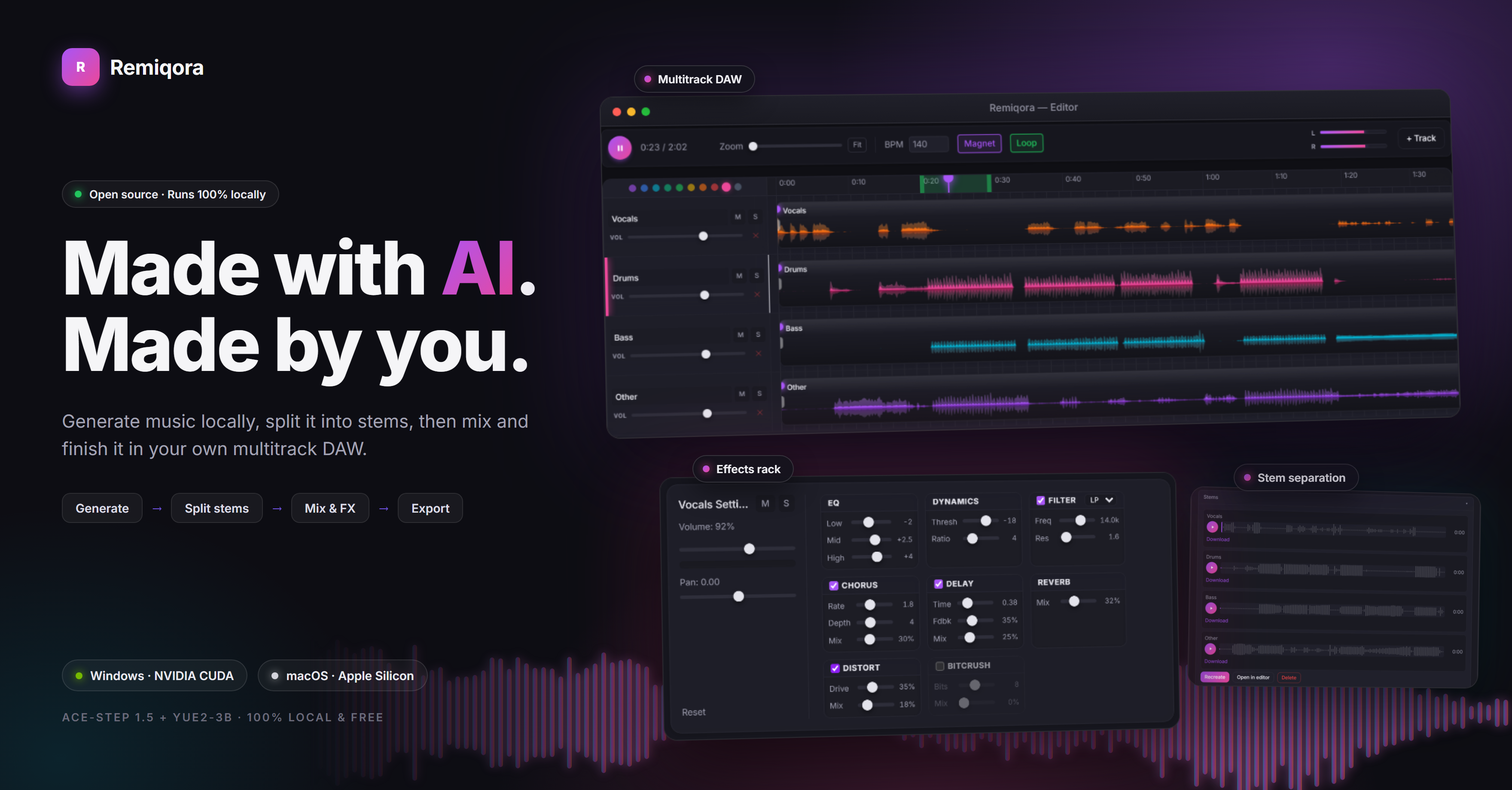
Remiqora combines two local music models with stem separation, MIDI transcription, LoRA training, and a simple multitrack DAW. The MIT project is useful, but explicitly still unstable.
What this is about
Local music models can generate complete tracks, yet the path from prompt to editable project is often fragmented: one server for generation, another tool for stems, another for MIDI, and finally a separate audio workstation. Remiqora aims to combine those steps in a browser-based interface.
The open-source project by developer Nikolai Inikov appeared in September 2026 under the MIT license. It supports Windows, macOS, and Linux as well as NVIDIA CUDA and Apple Metal systems. Its most important warning is prominent in the repository: Remiqora is under active development, contains bugs, and is not yet a stable release.
What Remiqora actually does
Remiqora provides a shared interface over ACE-Step 1.5 and YuE2-3B. Because the two models generally cannot run usefully at the same time on one consumer GPU, an orchestrator starts the selected model and stops the other. Generated, uploaded, and edited tracks live in a shared SQLite library.
ACE-Step covers text-to-music, covers, section replacement, and LoRA training with a user's own audio. YuE2 can use symbolic planning before audio generation. SheetSage2 derives melody and harmony from a reference for that workflow. Remiqora also includes Demucs for four-way stem separation, MuScriptor for MIDI transcription, and a multitrack DAW with trimming, fades, tempo adjustment, effects, and WAV or MP3 export.
Why it matters
The practical value is less about a new music model than connecting existing components. Local users otherwise have to start processes manually, move files between interfaces, and maintain different storage locations. Remiqora turns that tool stack into one continuous workflow.
That can interest musicians, sound designers, podcast producers, and developers who do not want to send audio to a commercial cloud service by default. Local does not automatically mean simple, however: the models require suitable hardware, storage, and a working driver environment. Rights to training material, voices, and generated tracks also remain the user's responsibility.
In plain language
Remiqora is like a small kitchen where the mixer, oven, and worktop finally sit in the same room. It does not reinvent the appliances, but ingredients no longer have to move to another building after every step. The quality of the final dish still depends on ingredients, operation, and experience.
A practical example
A producer generates four variants of a 90-second instrumental with ACE-Step. She picks one, separates it into vocals, drums, bass, and other instruments with Demucs, and opens the four tracks directly in the editor. There she trims eight seconds from the intro, lowers the bass, and adds reverb.
She then exports a WAV mix and transcribes one track to MIDI. Instead of managing five programs and several file directories, the workflow stays in one library. Before using it for paid work, she still checks the result in her normal DAW and verifies the rights attached to the models and source material.
Scope and limits
First, Remiqora is explicitly unstable; updates may change workflows or data formats. Important projects therefore need backups and a reproducible version. Second, the built-in DAW is not a replacement for a mature production environment: tempo detection can be wrong on complex material, and the project currently says there is no autosave. Third, quality and speed depend entirely on the integrated models and local hardware. Apple Metal and NVIDIA CUDA are supported, but actual results vary.
There are legal questions as well. Local processing does not solve copyright, personality-rights, or licensing problems. Training on voices or styles should only happen with clear consent and rights. A sensible first test is a short self-created instrumental without another person's voice, exported in a lossless format.
SEO & GEO keywords
Remiqora, local AI music, ACE-Step 1.5, YuE2-3B, Demucs, MuScriptor, stem separation, MIDI transcription, LoRA training, multitrack DAW, open source
💡 In plain English
Remiqora combines local music generation, stem separation, MIDI, and a simple multitrack editor in one interface. It reduces file shuffling, but needs suitable hardware and is not yet stable.
Key Takeaways
- →Remiqora combines ACE-Step 1.5 and YuE2-3B in one interface.
- →A shared library connects generation, stem separation, MIDI, and multitrack editing.
- →The project runs locally and uses the MIT license.
- →NVIDIA CUDA and Apple Metal are supported.
- →The project explicitly warns about bugs and breaking changes.
- →Local processing does not remove copyright or consent questions.
FAQ
Is Remiqora free?
The source code uses the MIT license. Hardware, electricity, storage, or optional services can still create costs.
Which systems does Remiqora support?
The repository lists Windows, macOS, and Linux, plus NVIDIA CUDA and Apple Metal. Exact model compatibility should be checked before installation.
Do I need a cloud connection?
The core workflow is designed for local models. Downloads, installation, and some optional dependencies still require network access.
Is Remiqora ready for production projects?
The project explicitly describes itself as actively developed and not yet stable. Important work needs backups, testing, and a pinned version.