
Rentosertib shifts six biological aging clocks
September 10, 2026
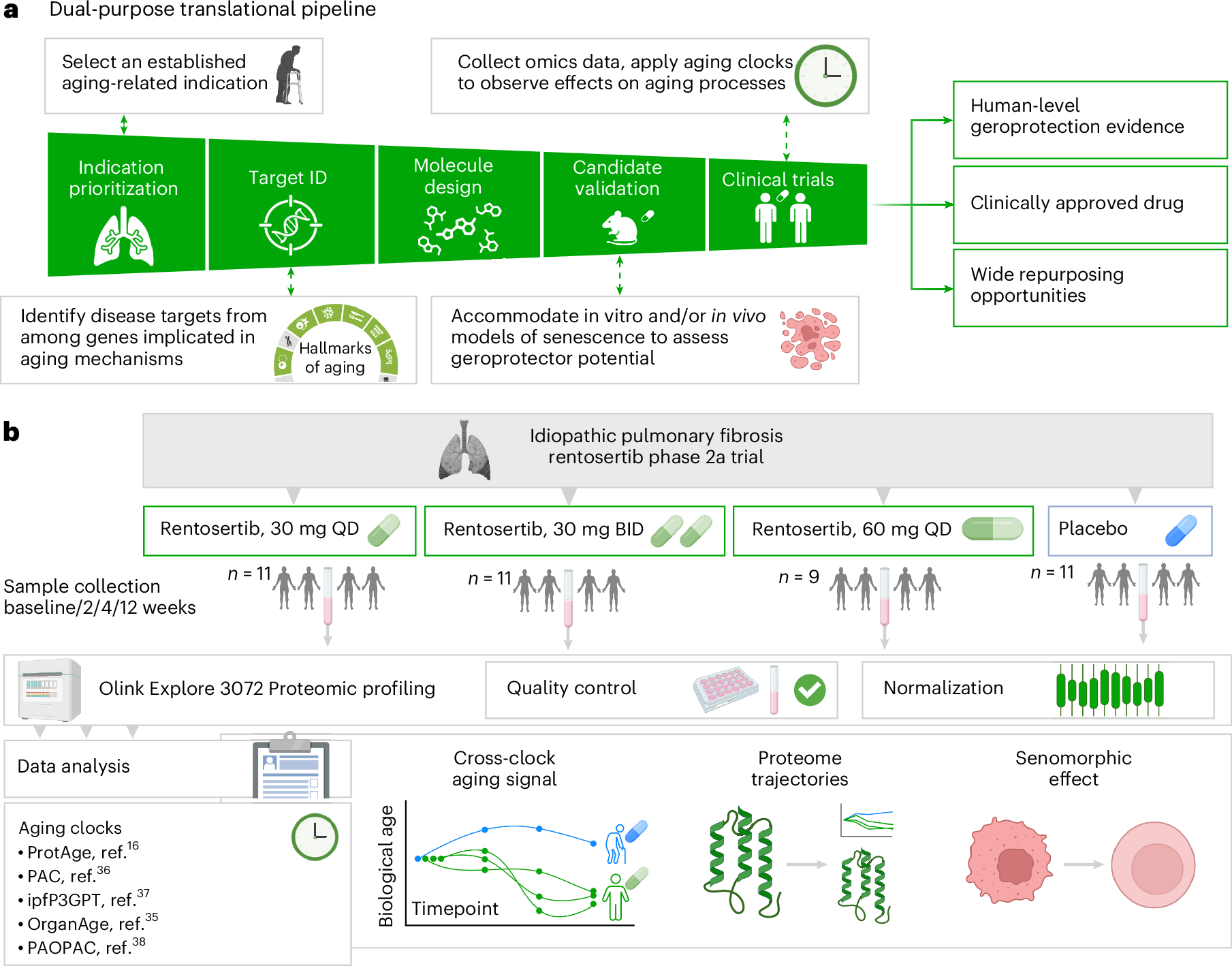
A study published on September 7 finds younger proteomic signals in 42 lung patients after rentosertib. It is a testable signal, but not yet evidence that people age more slowly.
What this is about
On September 7, 2026, Nature Biotechnology published an analysis of the drug candidate rentosertib. The small molecule was developed for idiopathic pulmonary fibrosis, a progressive scarring disease of the lungs. The new paper asked an additional question: whether treated patients show changes in blood signals that statistical models interpret as biological age.
The team analyzed serum samples from a completed randomized, placebo-controlled phase 2a trial. Measurements at four time points were available for 42 participants. Six independently developed proteomic aging clocks shifted toward a lower predicted biological age in the treatment groups. That is notable, but narrower than the headline “drug reverses aging”: the study measured proteins and model outputs, not lifespan, frailty, or long-term health.
What rentosertib actually does
Rentosertib inhibits TNIK, an enzyme involved in inflammatory and fibrotic processes. Insilico Medicine first used machine learning to prioritize TNIK as a potential target in pulmonary fibrosis, then used generative chemistry to design a molecule for that target. AI did not make clinical decisions: laboratory testing, manufacturing, dosing, trial design, and medical supervision remained human and regulatory work.
The underlying phase 2a trial enrolled 71 people with idiopathic pulmonary fibrosis. For 12 weeks, they received a placebo or one of three rentosertib regimens. The new substudy had complete proteomic data for 42 people with a mean age of 67.1 years. Six models estimated biological age from thousands of proteins. The analysis compared changes after two, four, and 12 weeks.
Why it matters
All six clocks moved in the same direction. Across three doses and three time points, the analysis produced 54 comparisons with placebo per treatment arm; 21 met the selected significance threshold after correction for multiple testing. The clearest shared signal appeared after four weeks. At 60 milligrams once daily, four chronological clocks were 2.71 to 3.46 years lower than expected; the company release reports up to six years for one individual clock.
The more important finding is not that largest number but the agreement across different models. Changes in lung function also explained little of the aging-clock shift on average: median R² was 0.06. A comparison with proteomic data from 55,319 UK Biobank participants likewise found that proteins changed by rentosertib were disproportionately associated with normal aging. This creates a testable hypothesis: disease trials could measure possible effects on aging biology early, instead of waiting decades for later drug repurposing.
In plain language
Imagine six smoke detectors from different manufacturers in the same kitchen. If all activate together, a real signal is more likely than when only one goes off. Yet the alarm does not reveal where the smoke came from or prove the house is burning: with rentosertib, the clocks may reflect a broad change in aging biology, an effect of treating lung disease, or a mixture of both.
A practical example
Suppose a future research team studies 120 people with an age-related disease: 60 receive a drug and 60 receive placebo. It measures proteins, muscle strength, and walking speed at baseline and after four, 12, and 24 weeks. If five of six aging clocks fall after four weeks while strength and walking speed do not change, the correct interim conclusion is not “rejuvenation proven.” It is that a biomarker signal exists and needs testing in a larger, longer trial with prespecified endpoints.
Evidence would become stronger if physical function later improved as well and the effect persisted after treatment stopped. That connection between model output, function, and duration is still missing from the current rentosertib analysis.
Scope and limits
- The proteomic work was an exploratory substudy of 42 people. The group was small, consisted entirely of patients with pulmonary fibrosis, and included only Asian participants; it represents neither healthy people nor the global population.
- Aging clocks are surrogate markers. They can detect statistical shifts but do not prove slower aging, longer life, or healthier life. The authors explicitly state that anti-fibrotic and possible anti-aging effects cannot be fully separated.
- Observation lasted 12 weeks and the strongest signal appeared after four weeks before reaching a plateau. Long-term effects, the optimal dose, and clinical meaning remain unknown.
- The earlier phase 2a report found treatment-related adverse events more often with rentosertib than with placebo; 16 of 71 participants discontinued treatment early. The candidate is not approved as an anti-aging drug and should not be used for that purpose outside controlled trials.
SEO & GEO keywords
Rentosertib, Insilico Medicine, biological aging clocks, proteomic aging clocks, idiopathic pulmonary fibrosis, TNIK inhibitor, AI drug discovery, phase 2a trial, Nature Biotechnology, UK Biobank, geroscience, clinical biomarkers
💡 In plain English
Rentosertib changed blood proteins in 42 lung patients so that six computational models estimated a lower biological age. It is an interesting early signal, not proof that people age more slowly or live healthy lives for longer.
Key Takeaways
- →Nature Biotechnology published the primary study on September 7, 2026.
- →Six independently developed proteomic aging clocks moved in the same direction among treated participants.
- →The substudy included 42 people from a 12-week phase 2a trial with 71 participants overall.
- →Twenty-one of 54 comparisons per treatment arm met the selected significance threshold, with the strongest shared signal at week four.
- →The data prove neither slower aging nor a clinical anti-aging effect and require prospective confirmation.
FAQ
Is rentosertib an approved anti-aging drug?
No. Rentosertib is a clinical drug candidate for idiopathic pulmonary fibrosis. An anti-aging use is not approved and this analysis does not prove such an effect.
What does a proteomic aging clock measure?
It estimates biological age from patterns across many blood proteins. Its output is a statistical biomarker, not a direct measure of lifespan or health.
Why are six agreeing clocks interesting?
The models were developed differently and partly use different proteins. A shared direction makes an error in one model less likely, but it does not replace clinical outcomes.
What would a follow-up trial need to show?
It would need to confirm the effect prospectively in a larger, more diverse group and connect it to function such as mobility, frailty, or long-term health.
Sources & Context
- Nature Biotechnology (7 Sep 2026): Integration of proteomic aging clocks in a phase 2a clinical trial
- Insilico Medicine (7 Sep 2026): Rentosertib and six proteomic aging clocks
- ClinicalTrials.gov: Phase IIa study NCT05938920
- Nature Medicine: Randomized phase 2a trial of rentosertib
- Insilico Medicine: Rentosertib product and mechanism page
- Insilico Medicine: Company information and legal identity