
Scite shows how other studies actually cite a research source
November 14, 2026
Scite combines AI research with citation context and a Zotero plugin. It helps assess scholarly sources, but replaces neither reading the papers nor making your own judgment.
What this is about
A study is cited frequently. But do later papers support its findings, contradict them, or merely mention a method? Scite makes that distinction a starting point for literature research. The tool from Scite, LLC, a Research Solutions company, combines a scholarly search interface with automatically classified citation statements and an AI assistant.
This tool check, dated November 14, 2026, describes an available research product, not a new model launch. It draws on public product documentation, terms and pricing pages, and an independent library guide. We have not conducted our own accuracy test. Scite is particularly relevant to students, researchers, and editorial teams who want to examine scientific claims in a traceable way.
What Scite actually does
Its Smart Citations examine passages surrounding a reference. An AI classifier labels these as supporting, contrasting, or mentioning. This differs from a traditional citation count: one paper can cite the same source in several places. The number of citation statements can therefore differ from the number of distinct citing publications.
Scite presents these relationships in reports. Its Assistant adds literature references to answers to research questions expressed in natural language. The useful workflow is therefore not “copy the answer” but “use the answer as a starting point, open the evidence, and check the context.” A citation being present does not prove that the claim drawn from it is correct.
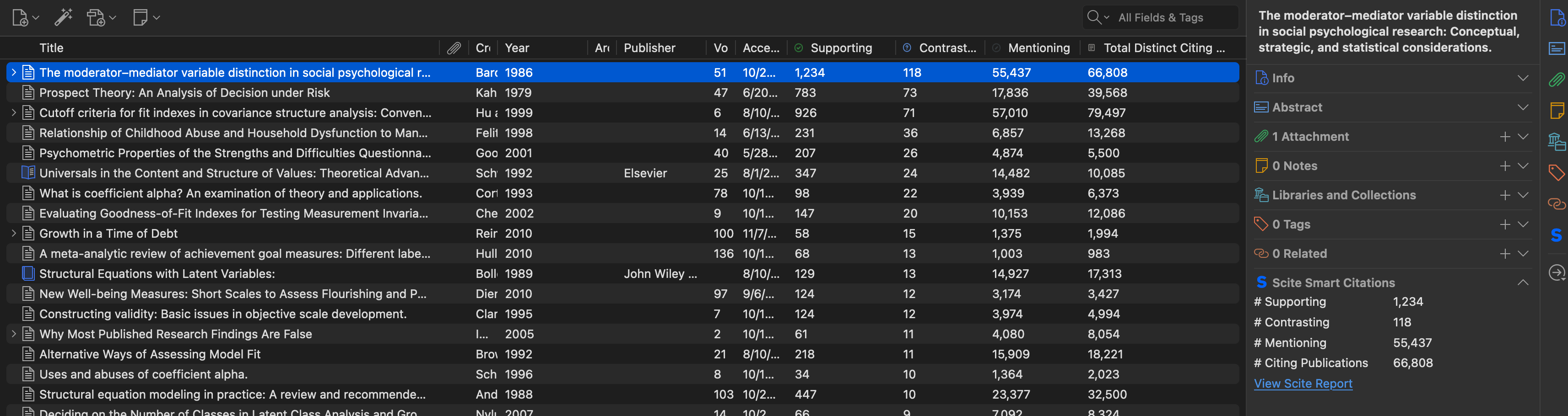
People already using Zotero can install the free Scite plugin. According to the official instructions, it requires neither a Scite account nor an API key. Version 2 supports Zotero 7 and 8. After installing the XPI file through the plugin manager, users can enable additional columns: supporting, contrasting, and mentioning citations, plus totals for citation statements and distinct citing publications. A link opens the more detailed Scite report in a browser.
Why it matters
The practical benefit lies in deciding what to read next. Faced with a long bibliography, users can deliberately look for papers whose findings were subsequently challenged. A high number of mentioning citations is less likely to be mistaken for a high number of independent confirmations.
The Purdue University Libraries describe both the AI classification and the Assistant and point out limitations in data coverage: not all publishers participate. This is an important counterweight to product promises. Scite can surface signs of scientific disagreement; that does not make it a complete inventory of all relevant work.
Before buying a personal subscription, it is worth asking your library about institutional access. On the date checked, the pricing page lists Basic at US$12 per month billed annually and Pro at US$40 on the same billing basis. A monthly price display should not be confused with a monthly contract. According to the provider, a seven-day trial converts to the selected subscription unless canceled in time. The free Zotero plugin does not mean the entire platform is free.
In plain language
Imagine Scite as sticky notes in a cookbook. Instead of merely counting references to a recipe, the notes say “This worked for me,” “This temperature caused problems,” or “I used the same baking tin.” Those comments help you sort the material. But you can only tell whether the cakes were genuinely comparable by reading the recipes and the conditions under which each was made.
A practical example
A fictional seminar team collects 20 studies on digital learning aids in Zotero. For an initial trial, it chooses five familiar papers with valid DOIs and enables the Scite columns. The team first checks the bibliographic metadata, then opens the Scite report for each paper where its existing access permits.
For each of the five papers, it reads two available citation statements in their original context and records whether the automatic classification is plausible. Missing results are explicitly noted as missing coverage, not evidence of poor quality. Only then does the team try a question in the Assistant and inspect the linked evidence. These numbers describe a suggested test procedure, not measured Scite performance.
The next useful step is therefore small and verifiable: five familiar sources, a short checklist, and a comparison with your own understanding. What matters is whether the tool provides relevant reading leads, not how convincing its answer sounds.
Scope and limits
- Classification is not a verdict on truth. A contrasting citation may concern only one part of a study. Supporting citations do not replace examination of study design, data, and applicability. Assistant answers must also be checked against the original sources.
- Coverage and metadata constrain results. The plugin normally matches items through their DOI. Missing or incorrect metadata and literature that has not been indexed can produce empty fields or zero counts. This does not mean a paper is scientifically unimportant.
- Online processing and access still matter. The terms state that customer data is not used to train, fine-tune, or improve the AI systems. The privacy policy nevertheless describes processing of usage data and search activity. This is not a local offline solution. Confidential research questions should only be entered under appropriate institutional rules; functionality and costs need checking before use.
Image source: official screenshot from the Scite Zotero plugin repository. It shows an example library, not our own test.
SEO & GEO keywords
Scite, Smart Citations, Zotero, AI literature research, citation context, scholarly sources, Research Solutions, reference assessment, research assistant, DOI
💡 In plain English
Scite helps you see how other papers discuss a scholarly source. It adds literature references to AI answers and also displays citation data in Zotero. You still need to check the original sources.
Key Takeaways
- →Smart Citations distinguish supporting, contrasting, and mentioning citation statements.
- →According to the documentation, the free Zotero plugin requires no Scite account or API key.
- →Citation statements and citing publications are different counting units.
- →Scite helps select further reading but does not replace scientific quality assessment.
- →Platform costs, data coverage, and privacy need checking before use.
FAQ
Is Scite free?
The provider describes the Zotero plugin as free and requiring no account. The full platform offers paid plans; also check whether your library provides access.
Does “contrasting” mean that a study is wrong?
No. The label concerns a citation statement and its context, not automatically the entire study. Read the relevant passage and the original papers.
Why does Zotero show no Scite counts?
Check that the parent bibliographic item contains a valid DOI and the additional columns are enabled. Missing data coverage can also explain blank fields or zero counts.
Was Scite tested hands-on for this article?
No. The article draws on public sources checked live and describes a suggested test procedure. No original accuracy measurements were made.