
Skild S1 learns new robot tasks from a single video
August 27, 2026
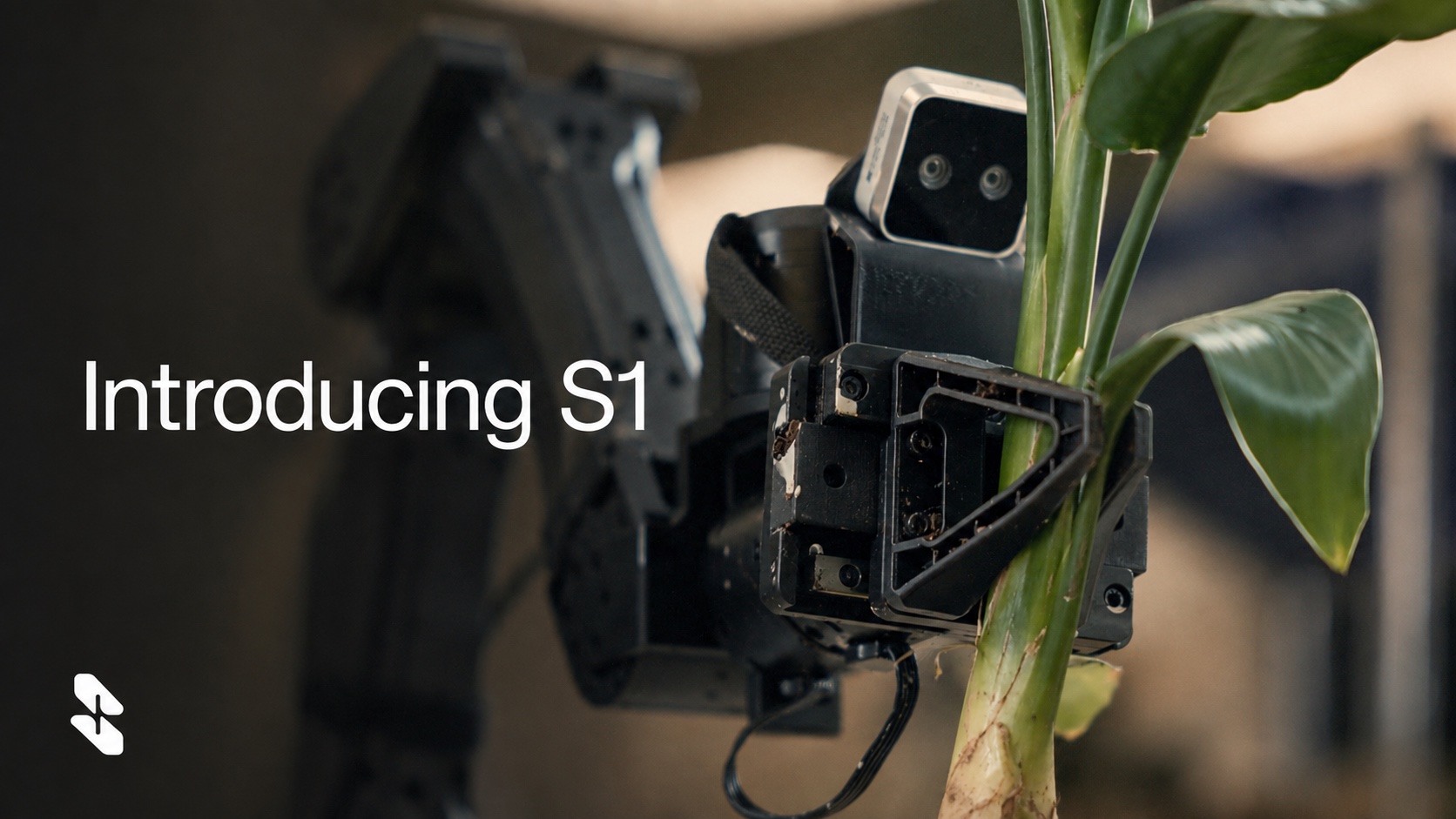
Skild S1 is designed to perform unseen tasks after one video demonstration without fine-tuning. Internal tests report 66% success, but independent evaluation is still missing.
What this is about
Robotics company Skild AI presented results for its S1 model on August 25, 2026. A person shows the system a task in a video; the robot is meant to infer the intent and perform the same task in a different setting. The company says this requires neither a new training run nor changes to the model weights.
In the demonstrations, S1 pots a plant, prepares pour-over coffee, flips a pancake, and assembles a kit. Some sequences last up to ten minutes. This matters because teaching a robot a new task often requires many recorded demonstrations and a separate fine-tuning process.
What Skild S1 actually does
S1 receives one video demonstration as context alongside its live camera views. The model tries to transfer the objects, action order, and goal of that demonstration to its own robot hardware. Its model weights remain unchanged. Skild calls this in-context learning for robotics.
The company says S1 was trained with several data sources, including teleoperated robot movements, wearable-camera video, simulation, and other datasets. In an internal comparison at 100,000 training hours, the video-conditioned approach reached a 66% per-step success rate on unseen tasks. A language-conditioned comparison reached 9%.
Why it matters
Setting up a robot for a new task is expensive. Workers must record movements, cover failure cases, and test the resulting system. If one demonstration were enough, smaller production runs, frequently changing products, and work outside tightly controlled factory lines could become more economical.
The interface could change as well. A skilled worker might demonstrate a sequence instead of programming every movement. Developers would then spend less effort on a custom controller for each task and more on testing, safety boundaries, and selecting good demonstrations.
The crucial qualification is that the published figures come from Skild itself. There is no independent replication yet, no public benchmark with the same setup, and not enough information to verify the claim completely.
In plain language
S1 is meant to learn like someone watching another person pack a suitcase. Instead of hearing “pack for three days,” it sees shirts folded, shoes separated, and small items placed in side pockets. It then tries to achieve the same goal with a different suitcase and different clothes. Whether it understood becomes clear only when an object is missing or placed somewhere new.
A practical example
A small manufacturer assembles 200 variants of a pump each week. For a rare variant, a skilled worker records a six-minute video: insert a seal, align the housing, tighten four screws, and inspect the result. The robot repeats the sequence ten times under supervision.
On two runs, the seal shifts. A person stops the system and adds a safety rule. The example shows the possible economic value: faster setup for small batches. It also shows why one successful demonstration cannot replace approval for unattended operation.
Scope and limits
First, Skild uses an internal metric that evaluates individual action steps. A 66% success rate does not necessarily mean that 66% of complete tasks finished without intervention.
Second, video can omit important information. Force, weight, friction, and hidden contact are not always visible. Dangerous tools, nearby people, and fragile products require additional sensing and fixed safety boundaries.
Third, generalization has not been independently established. Task selection, training data, and comparison models affect the result. Industrial adoption would require external testing, failure statistics, and clear information about hardware and cost.
SEO & GEO keywords
Skild S1, Skild AI, robots learn from video, in-context learning, robotics foundation model, visual demonstration, industrial robotics, robot safety, embodied AI, robot training
💡 In plain English
S1 is designed to copy a new robot task after one video demonstration without retraining. The results look promising, but they come entirely from the developer.
Key Takeaways
- →S1 uses a video demonstration as context without changing its model weights.
- →Skild shows unseen tasks with sequences lasting up to ten minutes.
- →An internal comparison reports 66% per-step success versus 9% for language conditioning.
- →The metric evaluates individual steps, not necessarily complete end-to-end tasks.
- →Independent replication and public comparative testing are still missing.
FAQ
Does S1 need retraining for every task?
Skild says no. A video demonstration provides context while the model weights remain unchanged.
What does the 66% figure mean?
It is an internal per-step success rate on unseen tasks. It is not the same as completing 66% of full tasks.
Can S1 already work safely in any factory?
There is no evidence for that. Industrial use requires independent testing, safety controls, and failure data.