
Wisp Science keeps AI research local and traceable
August 18, 2026
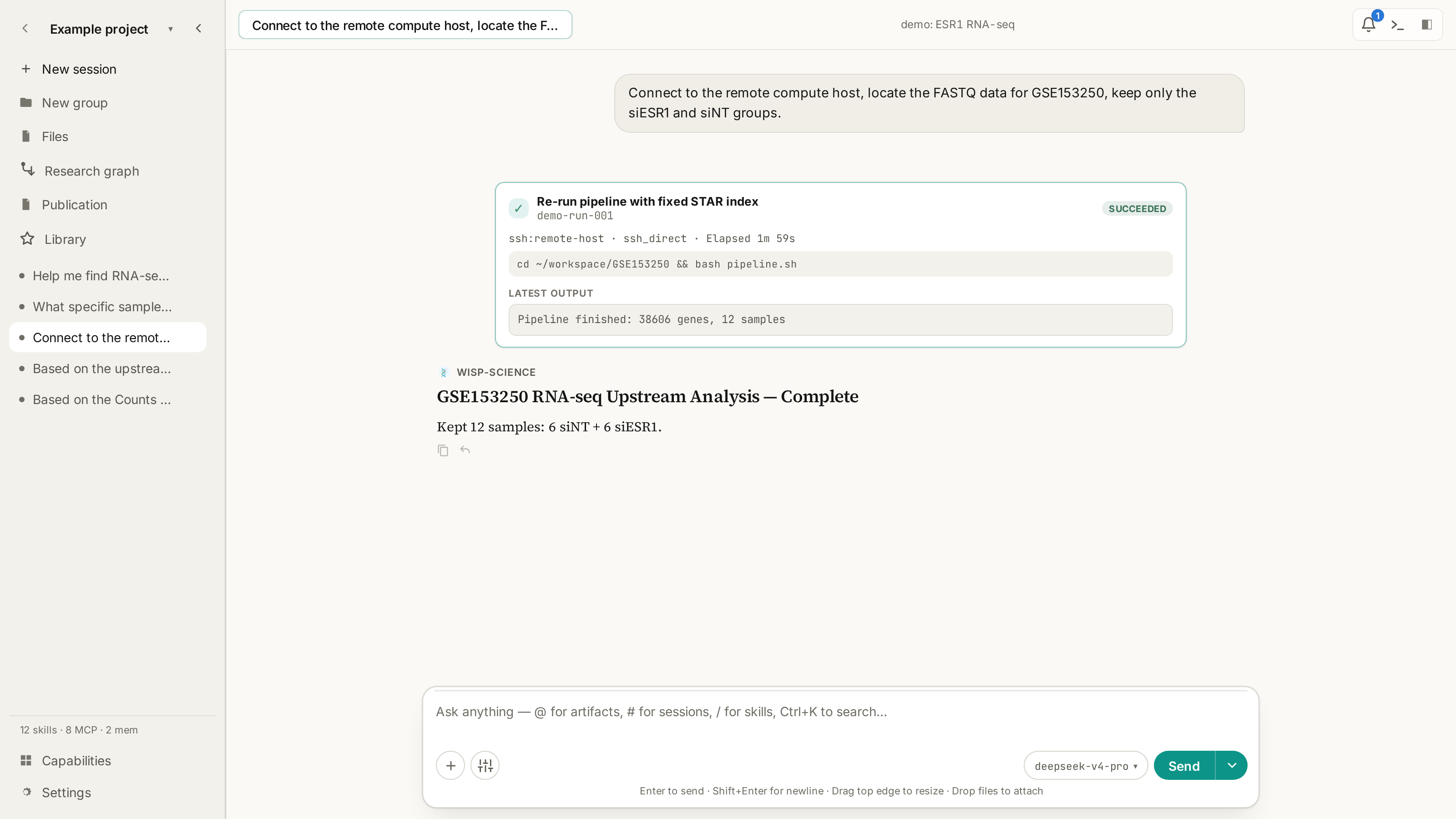
Wisp Science combines literature, Python, R, and remote compute in a local desktop workbench. This tool check examines its value, privacy model, and limits.
What this is about
Wisp Science is an open-source desktop workbench for scientific work with AI agents. It combines literature search, Python and R sessions, scientific databases, files, and remote computers in one project. It is aimed especially at people who do not want analysis, sources, and intermediate results scattered across chats, notebooks, and servers.
According to GitHub, the repository was created on July 1, 2026. Installers are available for Windows, macOS, and Linux, and the source code uses the AGPL 3.0 license. The project is young but available as a real desktop application. A Zenodo DOI also gives the software a citable reference.
What Wisp Science actually does
Wisp Science stores projects, conversations, and credentials on the user's own devices. According to its documentation, credentials live in the operating system keychain rather than the local SQLite database. Users connect their own models: the application supports OpenAI-compatible interfaces and Anthropic models, while Codex and Claude Code can be controlled through ACP.
Python and R kernels persist across individual steps. Users can register WSL, SSH, and GPU systems alongside the local computer. Longer computations appear as separate runs with logs. The project bundles MCP connections for scientific data sources, including PubMed and GEO. PDFs, Office documents, images, and notebooks can be previewed inside the application.
A publication workspace is designed to freeze manuscript revisions and associated evidence as Evidence Capsules. Experiments can be tried in isolated branches without immediately changing the main project state. Approval gates for agent actions remain enabled by default unless users explicitly select full permission.
Why it matters
Scientific AI workflows do not fail only because of model errors. Provenance, parameters, and context often disappear because literature sits in a browser, code in a notebook, data on a server, and explanations in a chat. A shared project trail can make later review easier.
The local approach is particularly relevant when unpublished data or credentials are involved. Local does not automatically mean confidential, however. When an external model is used, prompts and selected data may leave the computer. The model provider's settings and the files the agent is allowed to read therefore matter.
The AGPL 3.0 license permits inspection and self-hosting, but modified network services require particular attention to source-sharing obligations. Research teams should resolve licensing and privacy questions before a central deployment.
In plain language
Wisp Science is like a lab notebook with a calculator, library catalog, and remote control for a compute server attached. Instead of collecting loose notes later, questions, calculations, and results stay in the same folder. The lab notebook still cannot guarantee that an experiment was designed correctly or a source was understood accurately.
A practical example
A bioinformatician is examining 24 RNA-seq samples. She opens a bundled demonstration project, then connects her own SSH computer and starts an R analysis. The run takes 45 minutes; its log, generated figures, and input files remain attached to the project. At the same time, she searches PubMed for five relevant papers and adds two sources to a draft.
For a useful trial, she should begin with public sample data. She checks whether each value can be traced back to a script and input file, whether an interrupted run resumes cleanly, and which content is sent to the model provider. Only then should an ethics or privacy officer approve internal research data.
Scope and limits
First, Wisp Science is a very young project. Long-term stability, migration paths, and behavior with large projects have not yet been widely validated independently. Second, an AI agent can summarize sources incorrectly, generate faulty code, or select unsuitable statistical methods. Expert review and reproducible tests remain mandatory.
Third, local storage ends where external models or databases are called. Teams must assess network traffic, model contracts, and access rights themselves. Organizations should also determine which AGPL 3.0 obligations apply before shared web or server deployment. Wisp Science replaces neither a validated laboratory information system nor institutional research governance.
SEO & GEO keywords
Wisp Science, AI research, scientific workbench, local AI, Python, R, bioinformatics, MCP, reproducible research, research data
💡 In plain English
Wisp Science gathers literature, code, compute runs, and drafts in a local research application. It can improve traceability, but researchers still need method review, privacy controls, and source verification.
Key Takeaways
- →Wisp Science combines literature search, Python, R, and remote compute in one project.
- →The application is available for Windows, macOS, and Linux under AGPL 3.0.
- →Projects and credentials stay local, but external model calls can still transmit data.
- →Persistent kernels, run logs, and Evidence Capsules aim to improve research traceability.
- →The young project should first be tested with public sample data and limited permissions.
FAQ
Who is Wisp Science for?
The application targets researchers, especially in data-intensive fields such as bioinformatics and scientific computing.
Does all data stay on the user's computer?
Projects and credentials are stored locally. Selected content may leave the computer when external models or databases are used.
Which systems does the application support?
Official installers are offered for Windows, macOS, and Linux. WSL, SSH, and GPU computers can also be connected.
Does Wisp Science replace expert review?
No. Agent output, source summaries, code, and statistical methods still require review by qualified people.