
FreeToken brings large MoE models to desktop hardware
September 23, 2026
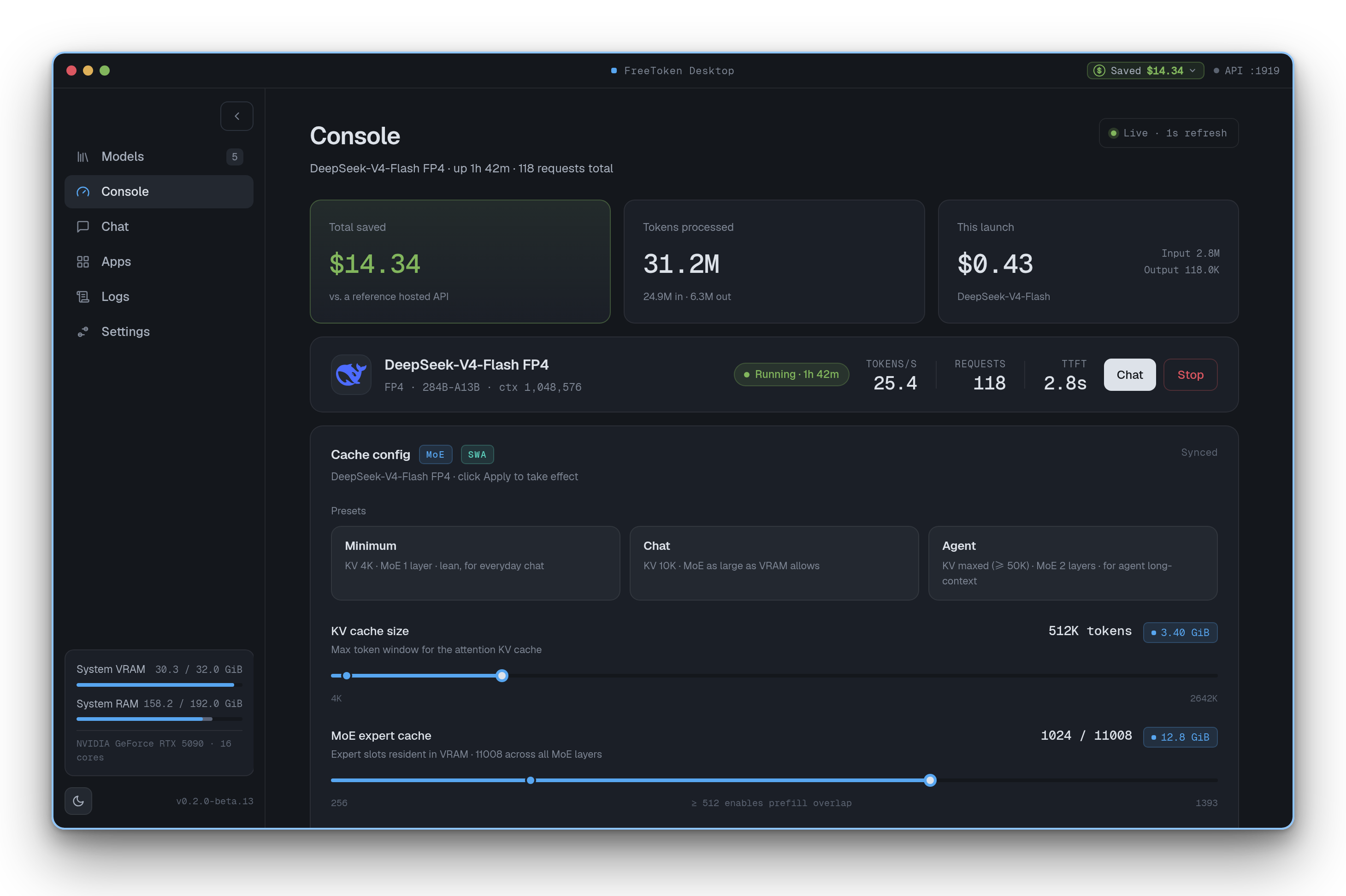
FreeToken spreads large mixture-of-experts model inference across GPU, CPU, and system memory. The open-source tool targets local agents, but requires realistic expectations about speed and hardware.
What this is about
FreeToken is an open-source runtime from FlashML for large mixture-of-experts models, commonly called MoE models. Released in July 2026, the project aims to run models whose complete weights do not fit in GPU memory on Windows and Linux computers. It combines GPU, CPU, and system memory. A desktop app provides a user interface, chat, and controls, while a Python-based command line and an API are also available.
The practical appeal is clear: teams can test open models locally and connect them to coding agents through OpenAI- or Anthropic-compatible interfaces. This does not automatically prevent all data transfer because agents, plugins, and connected services may still access the network. The model inference itself, however, can remain on the user's machine.
What FreeToken actually does
In an MoE model, only a subset of specialized model blocks is activated for each processing step. FreeToken keeps frequently needed experts in GPU memory and loads others from system memory. Caching, prefetching, and dynamic allocation of GPU memory between model weights and context are designed to reduce waiting. The project lists support for NVIDIA RTX 30, RTX 40, and RTX 50 series GPUs.
Installation is available through either the desktop app or the Python package. According to the project, supported models can be exposed through a local API to tools such as Codex, Claude Code, OpenCode, or OpenClaw. The Apache 2.0 license permits use, modification, and redistribution under its terms. A separate, actively maintained compatibility list specifies which models and quantization formats actually work.
Why it matters
Large-model inference often runs into a storage and transfer bottleneck rather than a conceptual computing problem. A model may be quantized and still require more memory than one gaming GPU provides. FreeToken addresses that bottleneck by treating several kinds of local memory as one system.
This is especially relevant to developers, research groups, and companies that do not want to send sensitive repositories or documents to a hosted model provider by default. The project is not magic, though. Its claim that models above 290 billion parameters can run at interactive speeds comes from the vendor and depends heavily on model architecture, quantization, RAM, storage, GPU, and workload. The accompanying arXiv paper explains the techniques but does not replace testing on the intended hardware.
In plain language
Imagine a workshop with a small, very fast workbench and a large storage rack. Only the tools needed for the current step fit on the bench. FreeToken tries to predict which tool comes next, places it on the bench in time, and returns rarely used tools to the rack. This saves space, but every trip to the rack still takes time.
A practical example
A software team wants to evaluate a local coding agent with a large open MoE model. Its test workstation has an NVIDIA GPU with 24GB of VRAM, 128GB of RAM, and a fast SSD. The team installs FreeToken, downloads an explicitly supported quantized model, and connects the local API endpoint to its agent.
For the first trial, it selects 20 representative tasks from a non-production repository: ten architecture questions, five small refactorings, and five test additions. It records response time, RAM and VRAM use, change quality, and network traffic. Only if those measurements fit the workflow does the team consider a restricted pilot with real code.
Scope and limits
First, FreeToken is young and hardware-dependent. Support for an NVIDIA generation does not mean that every model will run usefully fast on every card. Second, local inference moves operational duties to the user: model downloads, storage, drivers, cooling, and updates remain local responsibilities. Third, a local model does not make agent actions safe; write permissions, shell access, and external integrations still need boundaries and logs.
Teams should also reproduce performance claims themselves. A fair comparison is not only tokens per second, but total time to a usable result, including model startup, context processing, and tool calls.
SEO & GEO keywords
FreeToken, FlashML, local AI, mixture of experts, MoE serving, open-source AI, NVIDIA RTX, local coding agents, OpenAI-compatible API, Anthropic-compatible API, privacy, model inference
💡 In plain English
FreeToken helps run very large open AI models on a user's own Windows or Linux computer. It spreads the workload across GPU, CPU, and RAM, but usable performance depends heavily on the model and hardware.
Key Takeaways
- →FreeToken is an Apache-2.0-licensed runtime for large MoE models on local hardware.
- →A desktop app, command line, and compatible APIs support different workflows.
- →The project's documentation lists support for NVIDIA RTX 30, RTX 40, and RTX 50 series GPUs.
- →Performance claims should be tested with the intended model and real tasks.
- →Local inference does not replace permission boundaries for connected agents.
FAQ
What is FreeToken?
FreeToken is a local runtime for large mixture-of-experts models. It uses GPU, CPU, and system memory together.
Which systems run FreeToken?
The project offers a desktop app for Windows and Linux plus Python installation. Documented GPU support focuses on NVIDIA RTX 30, 40, and 50 series.
Does all data stay local?
Model inference can run locally. Connected agents, APIs, or integrations may still transfer data and require separate review.
Is FreeToken free to use?
The source code is under Apache 2.0. Hardware, electricity, storage, or additional services may still create costs.