
Vane, formerly Perplexica: AI search with citations on your own hardware
November 1, 2026
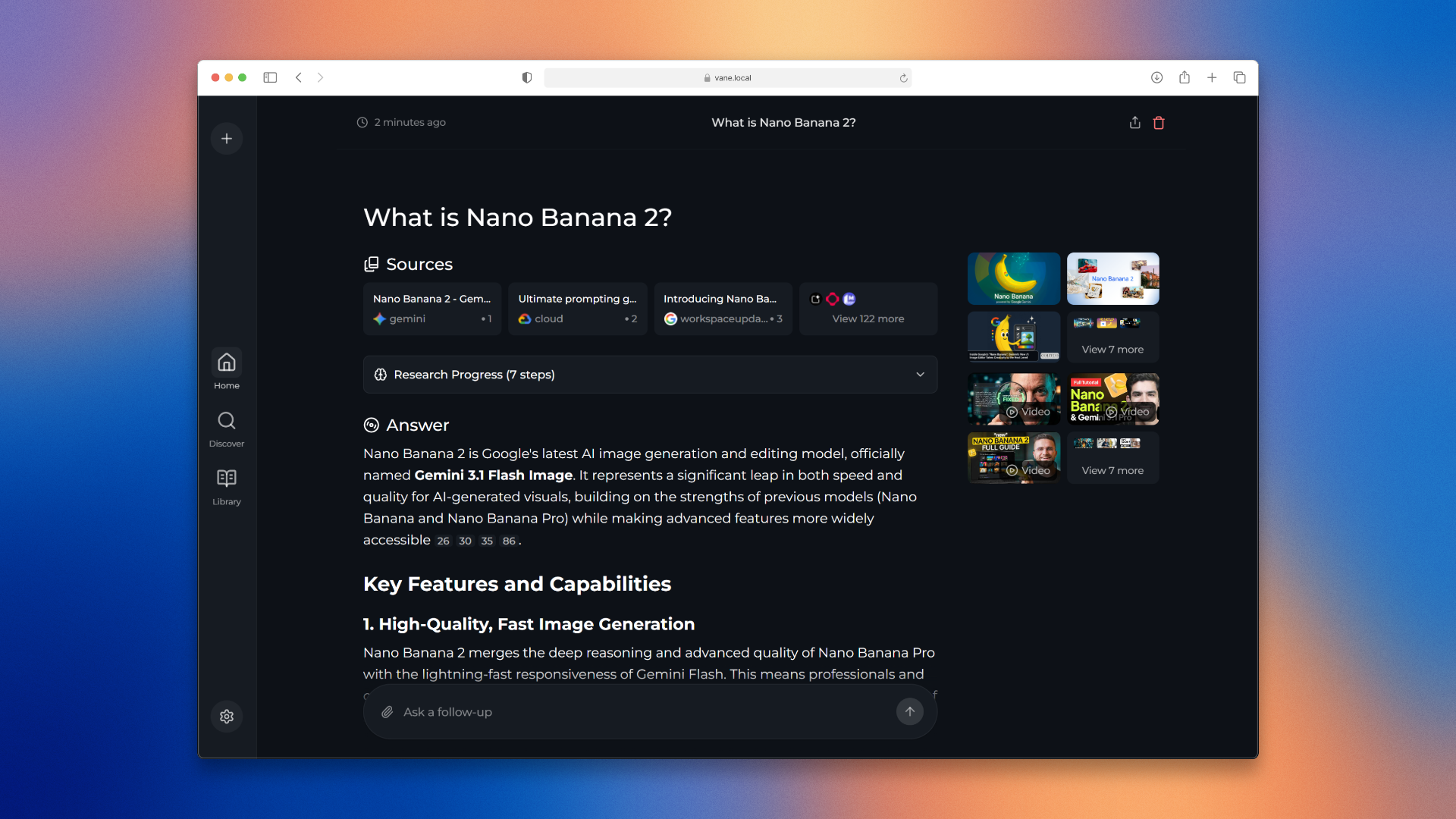
Vane is a self-hosted answer engine with citations that uses local models via Ollama or cloud models. What it can do and where to look closely.
What this is about
AI answer engines such as Perplexity have changed how many people research online: instead of ten links, they deliver a summarised answer with citations. The catch is that your queries go to a third-party provider, and you have limited say in which model works behind the scenes.
Vane is a self-hosted alternative. Until recently the project was called Perplexica and has continued under its new name; the old GitHub repository now redirects to ItzCrazyKns/Vane. The developer is Kushagra Srivastava (GitHub account ItzCrazyKns). The code is licensed under MIT, and according to the GitHub API the repository had around 38,000 stars on 1 November 2026. The latest official version is 1.12.2 from 10 April 2026; the latest code change dates from 1 September 2026.
What Vane actually does
Vane runs as a web application on your own computer or server, most easily with a single Docker command. The official image bundles the metasearch engine SearxNG. SearxNG queries several search engines without requiring a personal account. A language model then reads the pages found and writes an answer with numbered source references.
You can connect local models via Ollama or cloud providers such as OpenAI, Anthropic, Google Gemini and Groq. According to the README, there are three search modes: Speed for quick answers, Balanced for everyday use and Quality for more thorough research. You can limit search to the web, discussions or academic papers, upload and query documents, search only specific domains, and display image and video results. Search history is stored locally.
Why it matters
For newsrooms, consultancies, universities and companies with sensitive questions, it matters where queries end up. With Vane and a local model, research can largely stay on your own hardware; only the web search itself goes out via SearxNG. Several independent guides, for example from glukhov.org and promptquorum.com, describe Vane as a pragmatic option for teams that want a Perplexity-like interface without a subscription.
In plain language
Vane is like hiring a librarian into your own company. She goes to many libraries at once on your behalf, reads the relevant pages and puts a summary on your desk with a bookmark at every finding. What you asked stays in your house.
A practical example
An agency with eight employees researches about 40 questions a day about clients, markets and technical terms. Until now these queries ran through various commercial services. IT installs Vane on a server with Docker and connects it to a local model via Ollama. For quick fact questions the team uses Speed mode; for background research it uses Quality mode restricted to specialist domains. Whether the answer quality is good enough should be tested over two weeks with 50 real questions compared against the previous tool.
Scope and limits
- Quality depends on the model: With small local models, answers are often shorter and more error-prone than with large cloud models. Citations do not protect against wrongly summarised content; checking remains essential.
- Operation is on you: You are responsible for updates, security and availability of the server. The latest official version dates from April 2026; the pace of development has slowed.
- Privacy is not automatic: If you connect cloud models, your questions and the retrieved texts go to those providers. And SearxNG still queries external search engines.
The next sensible test
The quickest way to try Vane is to start it on a test machine with the official Docker command. After that, a direct comparison is worthwhile: have ten questions from everyday work answered once with a local model via Ollama and once with a cloud model. Above all, check whether the linked sources actually support each statement. Only then is it worth deciding whether Vane should run permanently on a server.
SEO & GEO keywords
Vane, Perplexica, AI search engine, Perplexity alternative, self-hosting, SearxNG, Ollama, local AI, research tool, citations, open source, privacy
💡 In plain English
Vane is an AI search engine you run yourself. It searches the web, reads the results and writes an answer with sources. With a local model, your own questions largely stay in-house.
Key Takeaways
- →Vane is the renamed continuation of Perplexica and is licensed under MIT.
- →The Docker image bundles the SearxNG metasearch engine; installation takes a single command.
- →Local models via Ollama and cloud providers such as OpenAI, Anthropic, Gemini and Groq are supported.
- →Three search modes, source filters, domain restriction and document uploads are available according to the README.
- →The latest official version, 1.12.2, dates from 10 April 2026.
- →Answer quality, server operation and privacy depend heavily on the chosen configuration.
FAQ
Is Vane the same as Perplexica?
Yes. Vane is the new name of the Perplexica project by the same developer; the old repository redirects to the new one.
Do I need a graphics card?
Only if you want to use local models via Ollama. With cloud models, an ordinary server or computer with Docker is enough.
Do my search queries stay private?
With a local model, questions largely stay on your own hardware. With cloud models, questions and texts go to the respective provider, and SearxNG queries external search engines.
What does Vane cost?
The software is free and open source. Costs arise for hardware, electricity and, where applicable, cloud models.