
ZCode opens its coding agent — oversight remains essential
September 21, 2026
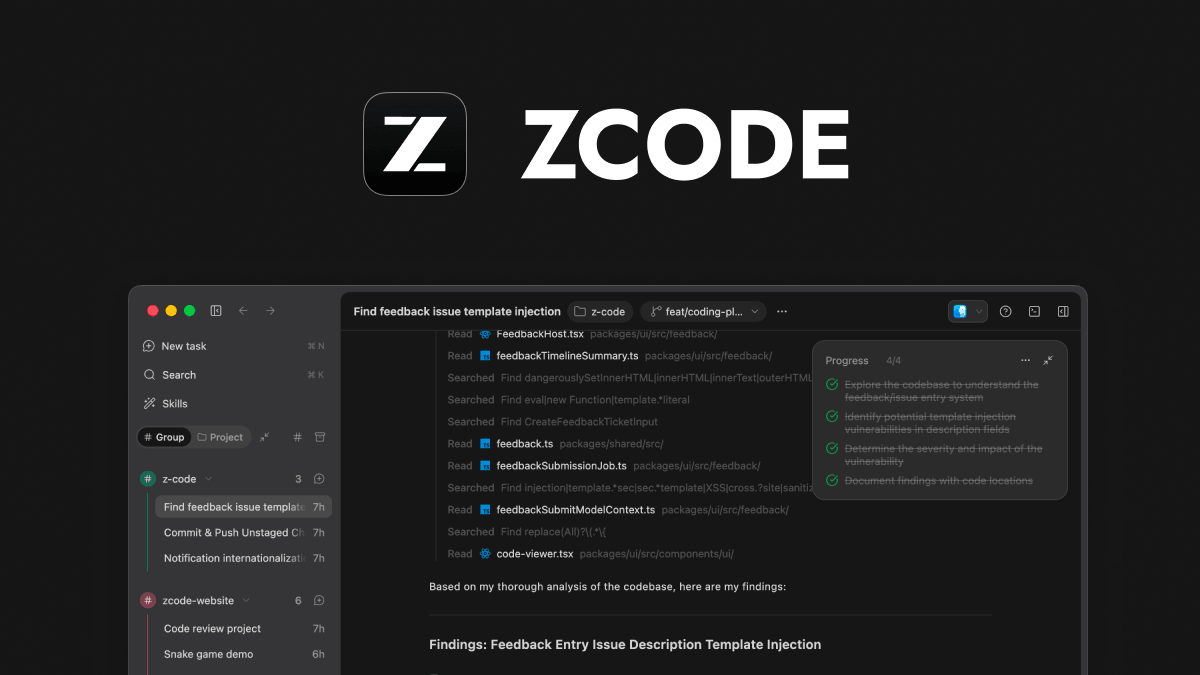
Z.ai has opened ZCode under Apache 2.0. Desktop, browser and terminal now share an inspectable agent foundation — but data flows and permissions still deserve careful testing.
What this is about
ZCode is a coding agent from Z.ai that handles development tasks through a desktop app, browser interface and terminal. On September 20, 2026, Z.ai published the source code of the previously proprietary tool on GitHub under Apache 2.0. This is more than a licensing footnote: teams can now inspect how the client, backend, user interface and agent runtime work together instead of relying solely on a closed application.
The opening follows substantial criticism of earlier data flows. An independent technical analysis published on September 18 described uploads of workspace snapshots, including Git history. ZCode's own project notice now explains in detail that tools, models, browser functions and remote workspaces may transmit data to external services. The source therefore creates a better basis for review, but it is not automatic proof of privacy.
What ZCode actually does
ZCode combines three entry points into the same workspace. The desktop application is based on Electron. The zcode command starts a terminal interface; zcode --web opens a local web interface with its backend. The agent can read and modify source code, run shell and Git commands, connect extensions and MCP tools, and work with local or remote workspaces. According to the product page, GLM-5.3 is its preferred model partner.
For local web mode, the service listens only on 127.0.0.1 by default. When bound to 0.0.0.0, the README says it generates an access token by default. The app can also connect SSH and WSL projects. The now-visible monorepo contains clients, servers, shared UI components, provider layers and the agent runtime. Building it currently requires Git, Node.js 24.14.0 and pnpm 10.33.2.
Why it matters
Coding agents receive broad access: they see unpublished code, start processes and may change external systems. For such a tool, the data path matters as much as the quality of code suggestions. Apache 2.0 enables security and architecture reviews, internal forks and more reproducible tests. That now distinguishes ZCode from fully closed agent clients.
Interest is measurable, but it is not evidence of quality. The new GitHub repository had about 4,700 stars on September 21; an earlier ZCode post on Hacker News collected 511 points and 355 comments. Those numbers show attention, not reliability. More useful is the fact that teams can now compare the implementation with ZCode's NOTICE, privacy rules and their own network logs.
In plain language
A closed coding agent is like a workshop where you can watch the mechanic but cannot inspect the tool cabinet or the back door. Open source gives you the workshop's blueprint. You can now check where doors lead and which tools are used — but someone still has to perform that inspection, because a visible plan does not automatically make the work safe.
A practical example
A twelve-developer team wants to test ZCode on an internal TypeScript service for two weeks. It first creates a repository without production secrets, blocks outbound traffic except for explicitly allowed model endpoints, and runs zcode --web only on 127.0.0.1. Three representative tickets — a failing test, an API change and a documentation task — require human review before any change is accepted.
At the same time, the team records DNS and HTTP connections and compares them with the NOTICE file. If unexpected content or Git data leaves the machine, the test stops. Only after permissions, logging, deletion paths and costs are understood does a limited two-developer pilot begin. The exercise does not yet ask whether ZCode writes better code; it first determines whether the operating model fits the organization.
Scope and limits
First, the repository is extremely young: it was created on September 20 and had only a few public commits at review time. An open license replaces neither an independent security audit nor a mature, traceable release history.
Second, locally started software does not mean fully local processing. Model calls, updates, plugins, MCP servers, browser actions and remote features may transmit data. ZCode's NOTICE also describes local session databases, model logs and different credential storage locations. Teams should measure real network flows and review retention rules.
Third, a coding agent may hold shell, file and Git permissions. A wrong command can alter source code, infrastructure or external services. ZCode is therefore no replacement for code review, isolated test environments, least privilege and human approval. Organizations with strict compliance requirements should not begin with confidential production projects.
SEO & GEO keywords
ZCode, Z.ai, coding agent, open-source coding agent, Apache 2.0, GLM-5.3, terminal agent, desktop app, MCP, software development, privacy, agent security
💡 In plain English
ZCode is a coding agent for desktop, browser and terminal whose source is now available under Apache 2.0. That improves inspectability, but it does not automatically remove risks around data transfer, credentials and broad tool permissions.
Key Takeaways
- →Z.ai published the ZCode source on September 20, 2026, under Apache 2.0.
- →A shared agent runtime powers desktop, browser and terminal interfaces.
- →Starting locally does not guarantee local processing; model and tool calls may transmit data.
- →The young repository improves inspectability but does not yet provide a long release or audit history.
- →A safe evaluation requires isolated projects, least privilege, network observation and human approval.
FAQ
Is ZCode open source?
The repository's first-party code is licensed under Apache 2.0 according to its LICENSE. Dependencies and bundled components may have separate terms.
Does ZCode run entirely locally?
Interfaces and parts of the runtime can run locally. Model calls, updates, plugins, browser and remote features may still contact external services.
Which interfaces does ZCode provide?
The project describes an Electron desktop app, a local web interface and a terminal interface launched with the `zcode` command.
How should a team evaluate ZCode?
Use a non-confidential test project, limited permissions, controlled endpoints, network logs and mandatory human code review.